

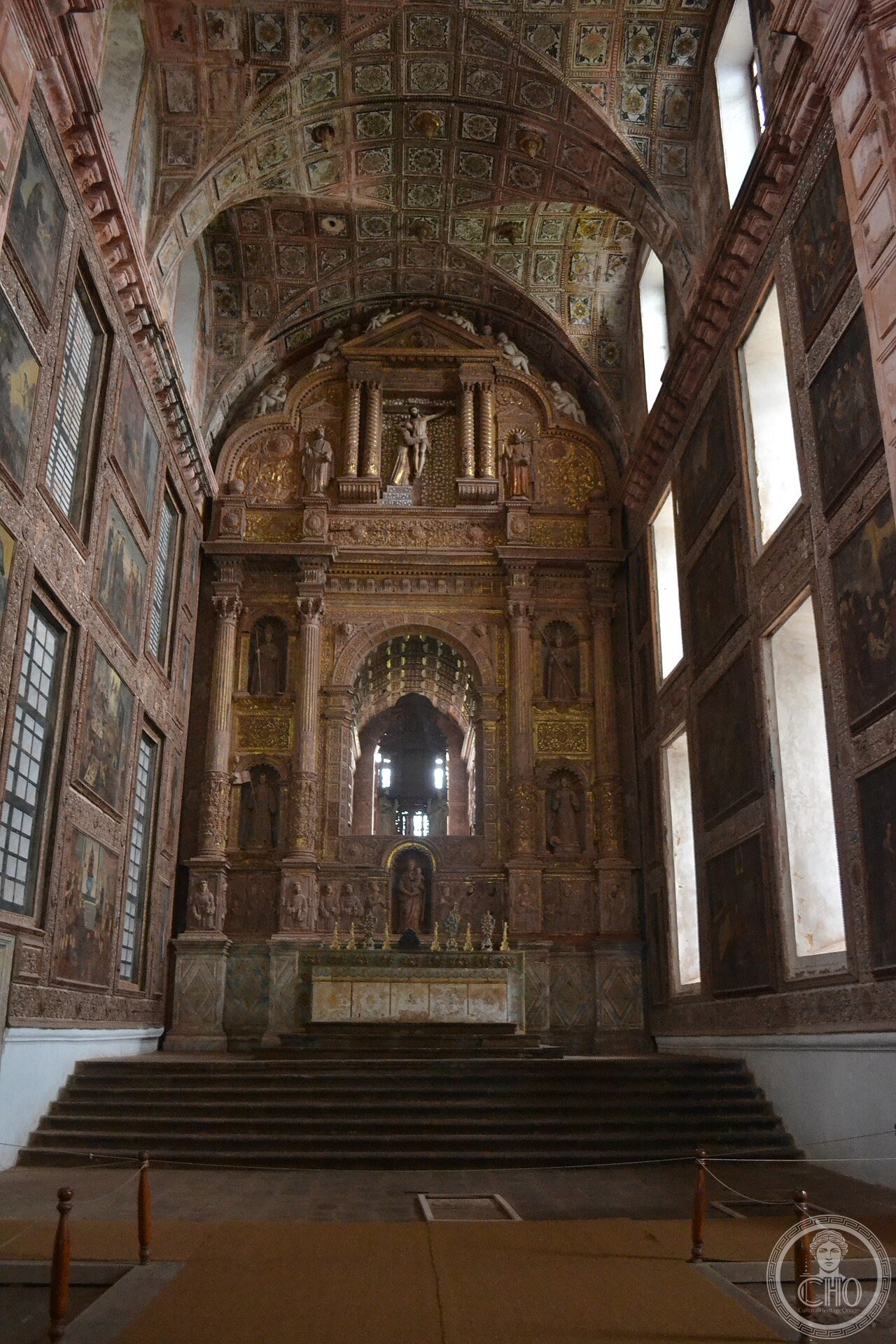
At Old Goa, in India, the Chapel of St Catherine was built in 1510 at the order of Afonso de Albuquerque to commemorate his victory over the ruler Adil Shah of Goa, won on the feast day of Saint Catherine, 25 November 1510. In 1534 Pope Paul III raised it to the rank of cathedral, and the chapel was rebuilt for the occasion; in 1550, under Governor Jorge Cabral, it was enlarged and given a new altarpiece. That role as cathedral was short-lived: the designation later passed to the far larger Sé Cathedral, built afterwards in Old Goa itself. The chapel, built of laterite stone with lime plaster, has a pale yellow exterior with flanking towers and rectangular windows in the old Portuguese style, once fitted with mica panels in place of glass. Having fallen into decay over the centuries, it was rebuilt in 1952 with laterite blocks and lime mortar. Today the chapel, rarely open to visitors, no longer holds regular services and is considered the oldest surviving ecclesiastical structure in Old Goa. Since 1986 it has completed, with six other monuments, the UNESCO World Heritage “Churches and Convents of Goa”.
About the Chapel of St. Catherine
The Chapel of St. Catherine, in Old Goa, India, was built in 1510 on the orders of Afonso de Albuquerque to commemorate his victory over the Adil Shah ruler of Goa, won on the feast day of Saint Catherine, 25 November 1510. In 1534, Pope Paul III elevated the chapel to cathedral status, and it was rebuilt to mark the occasion; in 1550, under Governor Jorge Cabral, it was further enlarged and given a new altarpiece. This cathedral role proved transitional, however, as the designation later passed to the much larger Se Cathedral, built subsequently elsewhere in Old Goa. The chapel is built of laterite stone with lime-mortar plaster, presenting a pale yellow exterior with flanking towers and rectangular windows in the old Portuguese style, originally fitted with mica-shell panes rather than glass. Having fallen into disrepair over the centuries, it was rebuilt in 1952 using laterite blocks and lime mortar. Today the chapel, rarely open to visitors, no longer holds regular religious services and stands as the oldest surviving church structure in Old Goa, valued primarily for its deep historical and symbolic connection to the very beginning of Portuguese rule in the city. Since 1986, it has completed, alongside six other monuments, the UNESCO World Heritage Site “Churches and Convents of Goa.”
Key facts
- 1510: chapel built by Afonso de Albuquerque to commemorate the conquest of Goa
- 1534: elevated to cathedral status by Pope Paul III and rebuilt
- 1550: enlarged under Governor Jorge Cabral
- Oldest surviving church structure in Old Goa
- 1952: restored using laterite blocks and lime mortar
- 1986: completes the UNESCO World Heritage Site “Churches and Convents of Goa”
History
The Chapel of St. Catherine’s origins as a monument to the very act of conquest that founded Portuguese Goa give it a symbolic weight disproportionate to its modest scale, marking the precise starting point of over four centuries of Portuguese presence on the subcontinent. Its brief tenure as Goa’s cathedral, before that role passed permanently to the much grander Se Cathedral, situates the chapel as a transitional monument bridging the earliest, improvised phase of Portuguese ecclesiastical administration in Asia and the far more elaborate church-building programme that followed in the decades after.
What you see
The chapel’s modest laterite structure, restored in 1952, presents a pale exterior with flanking towers and rectangular windows recalling the earliest phase of Portuguese ecclesiastical building in Goa, well before the ornate Baroque churches that later came to define the city. Standing within the same Archaeological Survey of India-managed compound as Se Cathedral and the Church of St. Francis of Assisi, facing the Mandovi River, the chapel offers a quiet, comparatively unadorned counterpoint to its far larger neighbours.
Practical information
- Opening hours: rarely open to visitors; check current access with local heritage authorities before visiting
- Address: Old Goa, Goa, India
Getting there
The Chapel of St. Catherine stands in Old Goa, near Se Cathedral, facing the Mandovi River, a short drive from the state capital Panaji. GPS: 15.5033° N, 73.9106° E.
Nearby
- Se Cathedral — the church that succeeded this chapel as Goa’s cathedral, adjacent
- Church and Convent of St. Francis of Assisi — part of the same UNESCO listing, nearby
- Mandovi River — the waterway facing the chapel
Sources
- Wikipedia — “Chapel of St. Catherine” (en.wikipedia.org)
- Archaeological Survey of India — “Churches and Convents of Goa” (asi.nic.in)
- UNESCO World Heritage Centre — “Churches and Convents of Goa” (whc.unesco.org)
Find it on the map
See this place and what’s around it →📷 Become a Cultural Heritage Online photographer
Share your photos of places: they stay published under your name as the author. The more they're seen, the more you get noticed — and soon a contest will reward the most appreciated photos.
Log in or sign up free to add a photo