
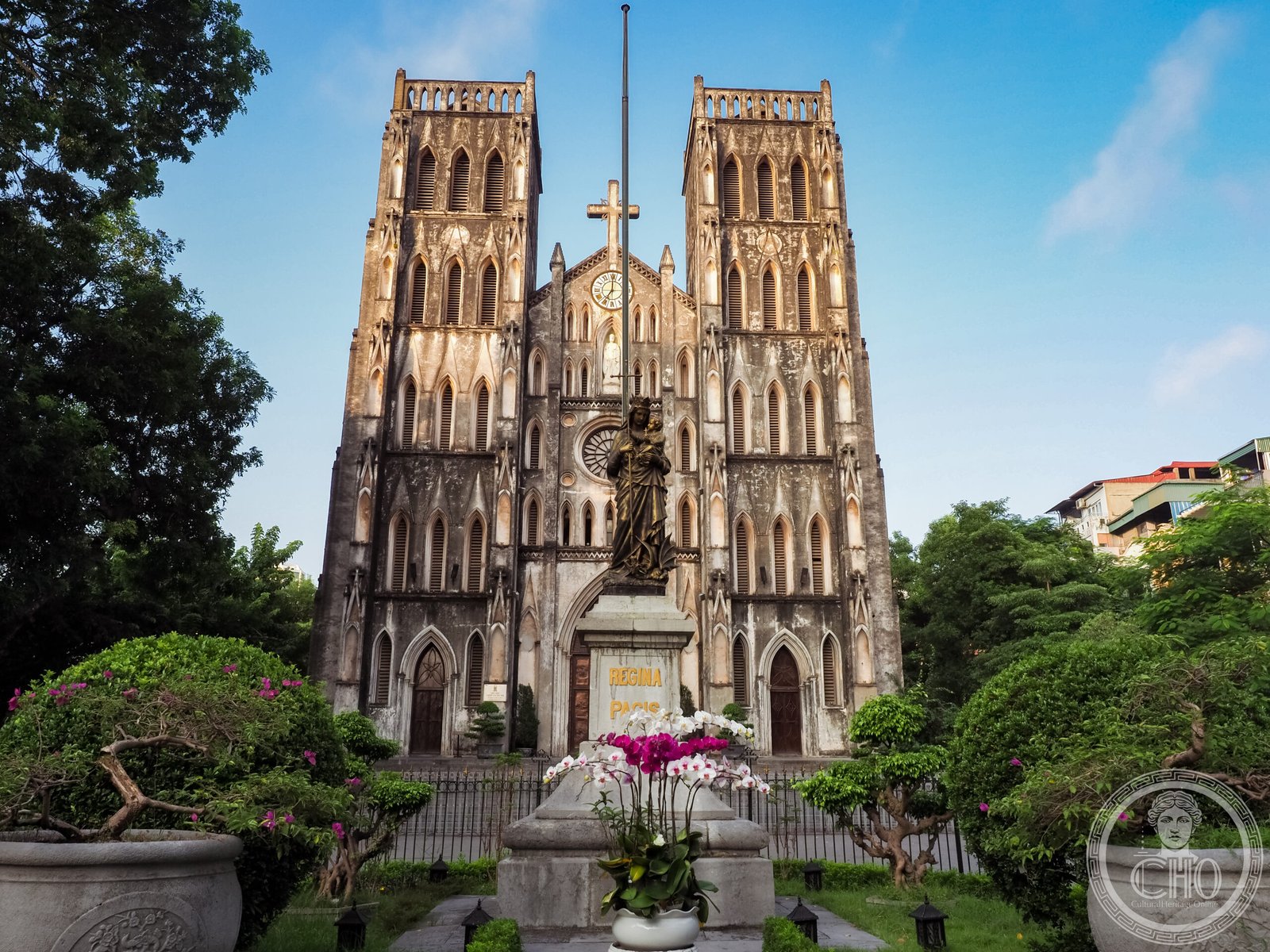
In the heart of the Old Quarter of Hanoi, the cathedral of Saint Joseph was begun in 1884. The work was led by Bishop Paul-François Puginier, a few years after the French took the city in 1873, and the church was consecrated in December 1886, on Christmas Eve according to one source, a detail not confirmed elsewhere. The building is neo-Gothic, with twin towers often compared to those of Notre-Dame de Paris and stained glass made in France and shipped to Vietnam. The ground it stands on belonged before to the Báo Thiên pagoda, raised in 1057 under King Lý Thánh Tông, with a tower some eighty metres tall by certain estimates. The pagoda was counted among the so-called «four great wonders» of old Vietnam and was the Buddhist centre of the capital for almost four hundred years. It was damaged by a storm in 1225, partly collapsed in 1322, destroyed during the Ming domination in 1414, rebuilt under the Lê, burned and finally abandoned. The French colonial authorities handed the site, by then in ruins for centuries, to Bishop Puginier in 1873, and the surviving remains were demolished between 1882 and 1886 to make room for the new cathedral. After the Geneva accords of 1954 the Catholic Church in North Vietnam went through decades of restrictions, and this cathedral is said to have stayed shut until Christmas Eve of 1990, when Mass was allowed again: a circumstance reported by several tourist sources but not yet traced to a primary historical source. In September 2008 about ten thousand Catholics gathered in prayer in front of the cathedral to protest against the demolition by the police of the buildings of the adjacent former apostolic nunciature, in a land dispute begun the year before and documented by Human Rights Watch and by international newspapers. The archdiocese of Hanoi, raised to metropolitan see on 24 November 1960 after having been the apostolic vicariate of Tonkin since 1659, is led today by Archbishop Joseph Vũ Văn Thiên, appointed by Pope Francis in November 2018. No pope has ever visited Vietnam, and the Holy See does not yet hold full diplomatic relations with the country, although since December 2023 a papal representative, Monsignor Marek Zalewski, has lived there for the first time since 1975.
About the Cathedral
St. Joseph’s Cathedral (Nhà thờ Lớn Hà Nội), seat of the Archdiocese of Hanoi, was built beginning in 1884 under Bishop Paul-François Puginier and consecrated in December 1886, on the site of the demolished Báo Thiên pagoda, a Buddhist monument dating to 1057.
Key facts
- 1057: Báo Thiên pagoda erected on this site under King Lý Thánh Tông, later ranked among Vietnam’s “Four Great Treasures”
- 1882–1886: pagoda’s long-ruined remains cleared for the new cathedral.
- December 1886: cathedral consecrated, in neo-Gothic style echoing Notre-Dame de Paris.
- 24 November 1960: Archdiocese of Hanoi erected as a metropolitan see.
- Christmas Eve 1990 (reported): Mass permitted again after decades of restriction under Vietnam’s communist government.
- September 2008: around 10,000 Catholics gathered in prayer outside the cathedral protesting the demolition of the adjacent former apostolic nunciature.
History
Built on ground once occupied by a thousand-year-old Buddhist pagoda leveled after centuries of decline, St. Joseph’s Cathedral became, after 1954, a rare surviving institution of open Catholic worship in North Vietnam, reportedly closed for years before Mass resumed on Christmas Eve 1990. Its most documented modern moment came in September 2008, when thousands of Catholics held sustained prayer vigils outside the cathedral over a land dispute involving the neighboring former apostolic nunciature — an episode covered by Human Rights Watch and international press as a rare instance of open, sustained religious protest in Vietnam.
What you see
A grey stone neo-Gothic facade rises in twin square bell towers flanking a central rose window, with pointed arches and buttresses throughout — French colonial Gothic Revival transplanted to a Southeast Asian street, its stained glass shipped from France for the original construction.
Practical information
- Opening hours: generally open daily outside services; check current hours before visiting.
- Address: 40 Nhà Chung Street, Hàng Trống ward, Hoàn Kiếm district, Hanoi, Vietnam.
Getting there
The cathedral stands just west of Hoàn Kiếm Lake, at the corner of Nhà Chung, Lý Quốc Sư and Nhà Thờ streets in Hanoi’s Old Quarter. GPS: 21°01′43″N, 105°50′56″E.
Nearby
- Hoàn Kiếm Lake — Hanoi’s central lake and civic heart, a short walk east of the cathedral.
Sources
- Wikipedia — “St. Joseph’s Cathedral, Hanoi,” “Archdiocese of Hanoi,” “Holy See–Vietnam relations,” “Four Great Treasures of Annam”
- GCatholic.org — Archdiocese of Hanoi records.
- Human Rights Watch, NPR, Radio Free Asia, National Catholic Register — coverage of the 2008 nunciature land-dispute protests.
- UCA News, AsiaNews, Agenzia Fides — coverage of the Archdiocese of Hanoi and Holy See–Vietnam relations.
Find it on the map
See this place and what’s around it →📷 Become a Cultural Heritage Online photographer
Share your photos of places: they stay published under your name as the author. The more they're seen, the more you get noticed — and soon a contest will reward the most appreciated photos.
Log in or sign up free to add a photo