
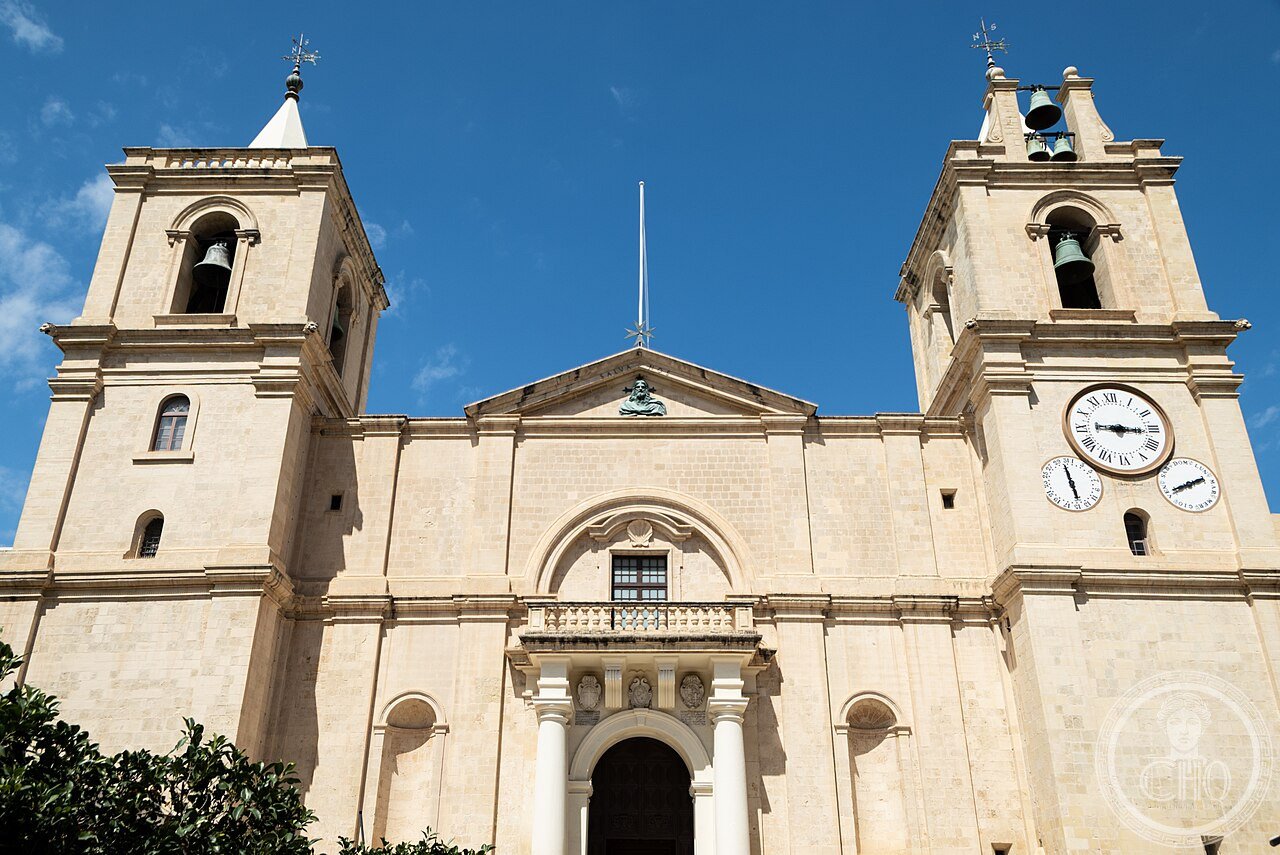
Dopo il Grande Assedio del 1565, il gran maestro Jean de la Cassière commissionò all’architetto militare maltese Girolamo Cassar la chiesa conventuale dell’Ordine degli Ospitalieri di San Giovanni, costruita tra il 1573 e il 1578: una facciata austera e quasi fortificata, tipica di un ordine appena uscito da un assedio, che nasconde un interno barocco sontuoso, decorato dal cavaliere-pittore calabrese Mattia Preti. Nell’oratorio della cattedrale si trova la Decollazione di san Giovanni Battista, dipinta da Caravaggio nel 1608: il più grande dipinto mai realizzato dall’artista e l’unico che egli abbia mai firmato, con il proprio nome scritto nel sangue che sgorga dalla gola recisa del Battista. Sei mesi dopo essere stato nominato cavaliere, Caravaggio fu spretato proprio in questo oratorio, davanti alla sua stessa opera.
About St John’s Co-Cathedral
Following the Great Siege of Malta in 1565, during which the Knights Hospitaller and Maltese defenders famously withstood a prolonged Ottoman assault, Grand Master Jean de la Cassière commissioned a new conventual church for the Order in the newly founded city of Valletta. Built between 1573 and 1578 to designs by the Maltese military architect Girolamo Cassar, the church presents a deliberately restrained, almost fortress-like Mannerist exterior — a plain, well-proportioned facade flanked by two bell towers, entirely in keeping with the character of an Order that had only recently emerged from a brutal siege. This austere exterior gives no hint of the extraordinary interior within: at the height of the Baroque period, the Calabrian artist and Knight of the Order, Mattia Preti, transformed the cathedral’s interior with intricately carved and gilded stone walls and a vaulted ceiling painted with scenes from the life of Saint John the Baptist, creating one of the most opulent Baroque interiors anywhere in Europe. The cathedral’s floor itself forms an extraordinary heraldic monument, inlaid with approximately 400 decorated marble tombstones marking the graves of Knights of the Order. Within the cathedral’s Oratory hangs The Beheading of Saint John the Baptist, painted in 1608 by Caravaggio, who had arrived in Malta in July 1607 aboard a vessel of the Order and was formally accepted as a Knight of Obedience by Grand Master Alof de Wignacourt on 14 July 1608. At 3.7 by 5.2 metres, it is the largest altarpiece Caravaggio ever painted, and it holds a unique distinction in his entire body of work: it is the only painting he ever signed, inscribing his name in the pool of blood spilling from the Baptist’s severed throat. Caravaggio’s tenure as a Knight proved brief and troubled; roughly six months after his induction, he was formally defrocked and expelled from the Order in a ceremony held in the very Oratory housing his own masterpiece.
Key facts
- 1565: Great Siege of Malta, prelude to the founding of Valletta
- 1573-1578: cathedral built by Girolamo Cassar for Grand Master Jean de la Cassière
- Interior decoration: Baroque transformation by Knight and artist Mattia Preti
- Floor: approximately 400 inlaid marble tombstones of Knights of the Order
- 14 July 1608: Caravaggio accepted as a Knight of Obedience
- 1608: Caravaggio paints The Beheading of Saint John the Baptist, his largest work and only signed painting
- c. late 1608: Caravaggio defrocked in the Oratory, before his own painting
History
The cathedral’s construction immediately after the Great Siege of 1565 embodies the Knights Hospitaller’s transformation of Valletta into a fortified capital city, its conventual church’s plain, defensible exterior a direct architectural expression of an Order still organised around military as well as religious and charitable functions. Mattia Preti’s later Baroque transformation of the interior, carried out by a fellow Knight rather than an outside commission, reflects the Order’s own internal artistic culture and its members’ direct participation in shaping the visual identity of their most important shared space.
Caravaggio’s brief, dramatic sojourn in Malta — arriving as a fugitive from a killing in Rome, achieving Knighthood, producing his largest and only signed work, and then being expelled from the Order within the same building housing that masterpiece — stands as one of the most compressed and consequential episodes in the entire history of Western painting, permanently binding the artist’s legacy to this single cathedral.
What you see
The Mannerist exterior, restored between 2014 and 2015, presents a plain limestone facade bounded by twin bell towers, giving little indication of the richly gilded Baroque interior within. Inside, Mattia Preti’s carved stone walls and painted vaulted ceiling depicting the life of John the Baptist surround a floor of some 400 inlaid marble knights’ tombstones, while the Oratory houses Caravaggio’s monumental Beheading of Saint John the Baptist alongside his equally significant Saint Jerome Writing.
Practical information
- Opening hours: generally open daily except Sundays and public holidays; admission fee applies; check current hours before visiting
- Address: Triq San Ġwann, Il-Belt Valletta VLT 1000, Malta
Getting there
St John’s Co-Cathedral stands in the heart of Valletta, Malta’s capital, easily reachable on foot from the city gate and main thoroughfare, Republic Street. GPS: 35.8977° N, 14.5126° E.
Nearby
- Grandmaster’s Palace — former seat of the Order’s government, nearby
- Upper Barrakka Gardens — historic gardens overlooking the Grand Harbour
- Valletta Waterfront — harbourside promenade, a short walk from the cathedral
Sources
- Wikipedia — “St John’s Co-Cathedral” (en.wikipedia.org)
- Wikipedia — “The Beheading of Saint John the Baptist (Caravaggio)” (en.wikipedia.org)
- St John’s Co-Cathedral Foundation — “Caravaggio” (stjohnscocathedral.com)
Find it on the map
See this place and what’s around it →📷 Become a Cultural Heritage Online photographer
Share your photos of places: they stay published under your name as the author. The more they're seen, the more you get noticed — and soon a contest will reward the most appreciated photos.
Log in or sign up free to add a photo