
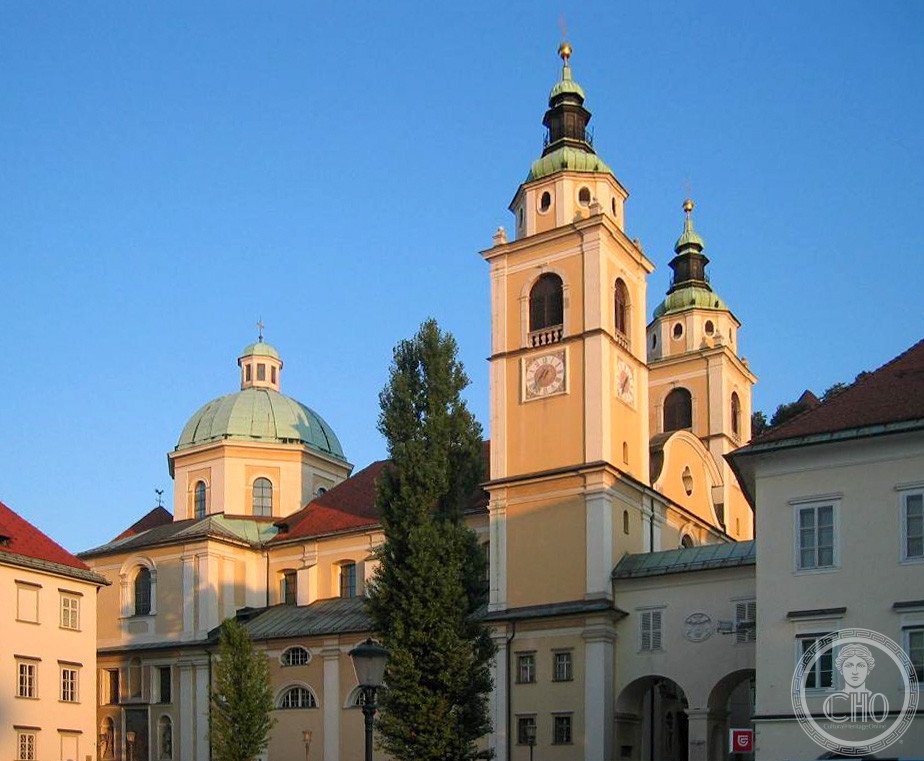
Sul sito dell’attuale cattedrale sorgeva già nel XIII secolo una chiesa romanica trinavata, menzionata per la prima volta nel 1262; un incendio devastante nel 1361 impose un rifacimento in stile gotico, mentre la fondazione della diocesi di Lubiana nel 1461 ne fece una cattedrale. All’inizio del Settecento l’edificio gotico fu sostituito dall’attuale costruzione barocca, i cui interni conservano gli affreschi di Giulio Quaglio, dipinti tra il 1703-1706 e il 1721-1723. Nel 1996, in occasione del 1250° anniversario della cristianizzazione della Slovenia e della visita di papa Giovanni Paolo II, furono installate due porte di bronzo scolpite: quella laterale, la Porta di Lubiana, ritrae i vescovi della diocesi nel Novecento, incluso Gregorij Rožman, condannato in contumacia per tradimento dal regime comunista jugoslavo nel 1946 e la cui condanna fu annullata nel 2009, con le sue spoglie infine riportate nella cattedrale nel 2013.
About Ljubljana Cathedral
The site of today’s Ljubljana Cathedral was originally occupied by an aisled, three-nave Romanesque church, first documented in 1262. A devastating fire in 1361 required extensive rebuilding in the Gothic style, and when the Diocese of Ljubljana was formally established in 1461, the church was elevated to cathedral status. This Gothic cathedral stood until the early 18th century, when it was entirely replaced by the Baroque building visible today, constructed between 1701 and 1706 and dedicated, like its predecessors, to Saint Nicholas — patron saint of boatmen, fittingly for a city built around river trade. Much of the cathedral’s original Baroque decoration survives intact, most notably the extensive fresco cycles painted by the Italian artist Giulio Quaglio across two separate campaigns, first from 1703 to 1706 and again from 1721 to 1723; the fresco filling the cupola depicts the Holy Spirit surrounded by angels, while further frescoes on the dome’s walls portray the coronation of the Virgin Mary and the glorification of Saint Nicholas amid angels and saints. In 1996, to mark both the 1,250th anniversary of Christianity’s arrival in Slovenian territory and a visit by Pope John Paul II, the cathedral’s entrances were fitted with newly sculpted bronze doors. The main entrance, known as the Slovene Door, bears a relief by sculptor Tone Demšar depicting key moments of Slovene history across the centuries. The side entrance, the Ljubljana Door, redesigned by Mirsad Begić, portrays the faces of the 20th-century bishops of the Diocese of Ljubljana — among them Gregorij Rožman, a wartime bishop whose conduct during the Axis occupation remains contested by historians: convicted of treason in absentia by the Yugoslav communist government in 1946, his conviction was formally annulled on procedural grounds in 2009, and his remains were repatriated and reinterred within Ljubljana Cathedral itself on 13 April 2013.
Key facts
- 1262: first documented mention of an earlier Romanesque church on the site
- 1361: church rebuilt in Gothic style after a devastating fire
- 1461: Diocese of Ljubljana established; church becomes a cathedral
- 1701-1706: present Baroque cathedral built, replacing the Gothic structure
- 1703-1706 and 1721-1723: interior frescoes painted by Giulio Quaglio
- 1996: bronze doors installed for the 1,250th anniversary of Slovenian Christianity and Pope John Paul II’s visit
- 2009: Bishop Gregorij Rožman’s 1946 treason conviction annulled on procedural grounds
- 13 April 2013: Rožman’s remains reinterred in the cathedral
History
The cathedral’s continuous religious use since at least the mid-13th century, through Romanesque, Gothic, and finally Baroque architectural phases, mirrors the broader development of Ljubljana itself from a medieval river-trade settlement into the ecclesiastical and later national capital of Slovenia; its dedication to Saint Nicholas, patron of boatmen, directly reflects the city’s origins as a trading post along the Ljubljanica River. The cathedral’s 1996 bronze doors, commissioned to mark both a major anniversary of Slovenian Christianity and a papal visit shortly after Slovenia’s 1991 independence, functioned as a deliberate act of national and religious self-representation during a formative period for the newly independent state.
The inclusion of Bishop Gregorij Rožman’s portrait on the Ljubljana Door, and the later repatriation of his remains to the cathedral following the 2009 annulment of his wartime treason conviction, situates the building at the centre of an unresolved and still-debated chapter of 20th-century Slovenian history concerning wartime collaboration, resistance, and post-war communist justice.
What you see
The cathedral’s green dome and twin towers, easily recognisable landmarks of the Ljubljana skyline, rise above Cyril and Methodius Square in the historic city centre. Inside, Giulio Quaglio’s Baroque frescoes cover the cupola and dome walls, while the exterior’s 1996 bronze doors — the Slovene Door at the main entrance and the Ljubljana Door at the side — carry sculpted reliefs of national history and 20th-century diocesan bishops respectively.
Practical information
- Opening hours: generally open daily with seasonal variation; free admission; check current hours before visiting
- Address: Dolničarjeva ulica 1, 1000 Ljubljana, Slovenia
Getting there
Ljubljana Cathedral stands on Cyril and Methodius Square in the heart of Ljubljana’s historic centre, easily reachable on foot near the city’s central market and Triple Bridge. GPS: 46.0508° N, 14.5083° E.
Nearby
- Ljubljana Central Market — historic market designed by architect Jože Plečnik, immediately adjacent
- Triple Bridge — iconic Plečnik-designed bridge over the Ljubljanica River, nearby
- Ljubljana Castle — hilltop castle overlooking the cathedral and Old Town
Sources
- Wikipedia — “Ljubljana Cathedral” (en.wikipedia.org)
- Wikipedia — “Gregorij Rožman” (en.wikipedia.org)
- Visit Ljubljana — “The Cathedral (Church of St. Nicholas)” (visitljubljana.com)
Find it on the map
See this place and what’s around it →📷 Become a Cultural Heritage Online photographer
Share your photos of places: they stay published under your name as the author. The more they're seen, the more you get noticed — and soon a contest will reward the most appreciated photos.
Log in or sign up free to add a photo