
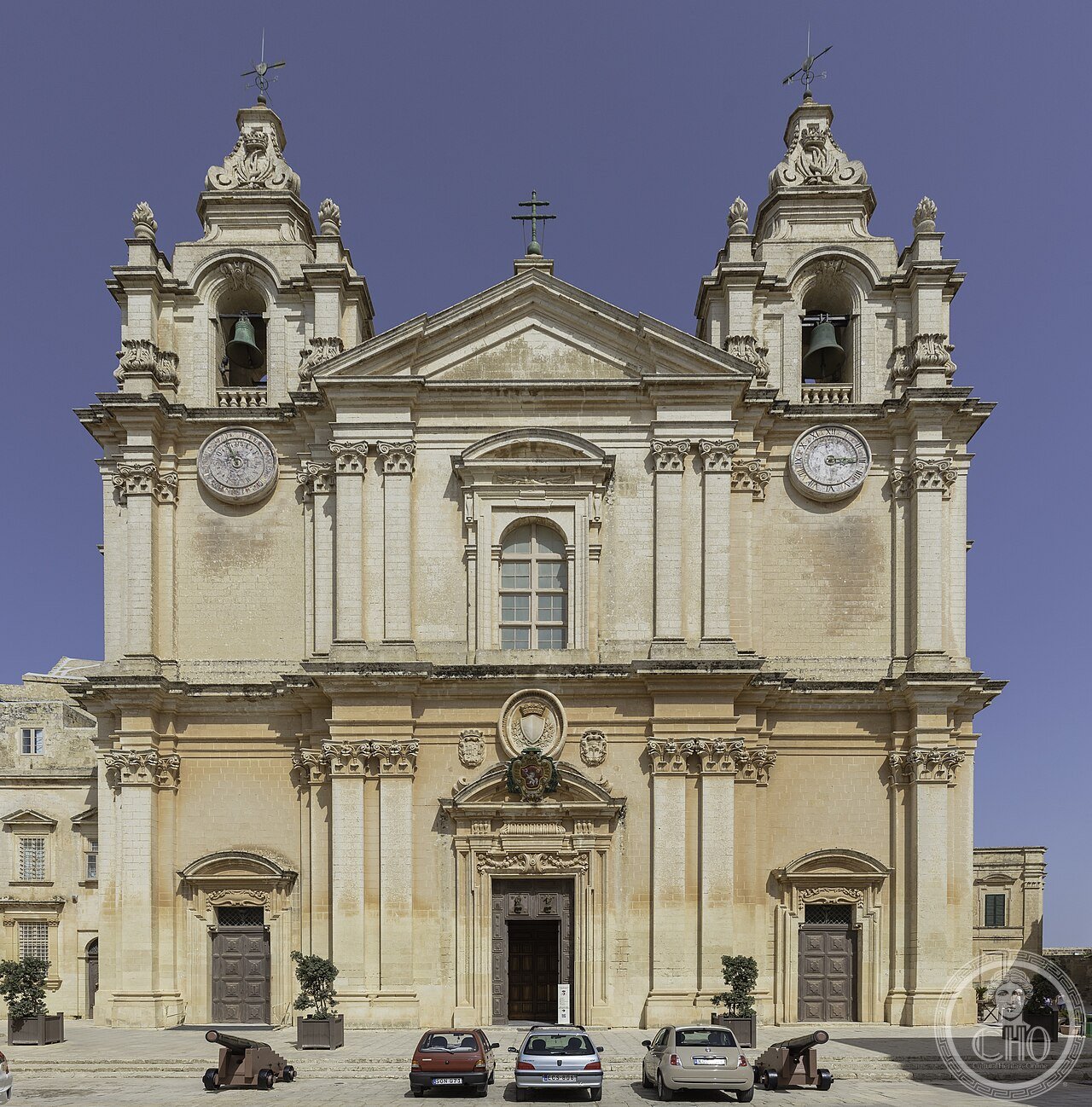
Tradition has it that Mdina Cathedral stands exactly where, around AD 60, the apostle Paul, shipwrecked off Malta on his journey to Rome, met Publius, the Roman governor of the island, whom according to the Acts of the Apostles he healed and converted to Christianity, making him in effect the first bishop of Malta. Archaeologists have indeed found Roman remains in the cathedral crypt, though it is impossible to prove that this was really Publius’s house. The medieval cathedral was badly damaged by the earthquake that struck Sicily in 1693 and was therefore taken down and rebuilt in Baroque style to a design by the Maltese architect Lorenzo Gafà between 1696 and 1705, incorporating the choir and sacristy that had survived the quake: the work is considered his masterpiece.
About Mdina Cathedral
St Paul’s Cathedral in Mdina, dedicated to the Apostle Paul, was founded as early as the 12th century on a site that tradition identifies as the location where the shipwrecked Paul met Publius, the Roman governor of Malta, around 60 CE. According to the Acts of the Apostles, Paul was shipwrecked on Malta while being transported as a prisoner to Rome; while on the island he performed healing miracles and, in this telling, converted Publius and many others to Christianity, with Publius traditionally regarded as Malta’s first bishop. Mdina itself occupied the site of the Roman city of Melite at the time, and archaeologists have indeed uncovered genuine Roman-era remains in the cathedral’s crypt, although it remains impossible to confirm that these specifically formed part of Publius’s own residence. The medieval cathedral that stood on this site for centuries was catastrophically damaged by the powerful earthquake that struck Sicily and the wider central Mediterranean region in 1693; the building was consequently dismantled and rebuilt in the Baroque style to a design by the Maltese architect Lorenzo Gafà between 1696 and 1705. Notably, plans to replace the cathedral’s outdated medieval choir with a fashionable Baroque one, with Gafà already appointed to the task, had been underway since 1679 — well before the earthquake struck — meaning the disaster accelerated rather than initiated the rebuilding. The cathedral’s choir and sacristy survived the earthquake and were incorporated directly into Gafà’s new structure, while the remainder of the building rose entirely anew; the reconstructed cathedral was largely complete and formally consecrated on 8 October 1702, with final work on its dome finished on 24 October 1705. The completed cathedral is widely regarded as Lorenzo Gafà’s architectural masterpiece.
Key facts
- c. 60 CE: traditional site of Paul’s meeting with Governor Publius after his shipwreck
- 12th century: earliest cathedral founded on the site
- 1679: plans begin to replace the medieval choir with a Baroque one, architect Lorenzo Gafà appointed
- 1693: Sicily earthquake severely damages the medieval cathedral
- 1696-1705: cathedral rebuilt in Baroque style by Lorenzo Gafà
- 8 October 1702: reconstructed cathedral consecrated
- 24 October 1705: final work on the dome completed
History
The cathedral’s traditional association with Paul’s shipwreck and his meeting with Publius places Mdina at the symbolic origin point of Christianity on Malta, a foundational narrative that has shaped the island’s religious identity for close to two millennia regardless of the precise historicity of the site’s exact location. The presence of genuine Roman-era remains beneath the cathedral crypt lends this tradition a tangible archaeological anchor, even if the specific identification with Publius’s own house cannot be definitively proven.
Lorenzo Gafà’s post-earthquake reconstruction, building directly on choir-replacement plans already set in motion more than a decade before the 1693 disaster, illustrates how a natural catastrophe can accelerate rather than originate major architectural transformation — the resulting Baroque cathedral, incorporating surviving medieval fabric alongside entirely new construction, stands today as the acknowledged masterpiece of Malta’s most celebrated native architect.
What you see
Lorenzo Gafà’s Baroque facade on St Paul’s Square is cleanly divided into three bays by pilasters of the Corinthian and Composite orders, crowned by twin bell towers and a central dome completed in 1705. The surviving medieval choir and sacristy, incorporated into Gafà’s otherwise entirely new structure, connect the present Baroque building directly back to its pre-earthquake predecessor, while Roman-era remains uncovered in the crypt point to the site’s much older, pre-Christian occupation.
Practical information
- Opening hours: generally open daily with seasonal variation; admission fee applies for the cathedral museum; check current hours before visiting
- Address: Misraħ l-Arċisqof, Mdina MDN 1191, Malta
Getting there
St Paul’s Cathedral stands within the fortified walls of Mdina, Malta’s former capital known as “the Silent City,” reachable by bus or car from Valletta, with parking outside the city walls. GPS: 35.8864° N, 14.4041° E.
Nearby
- Mdina city walls and bastions — the fortified perimeter of the Silent City, surrounding the cathedral
- Palazzo Falson — historic medieval palace and museum, nearby within Mdina
- Rabat — adjoining town with the Catacombs of St Paul and St Agatha
Sources
- Wikipedia — “St Paul’s Cathedral, Mdina” (en.wikipedia.org)
- Culture Malta — “Mdina Cathedral” (culture-malta.org)
- Church Trails of Malta — “Cathedral of St Paul” (churchtrailsmalta.com)
Find it on the map
See this place and what’s around it →📷 Become a Cultural Heritage Online photographer
Share your photos of places: they stay published under your name as the author. The more they're seen, the more you get noticed — and soon a contest will reward the most appreciated photos.
Log in or sign up free to add a photo