

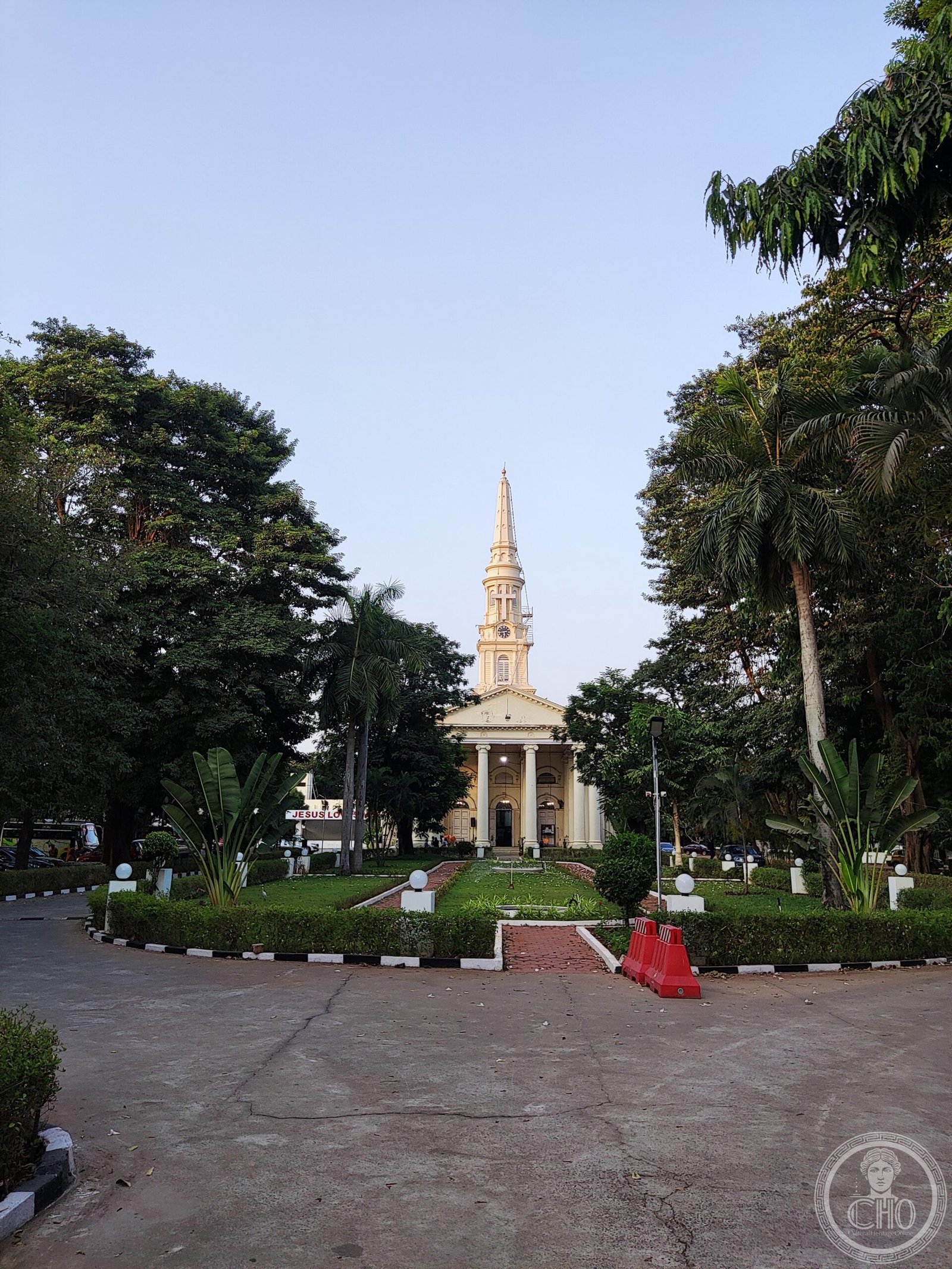
At number 224 of Cathedral Road, in the Gopalapuram district of Chennai, in India, St George’s Cathedral was built in 1815 to serve the growing European civilian population of Madras. That population had moved out to the Choultry Plain and Mount Road, and for them St Mary’s church inside Fort St George had become too far away. Contrary to what is sometimes claimed, it does not appear to have been conceived as a military garrison chapel: that role stayed with St Mary’s. Opened for worship on 30 April 1815, it was consecrated on 6 January 1816 — 8 January according to the cathedral’s own website, a figure the sources do not reconcile — by the Bishop of Calcutta, Thomas Fanshaw Middleton. The design is credited to Colonel James Lillyman Caldwell, chief engineer of the East India Company for the Madras presidency, while the execution was entrusted to Captain, later Major, Thomas Fiott de Havilland. The building is neoclassical and echoes the London churches of James Gibbs, St Martin-in-the-Fields in particular, with a spire compared to that of St Giles-in-the-Fields, 139 feet high. The claim sometimes repeated that it is the tallest spire in Asia, or in India, is confirmed by no source. The cost of building came to 41,709 pagodas, rising to 57,225 with furnishings, organ and the architect’s fee, and was funded by a public lottery. Inside is a bas-relief by the sculptor Francis Chantrey dedicated to Bishop Reginald Heber, the author of famous hymns, showing his last public appearance at Trichinopoly. Contrary to what is sometimes assumed, Heber is not buried in this cathedral, but at Trichinopoly itself, where he died on 3 April 1826 and where his tomb stands in the church of St John. The church was raised to the rank of cathedral in October 1835, with the erection of the diocese of Madras under its first bishop Daniel Corrie. On 27 September 1947 the Church of South India was inaugurated here, and it remains today the mother cathedral for the diocese of Madras. According to the cathedral’s own website, unconfirmed elsewhere, the building underwent a restoration from 8 January to October 2025, with a rededication on 1 November of the same year.
About the Cathedral
St. George’s Cathedral, on Cathedral Road in Chennai’s Gopalapuram district, was built in 1815 to serve the city’s growing civilian European population and consecrated in 1816. It became the seat of the Diocese of Madras in 1835 and, in 1947, the birthplace of the Church of South India.
Key facts
- 30 April 1815: the church opens for worship.
- 6 January 1816: consecrated by Thomas Fanshaw Middleton, first Anglican Bishop of Calcutta.
- Designed by Colonel James Lillyman Caldwell, built by Captain Thomas Fiott de Havilland; its spire stands 139 feet tall.
- October 1835: elevated to cathedral status as the seat of the new Diocese of Madras.
- 27 September 1947: the Church of South India inaugurated at this cathedral.
- Holds a Francis Chantrey memorial to Bishop Reginald Heber, who is actually buried at Trichinopoly, not here.
History
Built in 1815 for Madras’s expanding civilian European community rather than as a military chapel, St. George’s became the seat of a new Anglican diocese in 1835 and, over a century later, the site where the Church of South India was formally brought into being in 1947 — one of the earliest and most significant unions of Anglican, Methodist, Presbyterian and Congregationalist churches anywhere in the world. Its Chantrey memorial to hymn-writer Bishop Reginald Heber commemorates a figure actually buried elsewhere, at Trichinopoly.
What you see
A white neoclassical facade with an Ionic-columned portico, styled after the London churches of James Gibbs, rising into a tall multi-tier spire, its interior holding a Francis Chantrey bas-relief memorial to Bishop Reginald Heber.
Practical information
- Opening hours: generally open daily outside services; check current hours before visiting.
- Address: 224, Cathedral Road, Gopalapuram, Chennai, Tamil Nadu 600086, India.
Getting there
The cathedral stands on Cathedral Road in Chennai’s Gopalapuram district. GPS: 13.0521°N, 80.2529°E.
Nearby
- San Thome Basilica — a separate, older Roman Catholic basilica elsewhere in Chennai, built over the tomb of the Apostle Thomas.
Sources
- Wikipedia — “St. George’s Cathedral, Chennai,” “Reginald Heber”
- St. George’s Cathedral Chennai (official site).
- Sriram V. — “St George’s Cathedral Turns 200” (Madras Heritage and Carnatic Music blog).
- BACSA (British Association for Cemeteries in South Asia) — cathedral and cemetery history.
Find it on the map
See this place and what’s around it →📷 Become a Cultural Heritage Online photographer
Share your photos of places: they stay published under your name as the author. The more they're seen, the more you get noticed — and soon a contest will reward the most appreciated photos.
Log in or sign up free to add a photo