
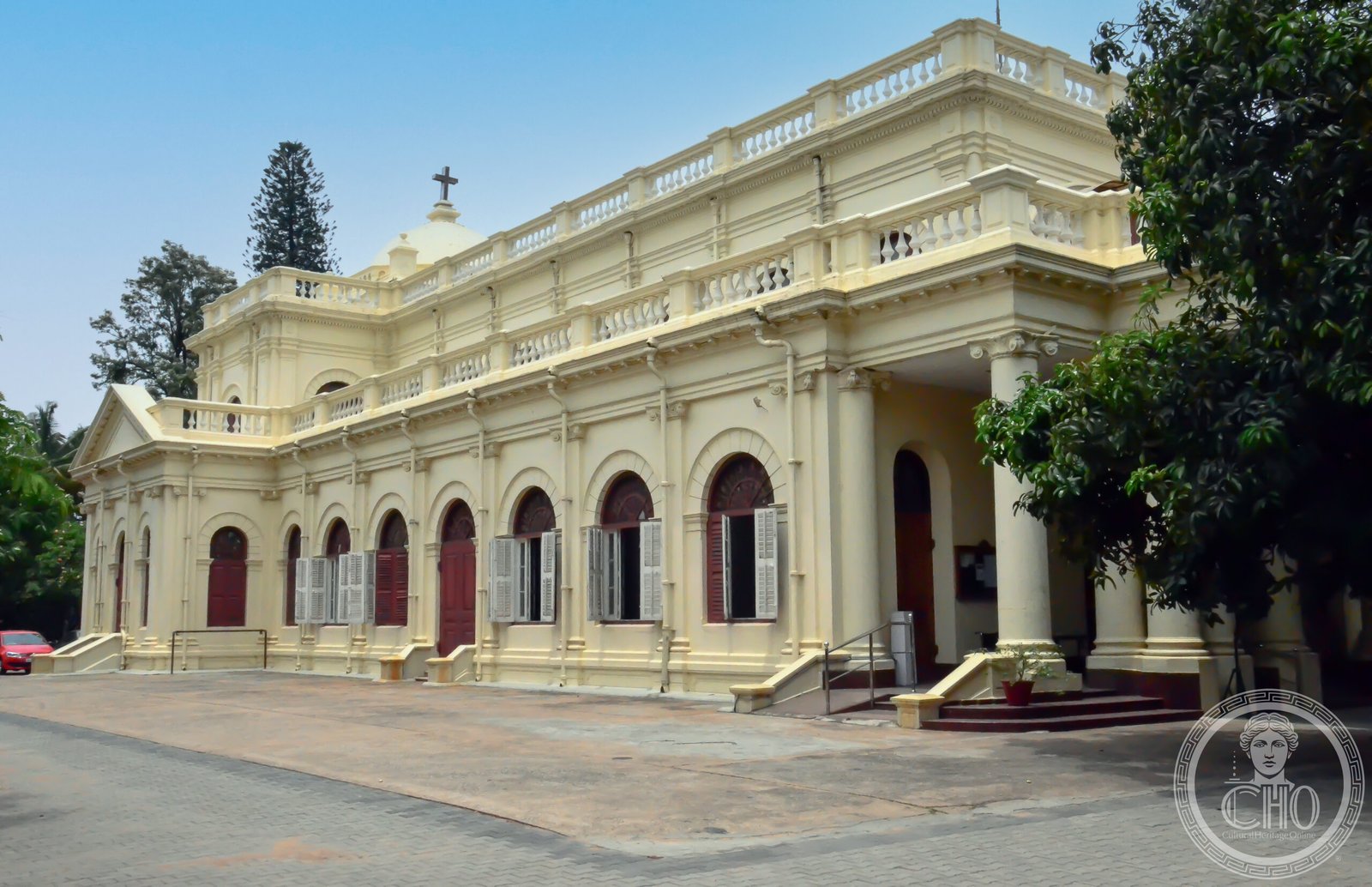
At number 1 Mahatma Gandhi Road, in the Shanthala Nagar district of Bengaluru, in India, the cathedral of St Mark was built between 1808 and 1812 as an Anglican church for the British garrison and the civil community of the Madras army, with an initial capacity of about four hundred seats. It was consecrated in 1816 by the bishop of Calcutta, since Bengaluru did not yet have a diocese of its own. The official site of the cathedral credits the laying of the foundation stone to the Reverend John Dunsterville, a detail not found in other sources. As the congregation grew, an enlargement project in 1901, followed according to that same source by the collapse of the new structure during the works, a detail not confirmed elsewhere, led to the rebuilding of the church, rededicated on 26 August 1902 by Bishop Whitehead of Madras, with a capacity of seven hundred seats. The architect of this phase, again according to the same not fully corroborated source, was James Ransome. On 17 February 1923 an electrical short circuit devastated the church in a fire, and in February 1924, during the restoration works, the weakened structure collapsed again. The final rebuilding, completed between 1926 and 1927, saw the congregation worship temporarily at St Andrew’s Kirk on Cubbon Road. The building, in colonial Baroque style, is explicitly modelled on the cathedral of St Paul in London, the work of Christopher Wren, with a large dome, a semicircular apse, Corinthian columns and round arches: contrary to what generic tourist sources sometimes report, the style is not Gothic Revival. The cathedral became a seat of the Church of South India after the ecclesiastical union of 1947, formally obtaining cathedral status in 1961, when the Reverend H.F.J. Daniel became the first Indian presbyter in charge. Today it is the mother cathedral of the diocese of Central Karnataka of the Church of South India. No direct link between the cathedral and Field Marshal K. M. Cariappa is confirmed, contrary to a suggestion that has circulated, and his biography does not mention the building. The nearby Field Marshal Cariappa Road, in the same district, is not in itself proof of any personal connection.
About the Cathedral
St. Mark’s Cathedral, on Mahatma Gandhi Road in Bengaluru, India, was built 1808–1812 as a garrison and civilian Anglican church and consecrated in 1816. Rebuilt after a 1901 collapse and again after a 1923 fire, it became the cathedral of the Church of South India’s Diocese of Central Karnataka in 1961.
Key facts
- 1808–1812: built for the British garrison and civilian community of Bangalore.
- 1816: consecrated by the Bishop of Calcutta.
- 26 August 1902: rebuilt and rededicated after an earlier structural collapse.
- 17 February 1923: gutted by fire from an electrical short circuit; weakened structure collapses again in February 1924.
- 1926–1927: final reconstruction completed.
- 1961: formally designated a CSI cathedral, its first Indian Presbyter-in-Charge appointed.
History
Built for Bangalore’s British garrison in the early 19th century, St. Mark’s has been rebuilt more than once — after a structural collapse around 1901 and again after a 1923 electrical fire that gutted the church and triggered a further collapse during repairs. The building standing today largely dates from a 1926–1927 reconstruction, and the church became the cathedral of a Church of South India diocese in 1961, following the historic 1947 union of Indian Protestant denominations.
What you see
A cream-colored colonial Baroque facade with Corinthian columns and round arches, rising to a large dome and semicircular chancel explicitly modeled on Christopher Wren’s St Paul’s Cathedral in London.
Practical information
- Opening hours: generally open daily outside services; check current hours before visiting.
- Address: 1, Mahatma Gandhi Road, Shanthala Nagar, Bengaluru, Karnataka, India.
Getting there
The cathedral stands at the western end of M.G. Road, near Cubbon Park. GPS: 12.9757°N, 77.6041°E.
Nearby
- Cubbon Park — Bengaluru’s central park, a short walk from the cathedral.
Sources
- Wikipedia — “St. Mark’s Cathedral, Bangalore,” “K. M. Cariappa”
- St. Mark’s Cathedral Bengaluru (official site) — church history.
Find it on the map
See this place and what’s around it →📷 Become a Cultural Heritage Online photographer
Share your photos of places: they stay published under your name as the author. The more they're seen, the more you get noticed — and soon a contest will reward the most appreciated photos.
Log in or sign up free to add a photo