

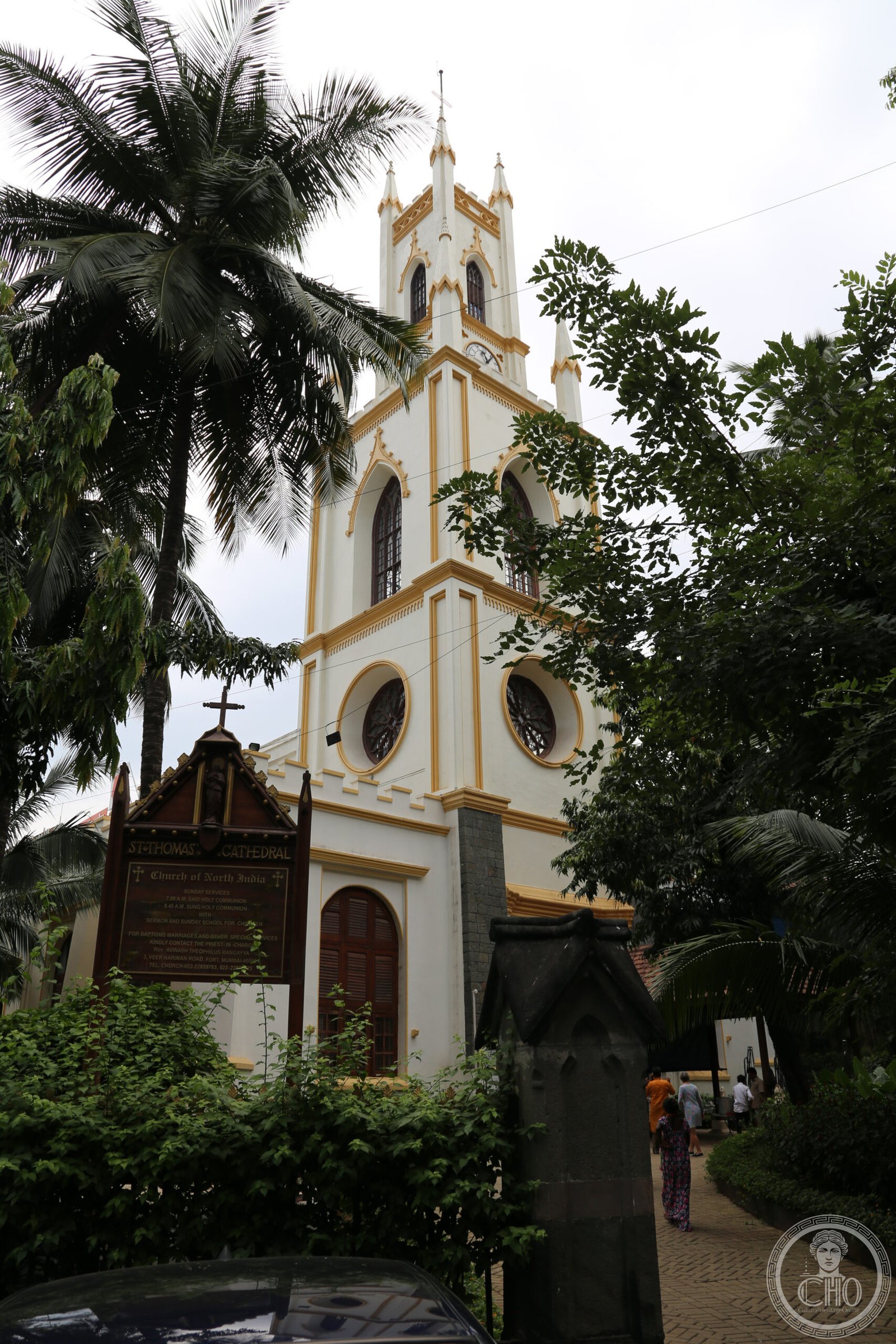
At 3 Veer Nariman Road, in Mumbai’s Fort district, just west of Horniman Circle Garden, St. Thomas Cathedral is commonly described as the city’s oldest church — and, according to some tourism sources not fully confirmed by academic sources, as the oldest English building of any kind in Mumbai.
The foundation stone was laid in 1676 on the Bombay Green, under Governor Gerald Aungier, who held office from 1669 to 1677. Work stopped once the walls had reached about fifteen feet in height, and stayed stalled for more than thirty years, most likely for lack of funds after Aungier’s own death in 1677.
Construction resumed in 1715, with a second foundation-stone ceremony on 18 November that year, according to tradition following a sermon by the chaplain Richard Cobbe, who then oversaw its completion through charitable donations. The building was finished in December 1718 and opened for worship on Christmas Day of that same year.
The name of the original architect is not documented in any source. The only known architect linked to the building is James Trubshawe, who also designed Elphinstone College, and who is responsible for the Gothic Revival eastern wing added in the sixties of the nineteenth century.
The church was elevated to cathedral status in 1837, with Bishop Thomas Carr consecrated on 19 November that year and installed on 25 February 1838. The bell tower and clock were added between 1838 and 1839.
Inside are numerous colonial-era funerary monuments, among them the recumbent effigy of Bishop Carr himself, the work of the sculptor Matthew Noble. There is also a monument to Jonathan Duncan, the longest-serving Governor of Bombay (1795-1811). A monument commemorates the crew of the steamship Cleopatra, which sank off the Malabar coast on 15 April 1847 while transporting convicts to Singapore, with the number of victims reported slightly differently across sources. There is a monument to Lieutenant Colonel John Campbell, who had fought in the siege of Mangalore against Tipu Sultan and died in Bombay on 23 March 1784, and one to Royal Navy Captain Frederick Lewis Maitland, who died at sea off Bombay on 30 November 1839.
A flat concrete roof, installed according to sources either in the Twenties or the Nineties of the twentieth century — a detail sources do not agree on — caused water infiltration. This was resolved by a restoration carried out between 2001 and 2004 by the architect Brinda Somaya, who replaced the covering with a sloping roof faithful to the 1865 original, and repaired the buttresses and clerestory masonry. The intervention won the 2004 UNESCO Asia-Pacific Heritage Award for cultural heritage conservation.
The cathedral also marks Mumbai’s historic “zero point,” from which the city’s road distances were once measured using sixteen milestones, of which eleven are said by sources still to be traceable today.
About the Cathedral
St. Thomas Cathedral, near Horniman Circle in Mumbai’s Fort district, is widely regarded as the city’s oldest church, its foundation stone laid in 1676 but its construction not completed until 1718 after a delay of more than three decades. A major 2001–2004 restoration won a UNESCO Asia-Pacific Heritage Award.
Key facts
- 1676: foundation stone laid under Governor Gerald Aungier.
- Construction stalled for over thirty years after funding collapsed following Aungier’s 1677 death.
- 18 November 1715 – 25 December 1718: work resumed and the church completed, opening for service on Christmas Day 1718.
- 1837: elevated to cathedral status under Bishop Thomas Carr.
- 1860s: Gothic Revival eastern wing added by architect James Trubshawe.
- 2001–2004: major restoration under architect Brinda Somaya, winner of a 2004 UNESCO Asia-Pacific Heritage Award of Distinction.
History
Begun in 1676 and left half-built for more than thirty years after its patron’s death, St. Thomas Cathedral was finally completed in 1718 through the fundraising efforts of a determined chaplain, becoming Mumbai’s oldest church and, by the 19th century, a burial ground for East India Company officials, naval officers and colonial administrators. Its 20th-century concrete roof, a source of decades of water damage, was replaced in a 2001–2004 restoration that returned the building to its historically accurate sloping profile and won international recognition.
What you see
A white-and-gold Gothic bell tower and rose windows mark the western entrance, with an eastern wing added in the 1860s in Gothic Revival style, and an interior lined with 18th- and 19th-century memorial tablets and effigies to colonial-era officials, officers and sailors.
Practical information
- Opening hours: generally open daily outside services; check current hours before visiting.
- Address: 3, Veer Nariman Road, Fort, Mumbai 400001, Maharashtra, India.
Getting there
The cathedral stands just west of Horniman Circle Garden in Mumbai’s Fort district. GPS: 18.9317°N, 72.8336°E.
Nearby
- Horniman Circle Garden — the historic circular garden immediately east of the cathedral.
- Churchgate — the nearby railway station and district, named after this cathedral’s gate on the historic city walls.
Sources
- Wikipedia — “St. Thomas Cathedral, Mumbai,” “Gerald Aungier,” “Brinda Somaya”
- VictorianWeb — construction and architectural history.
- Rangan Datta (heritage blog) — “St Thomas Cathedral: Zero Point of Mumbai”
- Re-Thinking The Future — “Restoration of St Thomas Cathedral by Brinda Somaya”
Find it on the map
See this place and what’s around it →📷 Become a Cultural Heritage Online photographer
Share your photos of places: they stay published under your name as the author. The more they're seen, the more you get noticed — and soon a contest will reward the most appreciated photos.
Log in or sign up free to add a photo