
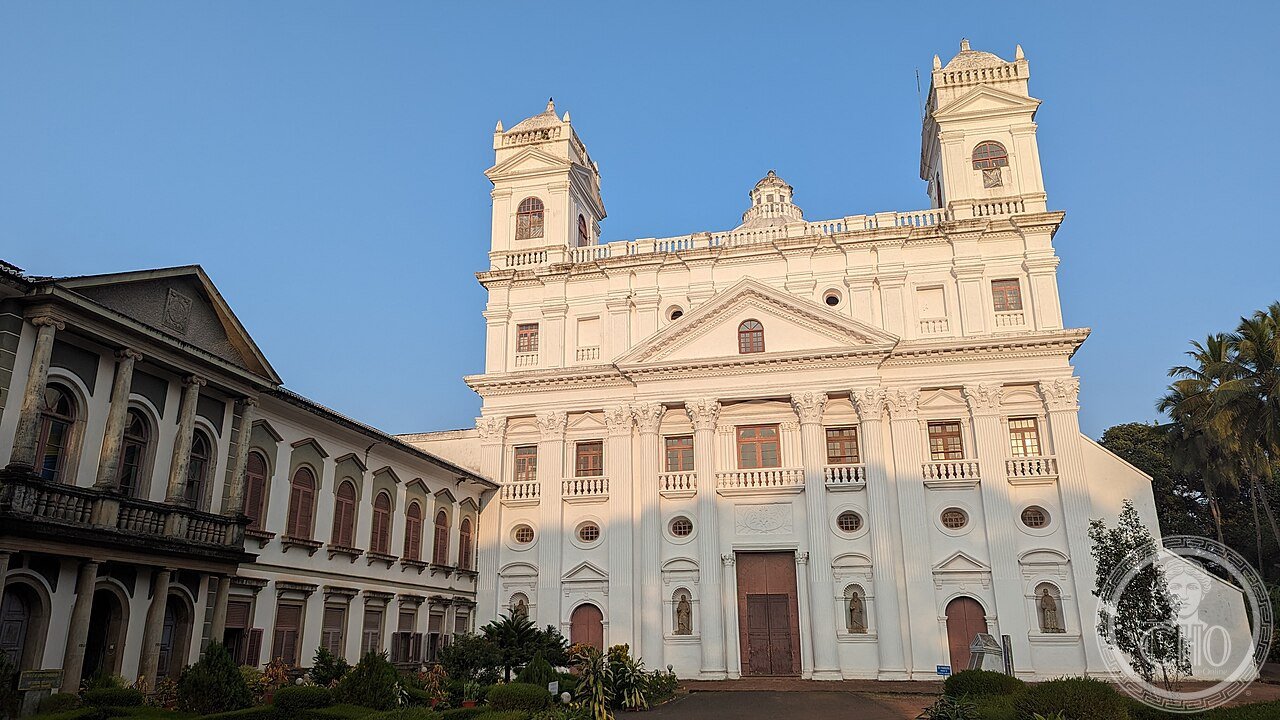
The chapel of St Cajetan, in Old Goa, India, was built by three Italian friars of the Theatine order. They arrived in Goa between 1639 and 1640, hoping to establish a mission in the sultanate of Golconda, an aim that never came about, and under the leadership of Pietro di Avitabili, who secured the support of King John IV of Portugal, they settled in Goa instead. The king approved a hospital in 1650 and the church itself in 1655. The work, directed by the Italian architects Carlo Ferrarini and Francesco Maria Milazzo, was completed in 1661. Built on a Greek-cross plan, the church is one of the few domed churches in Goa, the inside of its dome decorated with Latin inscriptions drawn from the Gospel of Matthew. The Corinthian façade carries four granite statues of Saints Peter, Paul, John the Evangelist and Matthew. Popular tradition holds that the church was modelled on the Basilica of St Peter in Rome, although some travellers of the time argued instead for a different model, the Theatine church of Sant’Andrea della Valle in Rome, a question that remains disputed among historians. Beneath the dome, on a raised square platform, stands a covered well, whose presence has fed the belief, never confirmed archaeologically, that the church stands on the site of an earlier Hindu temple linked to the Kadamba dynasty and to the pre-Portuguese town of Ela. Since 1986 the chapel has been part, along with six other monuments, of the UNESCO World Heritage site «Churches and Convents of Goa».
About the Chapel of St. Cajetan
The Chapel of St. Cajetan, in Old Goa, India, was built by three Italian friars of the Theatine order, who arrived in Goa around 1639-1640 hoping to establish a mission in the Golconda Sultanate, an ambition that never materialised; under the leadership of Pietro di Avitabili, who secured the support of King John IV of Portugal, the friars settled in Goa instead. The king approved a hospital in 1650 and the church itself in 1655, with construction, directed by the Italian architects Carlo Ferrarini and Francesco Maria Milazzo, completed in 1661. Built on a Greek-cross plan, the church is one of the few domed churches in Goa, its dome interior decorated with Latin inscriptions drawn from the Gospel of Matthew, while the Corinthian-style facade displays four granite statues of Saints Peter, Paul, John the Evangelist and Matthew. Popular tradition holds that the church was modelled on St. Peter’s Basilica in Rome, though some contemporary travellers argued instead that its true model was Sant’Andrea della Valle, the Theatine order’s own church in Rome — a question that remains genuinely disputed among historians rather than settled. Beneath the dome, on a raised square platform, stands a covered well, whose presence has fuelled the belief, never archaeologically confirmed, that the church occupies the site of an earlier Hindu temple connected to the Kadamba dynasty and the pre-Portuguese settlement of Ela. Since 1986, the chapel has formed part, alongside six other monuments, of the UNESCO World Heritage Site “Churches and Convents of Goa,” and it remains an active parish church today.
Key facts
- 1639/40: Italian Theatine friars arrive in Goa, their intended Golconda mission never established.
- 1655-1661: construction under architects Carlo Ferrarini and Francesco Maria Milazzo.
- Greek-cross plan with dome, one of the few domed churches in Goa.
- Popularly said to model St. Peter’s Basilica, though some sources cite Sant’Andrea della Valle instead.
- Covered well beneath the dome, linked by tradition to an earlier Hindu temple site.
- 1986: becomes part of the UNESCO World Heritage Site “Churches and Convents of Goa”
History
The Chapel of St. Cajetan’s origins in a failed missionary ambition, redirected into the construction of a permanent church in Goa, reflects the broader pattern of European religious orders adapting their objectives to the realities of colonial-era Asia. The unresolved question of the church’s architectural inspiration, along with the enduring local tradition linking its well to a pre-Portuguese Hindu temple, gives the building a layered, still-debated history that extends well beyond its documented 17th-century construction.
What you see
The church’s Corinthian facade, fronted by granite statues of four saints, opens onto a Greek-cross interior crowned by one of Goa’s few church domes, its interior inscribed with Latin verses from the Gospel of Matthew. Beneath the dome, a covered well set on a raised platform draws particular attention from visitors, its presence at the heart of the church’s ongoing historical mystery.
Practical information
- Opening hours: generally open daily with seasonal variation; free admission; check current hours before visiting.
- Address: Old Goa, Goa, India.
Getting there
The Chapel of St. Cajetan stands in Old Goa, close to Se Cathedral, a short drive from the state capital Panaji. GPS: 15.5057° N, 73.9153° E.
Nearby
- Se Cathedral — the largest church in Asia, a short walk away.
- Basilica of Bom Jesus — holding the remains of Saint Francis Xavier, nearby.
- Panaji — the Goan state capital, a short drive away.
Sources
- Wikipedia — “St. Cajetan Church” (en.wikipedia.org).
- UNESCO World Heritage Centre — “Churches and Convents of Goa” (whc.unesco.org).
- The Goan — “St Cajetan Church at Old Goa, Italian architectural wonder” (thegoan.net).
Find it on the map
See this place and what’s around it →📷 Become a Cultural Heritage Online photographer
Share your photos of places: they stay published under your name as the author. The more they're seen, the more you get noticed — and soon a contest will reward the most appreciated photos.
Log in or sign up free to add a photo