

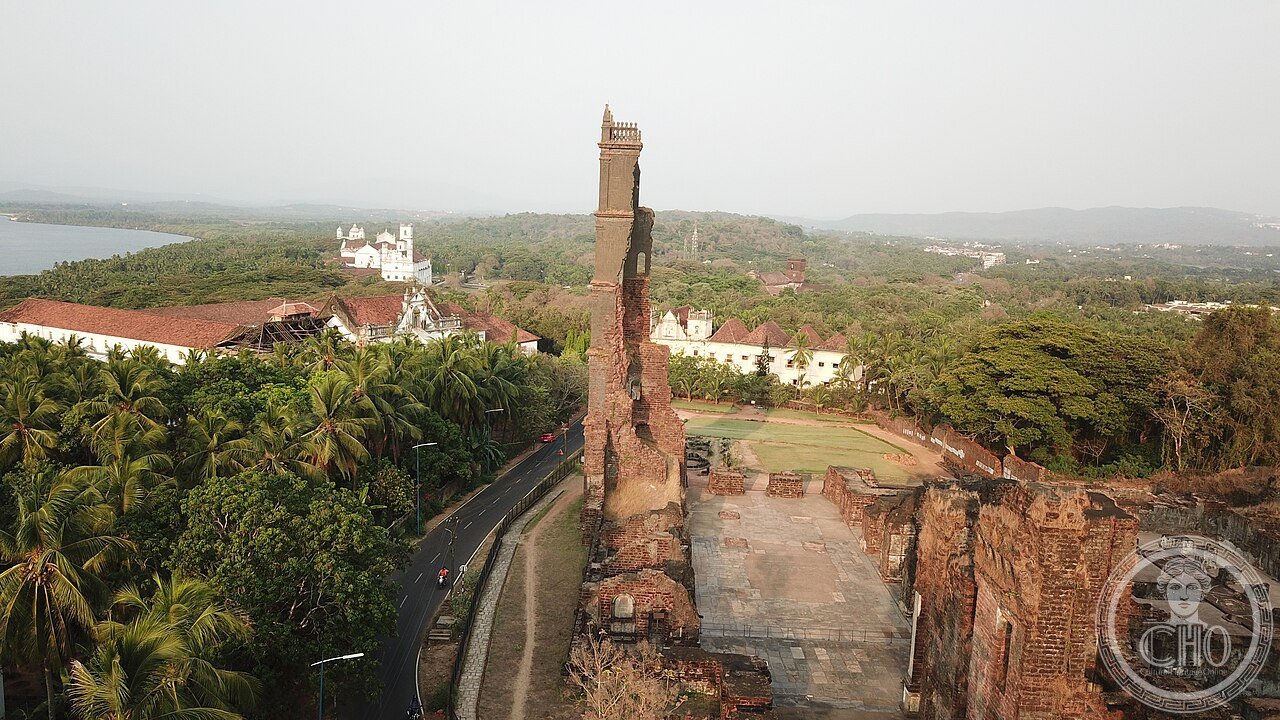
At Old Goa, in India, the Augustinian friars, who arrived in 1587, built between 1597 and 1602 a monumental church, counted among the three great Augustinian churches of the Iberian world together with the Escorial in Spain and the monastery of São Vicente de Fora in Lisbon: eight chapels, four altars, a convent and four towers made up the original complex. In 1835 the Portuguese colonial government suppressed the religious orders in Goa, and the Augustinian order was forced to abandon the building, which was progressively left to decay. The vault collapsed in 1842, and the facade and towers largely fell in 1931, with further collapses in the years that followed. Today only one of the four original towers survives, 46 metres high, whose bell was moved in 1871 to the church of Our Lady of the Immaculate Conception at Panjim, where it still hangs — a story separate from that of the famous “Golden Bell” of the Sé Cathedral, with which it has no documented connection. Between the late 1980s and 2005, archaeological excavation on the site led to the finding of bone fragments later identified by DNA analysis as probably belonging to Saint Ketevan, a Georgian queen martyred in the seventeenth century. Since 1986 the ruins have formed part, with six other monuments, of the UNESCO World Heritage “Churches and Convents of Goa”.
About the Ruins of the Church of St. Augustine
The Ruins of the Church of St. Augustine, in Old Goa, India, mark the site of a monumental church built by Augustinian friars, who arrived in Goa in 1587, with construction running from 1597 to 1602. The completed complex ranked among the three great Augustinian churches of the Iberian world, alongside El Escorial in Spain and the Monastery of São Vicente de Fora in Lisbon, and comprised eight chapels, four altars, an attached convent, and four towers. In 1835, the Portuguese colonial government suppressed religious orders across Goa, forcing the Augustinians to abandon the church, which was left to decay; its vault collapsed in 1842, and the facade and most of its remaining towers came down largely in 1931, with further collapses in the years that followed. Today, only one of the original four towers survives, rising 46 metres above the ruined complex; its bell was relocated in 1871 to the Church of Our Lady of the Immaculate Conception in Panjim (modern Panaji), where it remains today — a distinct story from the celebrated “Golden Bell” of Se Cathedral, with which it shares no documented connection. Between the late 1980s and 2005, archaeological excavations at the site recovered bone fragments later identified through DNA analysis as likely belonging to Saint Ketevan, a Georgian queen martyred in the 17th century, adding an unexpected chapter to the ruins’ history. Since 1986, the site has formed part, alongside six other monuments, of the UNESCO World Heritage Site “Churches and Convents of Goa,” preserved today as a stabilised ruin under the Archaeological Survey of India rather than an active place of worship.
Key facts
- 1597-1602: construction by Augustinian friars
- 1835: Portuguese suppression of religious orders forces the Augustinians to abandon the church
- 1842: the church vault collapses
- 1931 and after: the facade and most of the remaining towers collapse
- 46-metre surviving tower, the only one of four original towers still standing
- Bone fragments identified as Saint Ketevan of Georgia recovered in excavations between the late 1980s and 2005
- 1986: the ruins become part of the UNESCO World Heritage Site “Churches and Convents of Goa”
History
The Church of St. Augustine’s transformation from one of the grandest Augustinian churches in the Iberian colonial world into a dramatic, tower-dominated ruin traces the broader institutional decline that followed the 1835 Portuguese suppression of religious orders across Goa, a policy that emptied and abandoned several of Old Goa’s major religious complexes within a single generation. The later archaeological discovery of remains identified with Saint Ketevan, a Georgian queen martyred far from Goa, added an unexpected international dimension to the site’s history, connecting the ruins to the Caucasus through relics whose journey remains only partially understood.
What you see
The single surviving 46-metre laterite tower dominates the site, rising above scattered foundations, archways and wall fragments that hint at the scale of the original eight-chapel, four-altar church and its attached convent. The ruins today form one of Old Goa’s most photographed heritage sites, their stabilised but visibly decayed state offering a striking contrast to the intact, actively used churches nearby.
Practical information
- Opening hours: generally open daily with seasonal variation; free admission; check current access before visiting
- Address: Old Goa, Goa, India
Getting there
The Ruins of the Church of St. Augustine stand in Old Goa, near the Convent of Santa Monica, a short drive from the state capital Panaji. GPS: 15.5004° N, 73.9066° E.
Nearby
- Convent of Santa Monica — dedicated to Saint Monica, mother of Saint Augustine, nearby
- Se Cathedral — the largest church in Asia, a short walk away
- Basilica of Bom Jesus — holding the remains of Saint Francis Xavier, nearby
Sources
- Wikipedia — “Church of St. Augustine, Goa” (en.wikipedia.org)
- UNESCO World Heritage Centre — “Churches and Convents of Goa” (whc.unesco.org)
- Goa Tourism Development Corporation — “Ruins of the Church of St. Augustine” (goa-tourism.com)
Find it on the map
See this place and what’s around it →📷 Become a Cultural Heritage Online photographer
Share your photos of places: they stay published under your name as the author. The more they're seen, the more you get noticed — and soon a contest will reward the most appreciated photos.
Log in or sign up free to add a photo