

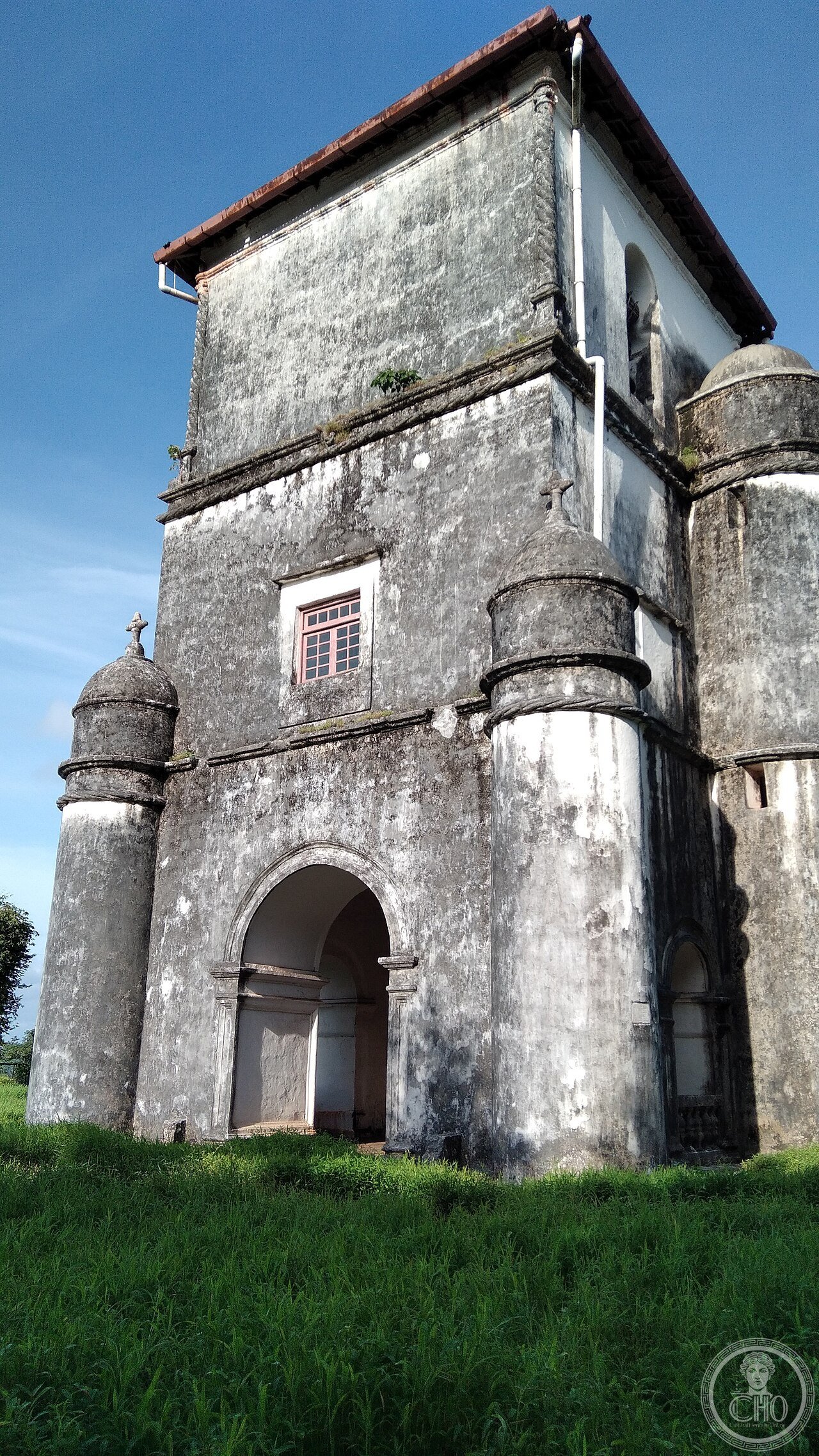
On Monte Santo, at Old Goa, the church of Our Lady of the Rosary is held to be the oldest religious building still standing in the whole of Old Goa. Its origins go back to a small chapel commissioned by Afonso de Albuquerque on the very spot where he stood when he received confirmation of the conquest of Goa, in 1510, the work of the master builder Antão Nogueira de Brito. About thirty years later that chapel was replaced by the present parish church, built between 1543/44 and 1547 in Portuguese Gothic style with Manueline elements. It is of granite, with a cross plan and the features of a «fortress church»: a façade on three levels with a portico on two floors, cylindrical towers crowned by cupolas and high windows set near the roof. Unlike the later Baroque churches of Old Goa, such as the Basilica of Bom Jesus or the Sé cathedral, this one keeps a plainer character, distinctly of the Renaissance. Inside is the tomb of Governor Garcia de Sá, who died in 1549, with the tombstone of his wife, Dona Catarina, set in the apse above it. From its high position the church looks out over the old city and the river Mandovi. Since 1986 it has formed part, together with six other monuments, of the UNESCO World Heritage Site «Churches and Convents of Goa».
About the Church of Our Lady of the Rosary
The Church of Our Lady of the Rosary, standing on Monte Santo (Holy Hill) in Old Goa, India, is widely regarded as the oldest surviving religious structure anywhere in Old Goa. Its origins trace back to a small chapel commissioned by Afonso de Albuquerque on the very spot where he stood when he received confirmation of the conquest of Goa in 1510, built by the master-builder Antão Nogueira de Brito. Roughly three decades later, that original chapel was replaced by the present parish church, constructed between 1543/44 and 1547 in Portuguese Gothic style with Manueline elements, built of granite in a cruciform “fortress church” plan, with a three-tiered facade fronted by a two-storey portico, cylindrical buttress towers crowned with cupolas, and high windows set near the roofline. Unlike the later Baroque churches that came to define Old Goa’s religious architecture, such as the Basilica of Bom Jesus or Se Cathedral, this church retains a comparatively austere, distinctly Renaissance-era character. Inside, the tomb of Governor Garcia de Sá, who died in 1549, lies within the church, with the tombstone of his wife, Dona Catarina, set in the apse above it. From its elevated position, the church commands views over Old Goa and the Mandovi River, a vantage that underscored its historical significance as a lookout point during the Portuguese conquest and early colonial period. Since 1986, the church has formed part, alongside six other monuments, of the UNESCO World Heritage Site “Churches and Convents of Goa.”
Key facts
- 1510: Afonso de Albuquerque commissions a chapel on this spot after the conquest of Goa.
- 1543/44-1547: construction of the present church, replacing the original chapel.
- Oldest surviving church structure in Old Goa.
- Portuguese Gothic with Manueline elements, built of granite in a fortress-church plan.
- Burial of Governor Garcia de Sá (d. 1549) and his wife Dona Catarina.
- 1986: becomes part of the UNESCO World Heritage Site “Churches and Convents of Goa”
History
The Church of Our Lady of the Rosary’s origin in a votive chapel built at the moment of Portuguese conquest ties the building directly to the founding act of Portuguese Goa itself, making it, as the oldest surviving church structure in Old Goa, a physical link to the city’s earliest colonial identity. Its comparatively austere Renaissance-Gothic architecture, standing in deliberate contrast to the later ornamental extravagance of Old Goa’s Baroque churches, offers visitors a rare glimpse of how the city’s religious buildings appeared before the wealth of the 16th- and 17th-century colonial economy transformed local church design.
What you see
The church’s granite facade rises in three tiers above a two-storey portico, flanked by cylindrical buttress towers topped with cupolas, its high roofline windows and cruciform “fortress church” plan reflecting early 16th-century Portuguese colonial architectural conventions. Inside, the tomb of Governor Garcia de Sá and the tombstone of his wife Dona Catarina occupy the apse, beneath a comparatively unadorned interior that contrasts sharply with the gilded excess of Old Goa’s later churches.
Practical information
- Opening hours: generally accessible daily with seasonal variation as a protected monument; check current access before visiting.
- Address: Monte Santo, Old Goa, Goa, India.
Getting there
The Church of Our Lady of the Rosary stands on Monte Santo hill in Old Goa, a short walk from Se Cathedral, reachable by car or taxi from Panaji. GPS: 15.4229° N, 73.7713° E.
Nearby
- Se Cathedral — the largest church in Asia, a short walk downhill.
- Basilica of Bom Jesus — holding the remains of Saint Francis Xavier, nearby.
- Mandovi River — visible from the church’s hilltop position.
Sources
- Wikipedia — “Church of Our Lady of the Rosary (Goa)” (en.wikipedia.org).
- Heritage Portal India Portal (HPIP) — “Church of Our Lady Of Rosary” (hpip.org).
- Wikipedia — “Churches and convents of Goa” (en.wikipedia.org).
Find it on the map
See this place and what’s around it →📷 Become a Cultural Heritage Online photographer
Share your photos of places: they stay published under your name as the author. The more they're seen, the more you get noticed — and soon a contest will reward the most appreciated photos.
Log in or sign up free to add a photo