
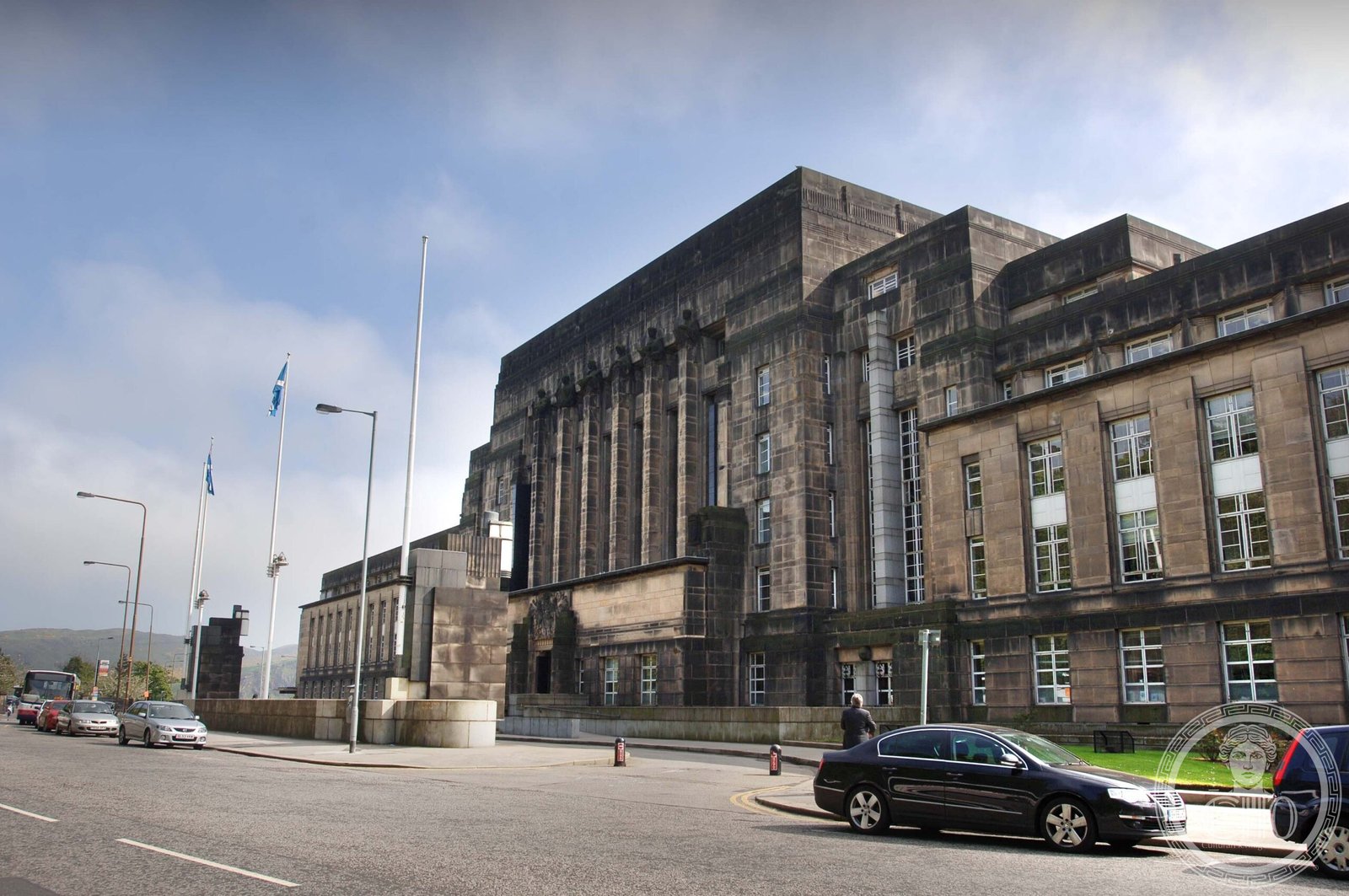
Carved into the southern face of Calton Hill and opened the day after Britain declared war on Germany, St Andrew’s House is perhaps the most dramatically sited government building in the United Kingdom. Designed by Thomas S. Tait of Burnet, Tait & Lorne and completed in 1939, it was the administrative headquarters of the Scottish Office — and later of the Scottish Government — for decades. On its north face toward Regent Road, the building presents a monolithic cliff of buff sandstone and metal-framed windows, restrained and authoritative. Turn to the south side, and the same building breaks into a more irregular, romantic silhouette against the volcanic rock of the hill. When it was completed, it was the largest metal-framed building in Europe. Sculptural reliefs by Sir William Reid Dick, Alexander Carrick, and three other artists animate the facades with allegorical figures of Scottish life, industry, and governance, making the building as much a civic artwork as a seat of power.
At a glance
- Type
- Government office building
- Period
- 1935–1939
- Style
- Art Deco / Scottish Classicism
- Location
- 2 Regent Road, Edinburgh EH1 3DG, United Kingdom
- Coordinates
- 55.9534° N, 3.1841° W
- Architect(s)
- Thomas S. Tait (Burnet, Tait & Lorne)
Overview
St Andrew’s House stands on the southern slopes of Calton Hill, the volcanic prominence that gives Edinburgh much of its dramatic skyline. The building served for decades as the Edinburgh headquarters of the Scottish Office, the arm of the British government responsible for Scottish affairs, and today houses departments of the Scottish Government. Category A listed — Scotland’s highest heritage designation — it is regarded as one of the finest examples of Art Deco civic architecture in Britain. The building accommodates approximately 1,400 civil servants across eight floors, and its sculptural programme by five leading artists of the period makes it an exceptional example of integrated public art in architecture.
History
Construction began in November 1935 on the site of the former Calton Jail, whose walls were demolished to make way for the new building. Thomas Tait’s design was chosen for its ability to sit dramatically within the Calton Hill escarpment rather than impose upon it. Work was completed in September 1939, and the building opened on 4 September — the day after Britain declared war on Germany. King George VI and Queen Elizabeth formally opened it on 26 February 1940. The building housed the Scottish Office through the entire post-war period, and after Scottish devolution in 1999 it became the operational base for the new Scottish Executive, later renamed the Scottish Government. A major refurbishment in 2001 modernised its interiors while preserving its listed fabric.
Architecture & Design
Tait’s design is a study in architectural duality. The north facade on Regent Road is a controlled composition of vertical bays, horizontal bands of buff sandstone, and metal-framed windows — monolithic, symmetrical, and restrained in the Art Deco tradition. The south facade, carved into the volcanic rock of Calton Hill, is irregular and romantic, responding to topography rather than imposing upon it. The structural innovation — at completion the largest metal-framed building in Europe — allowed generous interior spans and flexible office planning. Five sculptors contributed decorative reliefs: Sir William Reid Dick, Alexander Carrick, Phyllis Bone, Walter Gilbert, and Thomas Hadden, whose work represents agriculture, industry, justice, education, and civic life.
Cultural significance
St Andrew’s House embodies a particular moment in Scottish civic identity — the ambition of the 1930s to give Scotland’s administrative governance a physical presence equal in quality to anything in Westminster. Its opening on the first day of the Second World War gives it a charged historical resonance. For architectural scholars, it represents the successful fusion of continental Art Deco with a distinctively Scottish sensibility in both material and topographic integration. The building has come to symbolise the continuity of Scottish governmental identity from the Union through the post-devolution era.
Visiting today
St Andrew’s House is a working government building and is not open for general public visits. The exterior, however, is fully accessible and the sculptural reliefs on the facades can be examined at close range from Regent Road. The building’s dramatic relationship with Calton Hill makes it a compelling subject for architectural photography, particularly from the Nelson Monument above or from the Waverley Valley below.
Getting there
St Andrew’s House stands on Regent Road, a short walk east of Princes Street. Edinburgh Waverley mainline railway station is five minutes on foot via the steps descending from Calton Hill. The Edinburgh Trams stop at St Andrew Square, about ten minutes’ walk. Multiple bus routes on Princes Street and the Royal Mile serve the area. The building is directly on the route between the Old Town and Calton Hill.
Sources & resources
Find it on the map
See this place and what’s around it →Record researched and written by Luigi De Marchi for Cultural Heritage Online, 2026.
📷 Become a Cultural Heritage Online photographer
Share your photos of places: they stay published under your name as the author. The more they're seen, the more you get noticed — and soon a contest will reward the most appreciated photos.
Log in or sign up free to add a photoIs this page about you?
This page is read by travellers and heritage enthusiasts who find it on Google. Tell us how you are connected to this place and we will take it from there.