
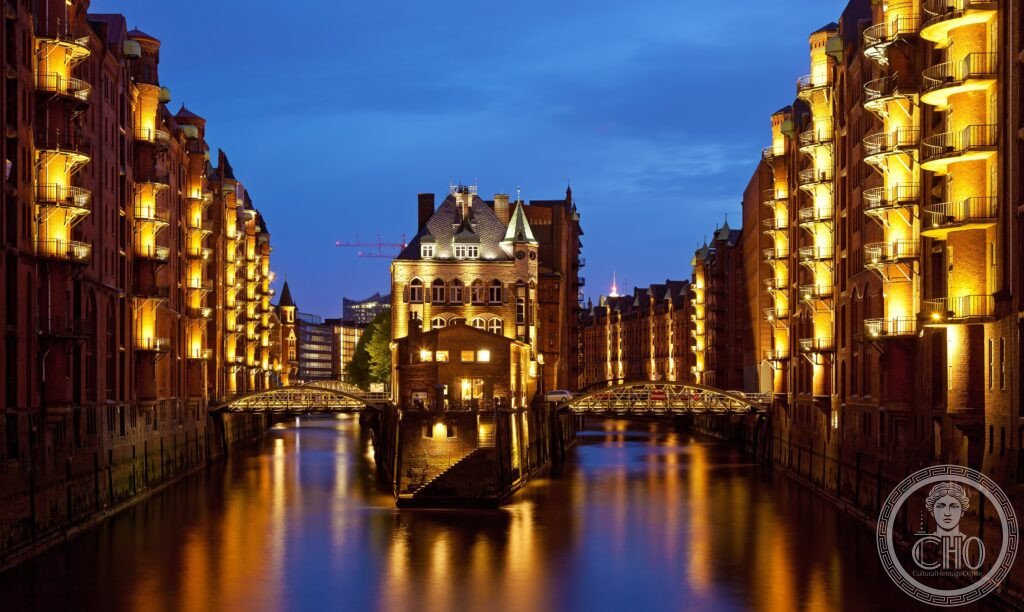
The Speicherstadt is the largest coherent warehouse complex ever built, its red-brick blocks rising six storeys above narrow canals on foundations of timber piles driven into the Elbe estuary silt. Together with the neighbouring Kontorhaus district, where the ship-shaped Chilehaus stands in Expressionist brick, it was inscribed as a UNESCO World Heritage Site in 2015 and is now largely given over to museums.
At a glance
The Speicherstadt is Hamburg’s historic warehouse district, a run of Neo-Gothic and Neo-Renaissance brick buildings lining the Fleets, the narrow canals that thread through the former Kehrwiederhalbinsel island. Each warehouse carries the characteristic timber-framed loading doors on every floor, through which goods were once hoisted by rope and pulley directly from barges below. Cast-iron railings and ornamental gables show that the complex was built to impress as well as to function.
Immediately to the east lies the Kontorhaus district, a quarter of early twentieth-century office buildings inscribed together with the Speicherstadt in 2015, and beyond that the glass and steel of the contemporary HafenCity development, giving the area a visible layering of Hamburg’s commercial history.
Key facts
- Status: UNESCO World Heritage Site, inscribed 2015, covering both the Speicherstadt and the Kontorhaus district.
- Construction: built in three phases between 1883 and 1927 by the Free and Hanseatic City of Hamburg.
- Scale: around 1.6 km long, with some 300,000 m² of floor space, making it the largest warehouse complex of its kind when completed.
- Foundations: the entire complex rests on some 480,000 timber piles, each 8 to 12 metres long, kept permanently waterlogged and so free from rot.
- Original use: storage of non-refrigerated bulk goods, especially Persian and Oriental carpets, coffee, cocoa, tea, tobacco and spices, handled through the three Kaiserspeicher warehouses.
- Present use: since Hamburg joined the EU customs union in 1988 the warehouses have been converted into one of Europe’s densest concentrations of museums.
History
The Speicherstadt exists because of Hamburg’s long resistance to joining the German Customs Union, or Zollverein, after national unification in 1871. Membership would have meant imposing duties on trade that had made the city prosperous. When Hamburg finally joined, the compromise was the creation of a free-port enclave within the city where goods could be stored, processed and re-exported without customs duty, and the Speicherstadt was built as the infrastructure for that enclave.
The site chosen was the Kehrwiederhalbinsel, a densely inhabited island known as the Gängeviertel, home to roughly 15,000 warehouse workers and dockers. The residents were evicted without compensation to clear the ground, one of the more significant forced displacements in nineteenth-century German history, and the episode is recorded in contemporary drawings and photographs. A cholera epidemic that killed several thousand Hamburgers shortly afterwards was taken at the time as vindication of the decision to replace the old medieval quarter with modern warehouse infrastructure.
What you see
The classic view of the district is from the Poggenmühlenbrücke over the Brooksfleet canal, where the red-brick facades sit reflected in the still water, a scene best seen at dawn or sunset when the light is warm. Walking the quaysides brings the visitor close to the loading doors on each floor of the warehouses, some still fitted with their original hemp-rope pulleys and cargo hooks. At the western end of the district, the Störtebeker brewery, named after the Hamburg pirate Klaus Störtebeker, has a rooftop terrace looking out over the Elbe.
Moving east from the Speicherstadt leads into HafenCity, one of the largest inner-city redevelopment projects in Europe, built on former port land since 2003. Its anchor building is the Elbphilharmonie, the Hamburg Philharmonic concert hall designed by Herzog & de Meuron, constructed on top of a 1960s concrete warehouse and completed after building work that ran from 2007 to 2016.
Practical information
- Access: the Speicherstadt itself is free to walk through; individual museums, including the Miniatur Wunderland, the Hamburg Dungeon, the Spice Museum, the Carpet Museum and the International Maritime Museum, charge separate admission.
- Booking: the Miniatur Wunderland is Hamburg’s busiest single attraction and advance booking through its official website is strongly advised, particularly in the warmer months.
- Transport within the city: the U3 or U4 U-Bahn lines run from Hamburg Hauptbahnhof to Baumwall station, close to the district; it is also a walkable route through the city centre.
Getting there
Hamburg is served by its own airport and by direct ICE rail connections to major German and neighbouring European cities, arriving at Hamburg Hauptbahnhof. From there the Speicherstadt lies a short distance to the southwest, reachable on foot through the city centre or by U-Bahn to Baumwall station.
Nearby
- Elbphilharmonie — about 500 m east; the Hamburg Philharmonic concert hall by Herzog & de Meuron, with a free public viewing platform at 37 metres and a 2,100-seat Grand Hall built in vineyard-style seating around the orchestra.
- Chilehaus — about 1 km northeast; Fritz Höger’s 1924 office building for shipping magnate Henry Sloman, its acute eastern corner shaped like a ship’s prow, and the defining work of Hamburg’s Expressionist brick architecture; the courtyard is free to enter.
Sources
- UNESCO World Heritage List.
- Miniatur Wunderland (official site).
Find it on the map
See this place and what’s around it →📷 Become a Cultural Heritage Online photographer
Share your photos of places: they stay published under your name as the author. The more they're seen, the more you get noticed — and soon a contest will reward the most appreciated photos.
Log in or sign up free to add a photo