
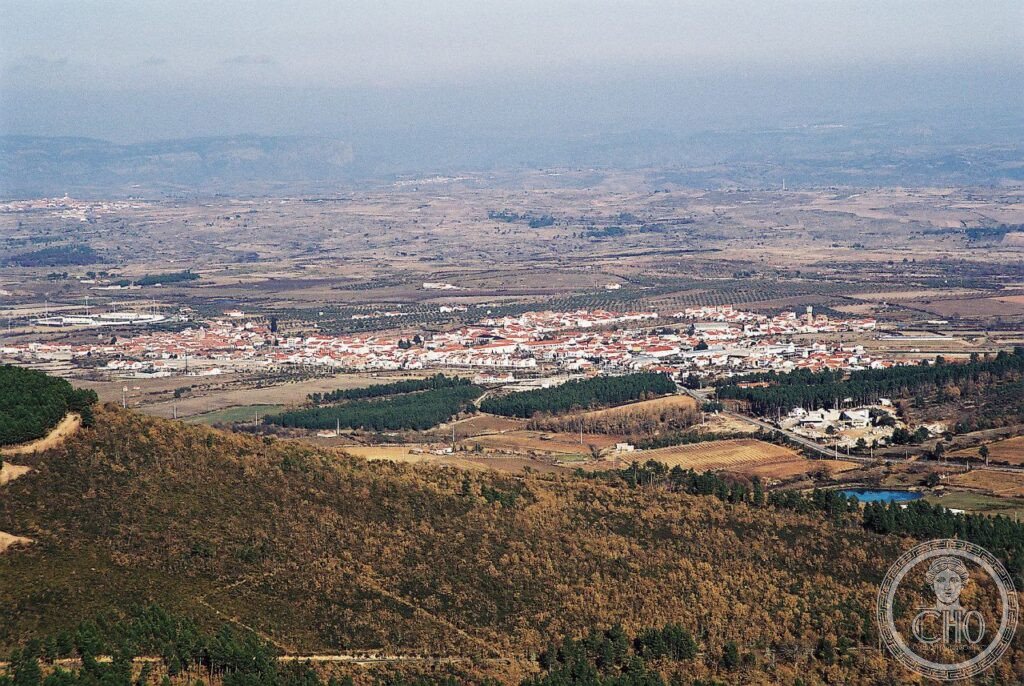
Along a gorge of the Côa River, thousands of animal figures are cut into dark schist cliffs, dating back to the last Ice Age. The valley was due to disappear under a hydroelectric reservoir until construction workers found the engravings in 1992, setting off a national controversy that ended with the dam cancelled and the art preserved in the open air.
At a glance
The Côa Valley runs through the Douro Superior region of northeastern Portugal, its schist cliffs rising from a narrow river gorge near the confluence of the Côa and the Douro. Along roughly 17 kilometres of the main valley and three side valleys, Paleolithic hunter-gatherers incised lines into the dark rock to depict aurochs, ibex, horses and deer, using direct and indirect percussion with flint tools. The cuts are shallow, often only a few millimetres deep, and are all but invisible in overhead light; they become legible only when the sun is low, in early morning or late afternoon, or under raking artificial light.
Key facts
- Location: Vila Nova de Foz Côa, Beira Interior Norte, Portugal
- Date of the art: approximately 22,000–10,000 BCE, spanning the Gravettian, Solutrean and Magdalenian periods
- Extent: around 900 engraved panels across some 17 kilometres of the Côa valley and its tributaries
- Subjects: aurochs, ibex, horses and deer, engraved rather than painted
- Dating methods: optically stimulated luminescence, AMS radiocarbon analysis of associated sediments, and stylistic comparison
- Status: inscribed on the UNESCO World Heritage List in 1998, extended in 2010 to include Siega Verde in Spain
History
The engravings were made by Ice Age communities living in the Douro basin around 20,000 to 12,000 years ago, when the Iberian Peninsula was a cold, dry steppe rather than an ice sheet, home to woolly mammoth, woolly rhinoceros, cave lion and cave bear alongside the aurochs, ibex, horse and deer still visible on the rock. What the images meant to the people who made them is not known; no accompanying text survives, and the leading interpretation links the art to hunting, territorial marking, social memory or ritual life, without certainty.
In 1992 the Portuguese utility EDP began building a hydroelectric dam at Foz Côa that would have flooded the valley and submerged the engravings under many metres of water. Construction workers uncovered the rock art that November. EDP initially argued the engravings were modern, but the archaeologist João Zilhão led a campaign for their recognition as genuinely Paleolithic, later confirmed by independent dating methods. The dispute became a defining issue in the 1995 general election; the Socialist Party, campaigning to cancel the dam, won, and the project was abandoned. The valley was declared a national monument and, in 1998, inscribed on the UNESCO World Heritage List. The dam was never built, and the episode is remembered as one of the clearest instances of heritage prevailing over a development scheme in European history.
What you see
Visits are organised through the Museu do Côa in Vila Nova de Foz Côa, the only museum dedicated specifically to open-air Paleolithic rock art. Its displays explain the dating and interpretation of the engravings, include full-scale cast reproductions of key panels, and offer digital viewing stations with oblique-light photography that make the incisions readable to visitors who cannot see the originals in ideal light.
Guided tours run to three main sites. Canada do Inferno, the most accessible, is reached by a jeep track along the river gorge, with panels visible at water level. Penascosa lies in a different section of the valley, and Piscos, the most remote of the three, holds the greatest concentration of horse figures. Each visit is conducted outdoors, on rough tracks, with the engravings appearing only under the right angle of light.
Practical information
- Access: all visits to the engraved panels are by guided tour only, booked through the Museu do Côa or its official online booking channel
- Management: the site and museum are run by Fundação Côa Parque
- Best conditions: early morning or late afternoon light makes the engravings easiest to see
- What to bring: sturdy footwear, as the tours involve walking on uneven outdoor tracks
Getting there
Vila Nova de Foz Côa lies in the Douro Superior region of northeastern Portugal. The nearest airport is Francisco Sá Carneiro Airport in Porto, from where the route runs via the A4 motorway and the IP2 through the terraced vineyards of the Douro. There is no direct rail line to Foz Côa itself; the nearest station is Pocinho, a short distance to the south, served by the scenic Douro line train from Porto.
Nearby
- Douro Wine Region — the demarcated wine region begins a short drive west, with terraced vineyards and historic Port wine estates along the river, some offering tastings and cellar visits
- Siega Verde, Spain — across the border in Salamanca Province, the Spanish half of the joint World Heritage inscription, with around 540 engraved panels along the Águeda River, visited by guided tour from the interpretation centre at Serranillo
Sources
- Wikipedia, Côa Valley Paleolithic Art
- UNESCO, Prehistoric Rock Art Sites in the Côa Valley and Siega Verde (WHS reference 866)
Find it on the map
See this place and what’s around it →📷 Become a Cultural Heritage Online photographer
Share your photos of places: they stay published under your name as the author. The more they're seen, the more you get noticed — and soon a contest will reward the most appreciated photos.
Log in or sign up free to add a photo