
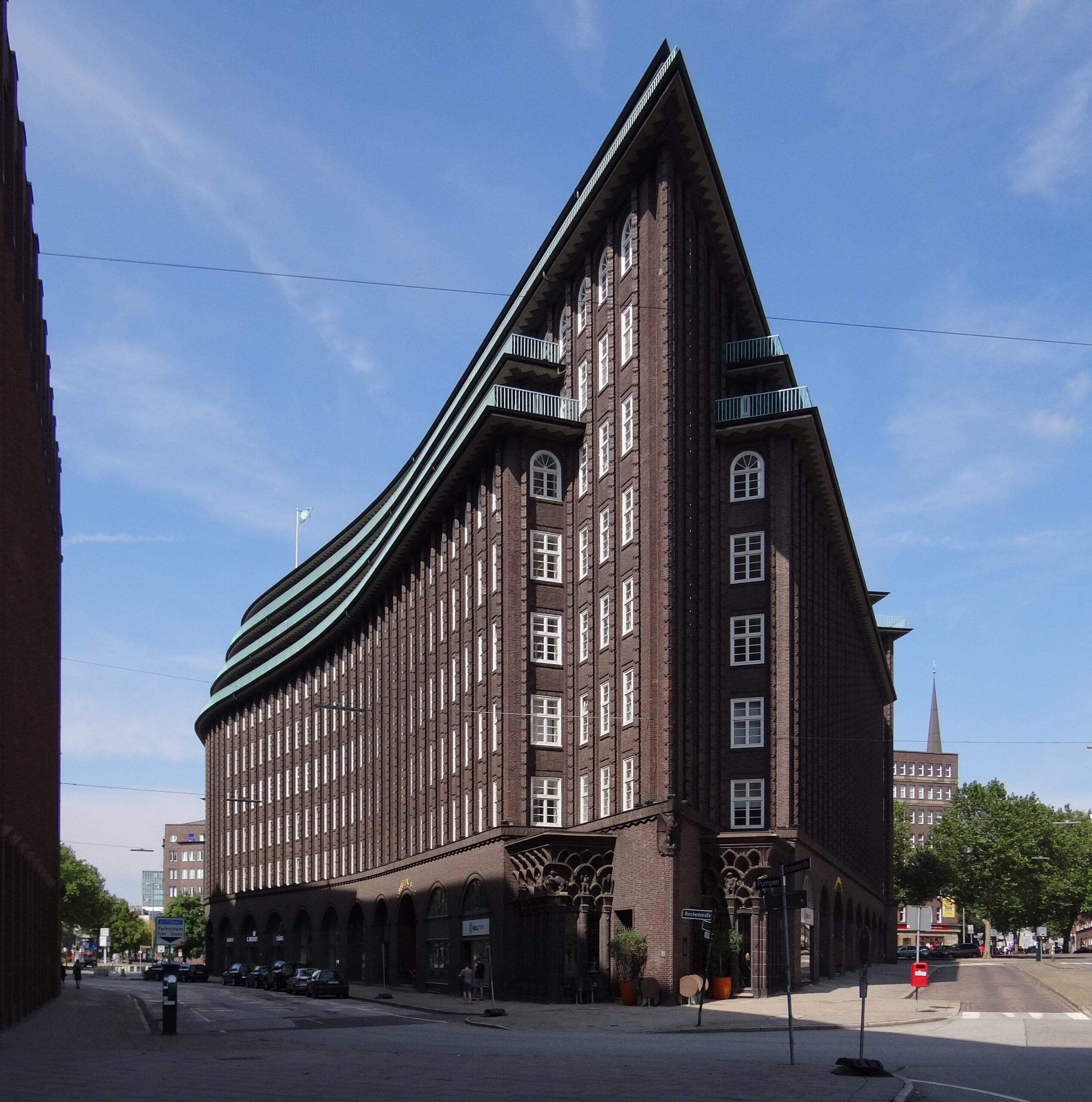
The Speicherstadt is the world’s largest warehouse district, a kilometre-long arc of seven-story red-brick neo-Gothic storehouses built on 300,000 oak piles in Hamburg harbour — adjacent to the Kontorhaus District, where Fritz Höger’s ship-prow Chilehaus is the masterpiece of German Brick Expressionism.
At a glance
The UNESCO World Heritage inscription of 2015 encompassed two adjacent areas in Hamburg’s historic port zone that together represent the high point of late 19th and early 20th-century commercial architecture. The Speicherstadt (City of Warehouses) — built 1883–1927 on a series of artificial islands in the Inner Harbour — is the world’s largest warehouse complex still in its original form. The seven-storey red-brick storehouses, their facades articulated with neo-Gothic pointed gable ends and cast-iron hoisting equipment, were the logistical heart of Hamburg’s position as the clearing house for global trade. Adjacent to it, the Kontorhaus District (office building district) contains four exceptional commercial buildings from the 1920s–30s, of which the Chilehaus (1922–24) by Fritz Höger is the undisputed masterpiece of German Brick Expressionism — a 10-storey building whose east facade tapers to a razor-sharp ship’s prow at the street corner.
Key facts
- UNESCO inscription: 2015, criteria (iv) and (vi)
- Speicherstadt built: 1883–1927 (demolished 24,000 residents to build customs-free zone)
- Construction: 300,000 oak piles driven into the harbour bed; 7-storey red-brick warehouses
- Commodities stored: Coffee, tea, cocoa, tobacco, carpets, spices, oriental rugs
- Kontorhaus District: 1920–1940; four office buildings, including Chilehaus and Sprinkenhof
- Chilehaus architect: Fritz Höger (1877–1949); built 1922–24
- Chilehaus height: 10 storeys, 58,000 m² office space; named after client’s Chile trade wealth
- Current use: Speicherstadt now hosts museums, design studios, restaurants; Kontorhaus remains offices
History
Hamburg in the 1880s was one of the great trading cities of the world — a free city whose harbour processed goods from five continents. But the German Empire’s new customs union threatened Hamburg’s position: goods could no longer be unloaded, sorted, and re-exported in the city without passing through German customs. Hamburg’s city fathers negotiated a compromise: a Freihafengebiet — a customs-free zone — within the inner harbour, where goods could be held and traded without tariff. To build this zone, an entire residential and commercial district of 24,000 people was cleared between 1883 and 1888.
The construction of the Speicherstadt was one of the largest urban engineering projects of the 19th century. The soft harbour mud was unsuitable for foundations, so the entire district was built on a forest of oak piles driven into the riverbed — approximately 300,000 piles supporting the warehouses above water level on artificial islands bisected by a network of canals. The architectural style chosen was a monumental neo-Gothic, in red brick with pointed gable ends, that gave the commercial district the gravitas of a medieval city. The warehouses were equipped from the start with cast-iron hoisting equipment, hydraulic goods lifts, and cable-winch gables — much of which survives in situ.
For decades the Speicherstadt stored the global commodity trade: Hamburg became the largest coffee market in the world, and the warehouses held enough coffee, tea, spices, and Oriental carpets to supply northern Europe for months. The district operated as intended until containerisation and the shift of Hamburg’s port to the deeper HafenCity area in the 1970s–90s rendered the historic warehouses obsolete for bulk storage.
Adjacent to the Speicherstadt, the Kontorhaus District developed in the 1920s as Hamburg’s commercial real estate expanded. The Chilehaus, commissioned by shipping magnate Henry B. Sloman from his Chilean nitrate trade fortune and designed by Fritz Höger, was completed in 1924. Its distinctive ship’s prow at the intersection of Fischertwiete and Burchardstraße — where the two street facades taper to a sharp edge — made it immediately one of the most photographed buildings in Germany and the defining work of German Brick Expressionism.
What you see
The Speicherstadt is most dramatically experienced by boat or from the canal bridges at dusk. The red-brick facades of the seven-storey warehouses — their gabled silhouettes rising from the dark water, their windows framed by Gothic tracery, their upper floors bristling with iron hoisting hooks — create one of the most distinctive urban waterscapes in northern Europe. At close range, the architectural detail reveals itself: the polychrome brick decorations, the carved stone grotesques at key junctions, the ornamental ironwork of the hoisting equipment, the cast-iron internal staircases still in place.
Inside, many of the former storehouses have been converted into museums and cultural facilities that are among Hamburg’s most visited attractions: the Miniatur Wunderland (the world’s largest model railway layout, receiving over 1.5 million visitors annually), the Spicy’s Gewürzmuseum (spice museum with original storage equipment), the Hamburg Dungeon, and numerous design studios and creative agencies. The conversion has been largely respectful of the historic fabric.
The Chilehaus, a 15-minute walk away in the Kontorhaus District, is best seen by approaching from the south along Burchardstraße. As you walk north, the building’s east facade narrows progressively until it terminates in the famous ship’s prow — an angled facade of perhaps 60 centimetres width at the apex, covered in the same clinker brick as the whole building, with a row of windows tapering to a vanishing point. The overall effect is of a ship bearing down: Höger’s tribute to Hamburg’s maritime identity expressed in brick and structural engineering. The building’s upper floors project outwards on corbelled cantilevers, adding to the sense of forward motion.
Practical information
- Location: Speicherstadt: Am Sandtorkai / Brooktorkai, Hamburg-Mitte. Chilehaus: Fischertwiete 2, Hamburg-Mitte
- Exterior: Both areas are freely accessible on foot and by canal boat at all times
- Miniatur Wunderland: Book tickets in advance online (very high demand); open daily
- Chilehaus interior: Partly accessible during office hours; lobby freely viewable
- Guided tours: Hamburg Tourism and specialist architectural guides offer Speicherstadt walking tours
- Best time: Dusk or at night for the Speicherstadt canal reflections; daytime for the Chilehaus detail
Getting there
U-Bahn U3 to Baumwall (Speicherstadt) or Rathaus (Kontorhaus/Chilehaus); S-Bahn S1/S2/S3 to Hamburg Hauptbahnhof (10 min walk to Kontorhaus). The Speicherstadt is also accessible by harbour ferry from the Landungsbrücken. Hamburg Airport has direct connections to most European cities; ICE trains connect Hamburg Hauptbahnhof with Berlin (1h 45min), Hanover (1h 15min), and Frankfurt (3h 30min).
Nearby
- HafenCity — adjacent: Hamburg’s new waterfront development, Elbphilharmonie concert hall by Herzog and de Meuron
- Hamburg Kunsthalle — 15 min on foot: one of Germany’s largest art museums, from medieval altarpieces to contemporary art
- Planten un Blomen — 20 min: botanical gardens with water-light shows
- Lübeck — 65 km north-east: UNESCO old city, Gothic brick architecture, Holstentor
Sources
- UNESCO WHC: Speicherstadt and Kontorhaus District with Chilehaus
- Wikipedia: Speicherstadt
- Wikipedia: Chilehaus
- Wikipedia: Fritz Höger
Find it on the map
See this place and what’s around it →📷 Become a Cultural Heritage Online photographer
Share your photos of places: they stay published under your name as the author. The more they're seen, the more you get noticed — and soon a contest will reward the most appreciated photos.
Log in or sign up free to add a photo