
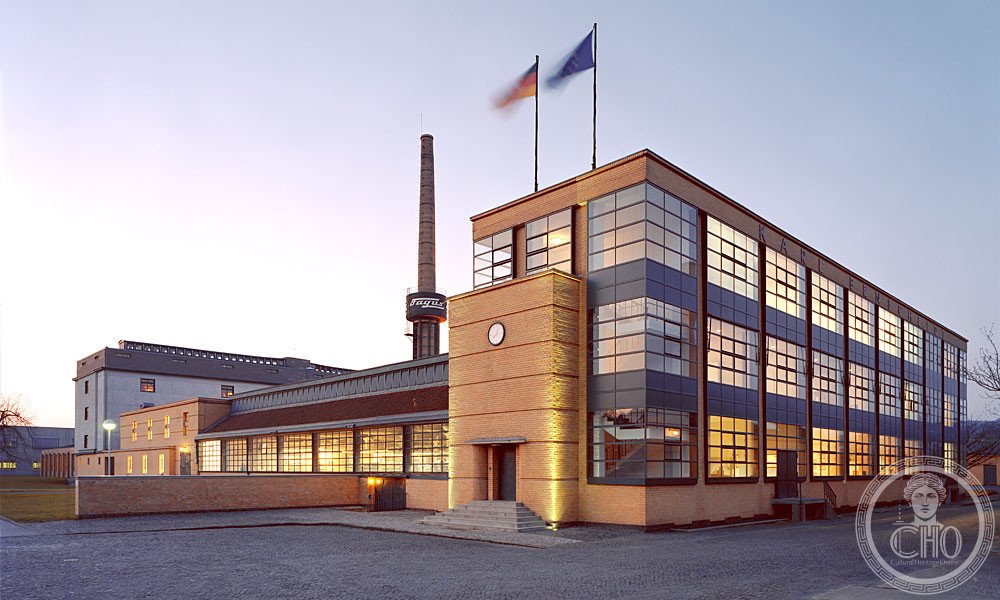
Built in 1911–1913 by the 28-year-old Walter Gropius and Adolf Meyer, the Fagus shoe-last factory in Alfeld is the building where modern architecture was born — the first glass curtain wall, the first cornerless glazing, and the definitive demonstration that structure and surface could be separated forever.
At a glance
The Fagus-Werk (shoe-last factory) in Alfeld an der Leine, Lower Saxony, is one of the most consequential buildings of the 20th century. In 1911, Karl Benscheidt — the factory owner — rejected a conventional historicist design and commissioned the young Walter Gropius, then 28 years old and fresh from Peter Behrens’s office, to create a modern building that would express the progressive identity of his business. The result was the first completely realised modernist building in architectural history: a three-story structure with a glass curtain wall that wraps around the brick piers at the corners without structural support — the first glass corner ever built — revealing the interior structure and making the building appear weightless and transparent. The UNESCO inscription of 2011 recognised the Fagus Factory as the founding work of modern architecture and the direct precursor of the Bauhaus, which Gropius would establish in 1919, six years later.
Key facts
- UNESCO inscription: 2011, criteria (ii) and (iv)
- Architects: Walter Gropius (1883–1969) and Adolf Meyer (1881–1929)
- Client: Karl Benscheidt, Fagus-Werk GmbH
- Construction period: 1911–1913 (main building); extensions to 1925
- Innovation: First glass curtain wall; first structural glass corner (no corner columns)
- Still in use: The Fagus-Werk has operated continuously as a shoe-last factory since 1910
- Precursor to: The Bauhaus school, founded by Gropius in Weimar in 1919
- Location: Hannoversche Straße 58, 31061 Alfeld an der Leine, Lower Saxony, Germany
History
In 1910, Karl Benscheidt established the Fagus-Werk to manufacture shoe lasts — the wooden forms used by cobblers to shape shoes. His factory site in Alfeld already had a design from Eduard Werner, a local architect working in the conventional historicist style. Benscheidt rejected it and sought someone who could give his progressive business a progressive building. He found Walter Gropius through the architect Hermann Muthesius.
Gropius had just spent three years in Peter Behrens’s Berlin office — the same office that had simultaneously employed Ludwig Mies van der Rohe and Le Corbusier, making it perhaps the most consequential architectural atelier of the 20th century. From Behrens he absorbed the idea of a total design philosophy that embraced industrial production. But where Behrens’s buildings remained rooted in classical structure, Gropius pushed further: at Alfeld, he used the existing Werner design’s structural framework as a starting point and then stripped it of everything decorative, replacing solid masonry infill with continuous glass panels and, crucially, carrying the glass around the corners without any structural support.
The glass corner was the decisive innovation. In all previous construction, the corner of a building required a structural pier — stone, brick, or concrete — to carry the load at the angle. Gropius transferred the structural load to the piers set back from the corner, allowing the glass to wrap continuously around the building’s edge. The result was a building that appeared to have no solid corners at all: the facade became pure transparency, a screen rather than a wall.
The factory opened in 1913 and has operated continuously ever since. The Fagus-Werk GmbH still manufactures shoe lasts on the same site — making it the rare case of an architectural monument that is also a living, functioning industrial building. Gropius went on to found the Bauhaus in 1919; the principles of the Fagus Factory — transparency, the rejection of applied ornament, the expression of industrial production — became the foundation of that institution and, through it, of almost all subsequent modern architecture.
What you see
The main building of the Fagus-Werk is a three-story block of exceptional visual clarity. The most striking feature is immediately apparent: the corners of the building have no solid piers. The glass curtain wall — a continuous grid of large windows with slim yellow-brick spandrel panels between floors — turns the corners without interruption, giving the building an almost weightless, hovering quality. This was technically achieved by cantilevering the floor slabs beyond the brick piers and hanging the glass panels from the cantilevered edge.
The facade composition is governed by a strict grid: large rectangular windows separated by thin yellow-brick bands, with slightly projecting brick piers at regular intervals that articulate the rhythm without breaking the transparency. The roof is flat — another radical departure from the pitched roofs that covered every industrial building of the period. The flat roof, combined with the large windows and the absence of historical ornament, gives the building its characteristic modernist profile.
The interior, where shoe lasts are still being manufactured, is flooded with natural light — the practical consequence of the curtain wall that Benscheidt had sought when commissioning a modern design. The building also contains a small Fagus Gropius Museum (opened 2011, coinciding with the UNESCO inscription) where visitors can see the history of the building and the shoe-last manufacturing process alongside original architectural drawings by Gropius and Meyer.
The wider factory complex, built out over subsequent decades, includes additional buildings that demonstrate how Gropius’s principles were applied and extended, and provides context for understanding the Fagus-Werk as an evolving industrial ensemble rather than a single object.
Practical information
- Address: Hannoversche Straße 58, 31061 Alfeld an der Leine, Lower Saxony, Germany
- Museum: Fagus Gropius Museum — open Tuesday–Sunday; admission charged
- Factory tours: Guided tours of the working factory available by prior booking
- Exterior: The main facade can be viewed from the street without charge at any time
- Nearest city: Hanover, 45 km north
Getting there
Alfeld an der Leine is served by regional trains from Hanover (RE/RB lines, approximately 45 minutes). By car, Alfeld is on the B3 federal road, 45 km south of Hanover. From the station, the factory is a 10-minute walk. From Berlin: approximately 3 hours by car (A2 motorway to Hanover, then B3 south).
Nearby
- Hanover — 45 km north: Herrenhäuser Gärten (Baroque royal gardens), Sprengel Museum (modern art)
- Hildesheim — 30 km north-east: two UNESCO-listed Romanesque churches (St Michael’s, St Mary’s Cathedral)
- Göttingen — 50 km south: historic university town, medieval old town
- Hamelin (Hameln) — 35 km north-west: the Pied Piper city, exceptional Weser Renaissance architecture
Sources
- UNESCO WHC: Fagus Factory in Alfeld
- Wikipedia: Fagus Factory
- Wikipedia: Walter Gropius
- Official site: fagus-werk.com
Find it on the map
See this place and what’s around it →📷 Become a Cultural Heritage Online photographer
Share your photos of places: they stay published under your name as the author. The more they're seen, the more you get noticed — and soon a contest will reward the most appreciated photos.
Log in or sign up free to add a photoDo you manage this place?
This page is read by travellers and heritage enthusiasts who find it on Google. Keep it accurate — and make it work for you. Free for non-profit heritage institutions.