
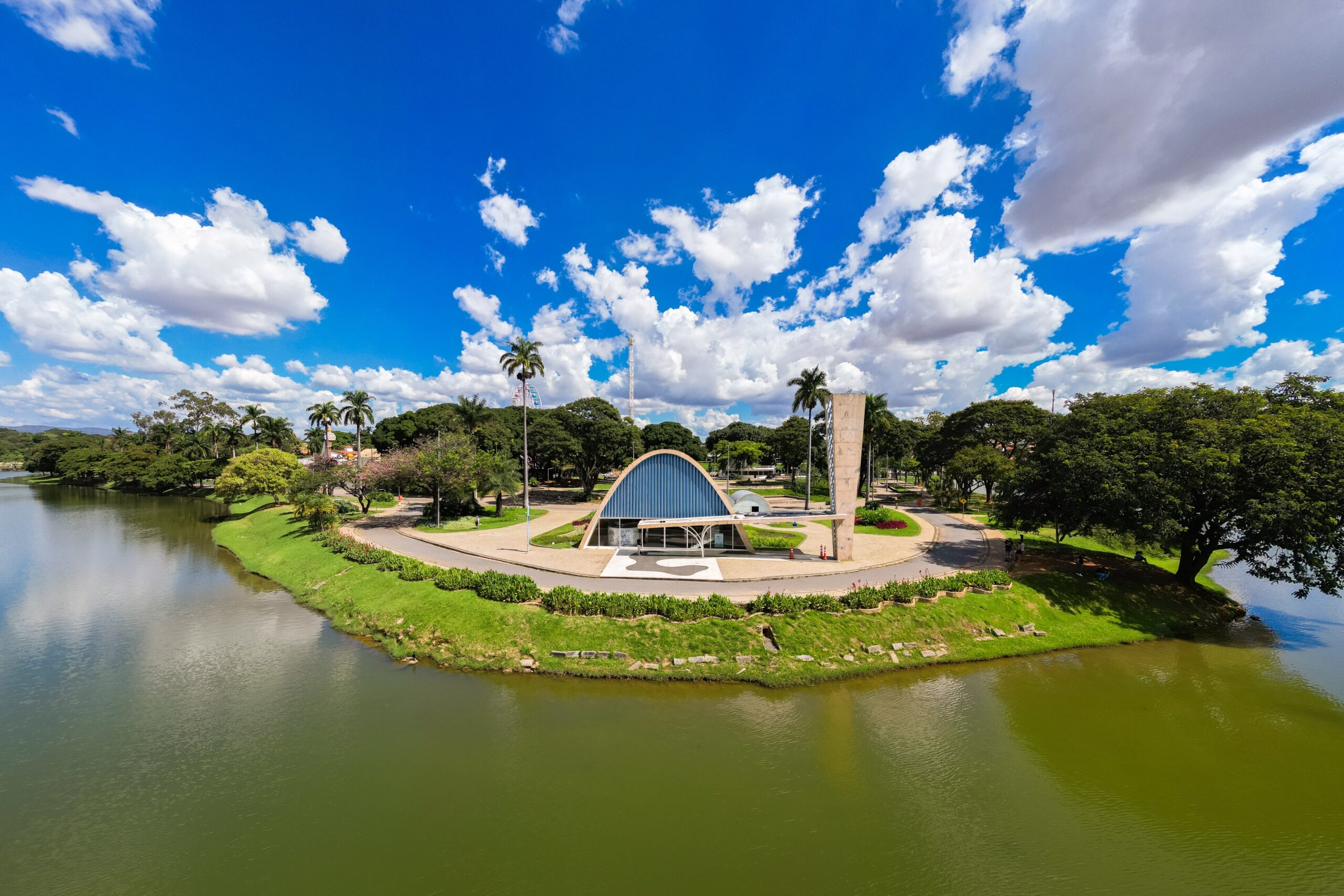
Four buildings on the shores of an artificial lake that launched Oscar Niemeyer onto the world stage and established Brazilian Modernism as a major architectural movement. UNESCO World Heritage Site since 2016.
At a glance
The Pampulha Modern Ensemble is a group of four complementary buildings commissioned in 1940 by Juscelino Kubitschek — then mayor of Belo Horizonte, later president of Brazil — and designed by architect Oscar Niemeyer, with landscape design by Roberto Burle Marx around the newly created Pampulha Lake in Minas Gerais. Built between 1940 and 1944, the ensemble broke decisively with academic formalism: Niemeyer used free-form reinforced concrete shells, parabolic vaults, and curved glass walls to create buildings that were at once technically audacious and sensuously sculptural. The ensemble proved that modern architecture could be lyrical rather than purely functionalist — a revelation that shaped the next half-century of architectural thought and directly influenced Niemeyer’s later masterpiece, the purpose-built capital city of Brasília (1956–60). Inscribed by UNESCO in 2016 for outstanding universal value as a landmark of 20th-century modernism.
Key facts
- UNESCO inscription: 2016
- Architect: Oscar Niemeyer (1907–2012), age 33 at commission
- Patron: Juscelino Kubitschek, mayor of Belo Horizonte, future president of Brazil
- Landscape designer: Roberto Burle Marx
- Construction: 1940–1944
- Style: Brazilian Modernism; free-form reinforced concrete
- Location: Pampulha district, Belo Horizonte, Minas Gerais, Brazil
- The four buildings: Casino/Museu de Arte da Pampulha (1940), Iate Tênis Clube (1942), Casa do Baile (1942), Chapel of São Francisco de Assis (1943)
History
In 1940, Mayor Juscelino Kubitschek commissioned a grand urban development on the northern outskirts of Belo Horizonte: the creation of an artificial lake and a leisure district on its shores. He chose the young Oscar Niemeyer, then 33, to design the buildings. Niemeyer had recently worked under Le Corbusier on the Ministry of Education and Health building in Rio de Janeiro (1936–43), and he was eager to push modernist principles toward a specifically Brazilian sensibility: sinuous, sensual, rooted in the baroque curves of colonial Brazilian churches rather than the rectilinear purism of European modernism.
The four buildings went up in rapid succession between 1940 and 1944. The Casino was the first and immediately recognised as extraordinary — its curved glass wall, flat roof, and open-plan interior on a lake promontory were unlike anything previously built in Brazil. The Iate Tênis Clube (Yacht Club) followed in 1942, with two interlocked barrel-vault concrete shells. The Casa do Baile (Dance Hall, 1942) features a circular dance floor beneath a concrete saucer roof with a projecting bandstand pier over the water. The Chapel of São Francisco de Assis (1943) is widely considered Niemeyer’s masterpiece of this period: four parabolic concrete shells cascade down to the lakeshore, with a tall bell tower; the entire rear wall is covered in azulejo tile panels by Cândido Portinari depicting the life of Saint Francis.
The Chapel’s consecration was delayed eight years because the Archbishop of Belo Horizonte refused to bless so revolutionary a building; it was finally consecrated in 1959. The Casino was closed when Brazil federally banned gambling in 1946 and has operated since 1957 as the Museu de Arte da Pampulha. The ensemble was inscribed as a UNESCO World Heritage Site in 2016 — recognised as a direct precursor to Brasília, which Kubitschek and Niemeyer created together on a national scale in 1956–60.
What you see
Chapel of São Francisco de Assis (1943) — Four parabolic reinforced concrete vaults cascade toward the lakeside. The exterior rear wall is entirely clad in a monumental azulejo tile mural by Cândido Portinari — blue and white tiles depicting scenes from the life of Saint Francis. A freestanding bell tower rises beside the chapel. The interior vault carries another Portinari fresco. This building is considered one of the most important religious structures of the 20th century.
Museu de Arte da Pampulha — former Casino (1940) — A flat-roofed block with a dramatically curved glass wall fronting the lake. Inside, a ramp rather than stairs connects floors. Now houses the Municipal Museum of Art; open to visitors.
Iate Tênis Clube — Yacht Club (1942) — Two interlocked barrel-vault concrete shells, one elevated for the restaurant and one lower for the boat dock. The sinuous profile from the water is particularly arresting. Exterior and lakeside view publicly accessible.
Casa do Baile — Dance Hall (1942) — A circular dance floor beneath a wide concrete slab, with a curved wing bar and a narrow pier extending into the lake, terminating in a circular bandstand canopy. Restored and now serves as a reference centre for Niemeyer’s work. Burle Marx’s undulating garden with native Brazilian plants surrounds and connects all four buildings.
Practical information
- Chapel of São Francisco de Assis: Av. Otacílio Negrão de Lima 3000 — Tue–Sun 09:00–17:00, free entry
- Museu de Arte da Pampulha: Av. Otacílio Negrão de Lima 16585 — Tue–Sun 09:00–21:00, free entry
- Casa do Baile: Av. Otacílio Negrão de Lima 751 — Tue–Sun 09:00–17:00, free entry
- Iate Tênis Clube: private members’ club; exterior and lakefront viewable from public walkways
- All four buildings are on the lakeside boulevard — walkable or by bicycle along the lake circuit (~11 km full loop)
Getting there
Belo Horizonte is served by Tancredo Neves International Airport (CNF, Confins), 38 km north, and Pampulha Airport (PLU) — itself a 1944 Niemeyer building — directly adjacent to the ensemble. From central Belo Horizonte the ensemble is 10 km north by the BH Express rapid transit or by taxi/ride-share (20 minutes). The lakeside circuit road circles the entire lake and connects all four buildings.
Nearby
- Aeroporto da Pampulha terminal (1944) — Niemeyer building, recently restored; 2 km from the Chapel on the lakeshore
- Jardim Botânico de Belo Horizonte — 5 km southeast; notable for its steel-and-glass tropical greenhouse
- Praça da Liberdade — 8 km south; historic government square with the Circuito Cultural, a cluster of free museums in former government palaces
- Museu Abílio Barreto — last farmhouse from before Belo Horizonte was planned and built in 1897
Sources
- UNESCO World Heritage — Pampulha Modern Ensemble, whc.unesco.org, inscription 2016 (criteria i, iv)
- Underwood, David. Oscar Niemeyer and the Architecture of Brazil. Rizzoli, 1994
- Wikipedia — “Pampulha Modern Ensemble” (en.wikipedia.org), consulted June 2026
Find it on the map
See this place and what’s around it →📷 Become a Cultural Heritage Online photographer
Share your photos of places: they stay published under your name as the author. The more they're seen, the more you get noticed — and soon a contest will reward the most appreciated photos.
Log in or sign up free to add a photo