
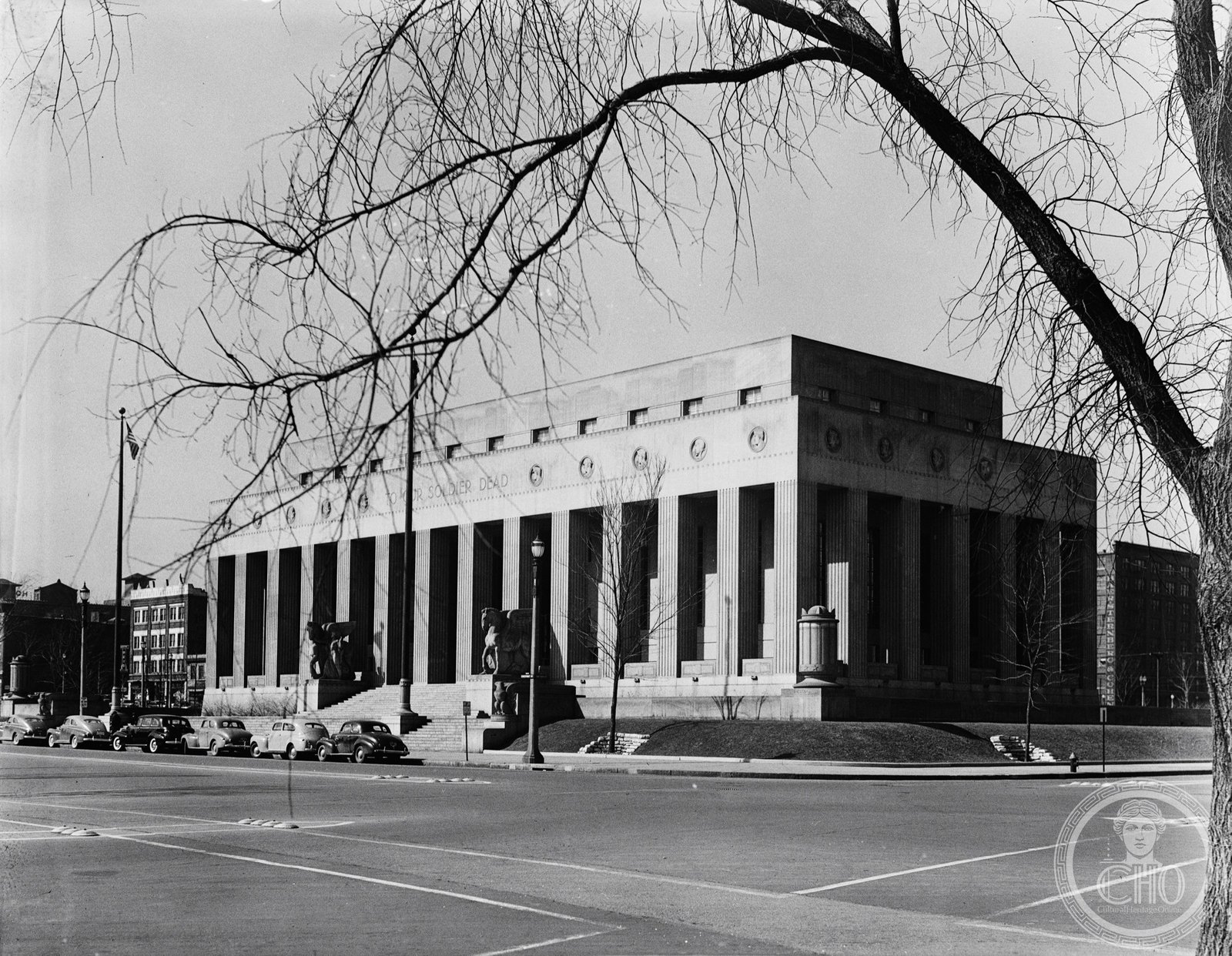
The most formal Art Deco civic monument in St. Louis, the Soldiers Memorial stands on Chestnut Street as a limestone colonnade dedicated to the city’s veterans of two world wars — a building that reconciles the stripped classicism of the New Deal era with the severity of the Art Deco vocabulary.
At a glance
The Soldiers Memorial Military Museum at 1315 Chestnut Street is St. Louis’s principal World War I memorial, completed in 1938 and subsequently expanded to honor veterans of World War II, Korea, and Vietnam. The building occupies a prominent site in the civic corridor west of the Old Courthouse and the Gateway Arch, its limestone colonnades and Art Deco proportions forming one of the defining architectural episodes on the downtown street grid. Reopened in 2018 after a major renovation, the museum exhibits military artifacts, photographs, and personal objects donated by St. Louis families across four generations of American warfare.
Key facts
- Address: 1315 Chestnut Street, St. Louis, MO 63103
- Dedicated: 1938
- Style: Art Deco Moderne — stripped limestone colonnades with sculptural program
- Status: NRHP Listed; operated by the Missouri Historical Society
- Dedicated to: St. Louis veterans of World War I, with subsequent additions honoring WWII, Korea, and Vietnam veterans
- Theme: Art Deco USA
History
The campaign to build a permanent memorial to St. Louis’s World War I veterans began in the 1920s, when the scale of the city’s wartime losses — and the civic ambition of a city that ranked among the four largest in the United States — demanded a monument commensurate with both. The site on Chestnut Street, between 13th and 14th Streets in the civic core of downtown, was selected for its visibility and its relationship to the corridor of public buildings extending toward the Old Courthouse and the waterfront.
The memorial was completed in 1938, at the intersection of two architectural imperatives: the stripped neoclassicism favored by the federal government for New Deal-era public buildings, and the Art Deco Moderne vocabulary that had been the dominant commercial and civic language of the preceding decade. The result is a building that belongs to neither tradition exclusively — its columnar facades recall the Beaux-Arts memorial architecture of the post-WWI generation, while its attenuated proportions, simplified ornament, and relationship to the horizontal street plane are distinctly of the 1930s.
The building closed in the early 2000s for structural assessment and entered a period of uncertainty as the city evaluated options for its renovation or adaptive reuse. A major public and private investment campaign culminating in 2018 restored the building and reopened it with updated museum programming focused on the personal experiences of St. Louis servicemen and servicewomen. The renovation preserved the integrity of the 1938 exterior while updating the interior exhibitions to contemporary museum standards.
What you see
The Chestnut Street elevation presents a long, low limestone colonnade — a horizontal composition unusual for civic monuments of the era, which more typically sought vertical emphasis. The columns are stripped of historicist ornament, their capitals reduced to Art Deco geometric simplification, and the cornice is resolved in a continuous horizontal band rather than the broken entablatures of the classical tradition. The effect is of a building that acknowledges the grammar of civic monumentality while translating it into the contemporary idiom of the late 1930s.
The internal courtyard is the building’s principal public space: an open sky court surrounded by low colonnades on all four sides, with the memorial tablets and sculptural program concentrated at the central axes. The space reads as a secular cloister — quiet, measured, and calibrated to individual contemplation rather than mass gathering. The flanking exhibition wings are accessible from the courtyard, their interiors now housing the updated Missouri Historical Society collections on St. Louis’s military history.
Practical information
- Access: 1315 Chestnut Street, downtown St. Louis; free admission
- Hours: check Missouri Historical Society for current schedule; typically Thursday–Sunday
- Time needed: 1–1.5 hours for museum plus exterior; combine with a walk to the Gateway Arch (0.5 miles east) and Old Courthouse (0.3 miles east)
- Best season: year-round; the limestone exterior reads particularly well in low morning light from the east
Getting there
St. Louis Lambert International Airport (STL) is approximately 12 miles northwest. The MetroLink light rail Red Line connects Lambert to downtown St. Louis and stops at the Convention Center and 8th & Pine stations near Chestnut Street. St. Louis Union Station (Amtrak: Texas Eagle and Missouri River Runner) is approximately 0.7 miles west. The Gateway Arch and Old Courthouse are within a 10-minute walk east along Chestnut and Market Streets.
Nearby
- Civil Courts Building (1930) — the Art Deco courthouse with its distinctive Greek Revival rooftop temple, one of the finest civic Art Deco buildings in the Midwest, approximately 0.3 miles east on Market Street
- Gateway Arch National Park — Eero Saarinen’s stainless-steel catenary arch (1965) on the Mississippi River waterfront, approximately 0.5 miles east
- Fox Theatre — The Fabulous Fox (1929) — one of the largest surviving movie palace interiors in the United States, approximately 1 mile west on Grand Boulevard
Sources
- Missouri Historical Society — Soldiers Memorial Military Museum programming and history documentation
- National Register of Historic Places — Soldiers Memorial listing, Missouri State Historic Preservation Office
- City of St. Louis Landmarks Association — downtown civic corridor architectural history
- Wikimedia Commons — Soldiers memorial st. louis.jpg, Public Domain
Find it on the map
See this place and what’s around it →Record researched and written by Luigi De Marchi for Cultural Heritage Online, 2026.
📷 Become a Cultural Heritage Online photographer
Share your photos of places: they stay published under your name as the author. The more they're seen, the more you get noticed — and soon a contest will reward the most appreciated photos.
Log in or sign up free to add a photoIs this page about you?
This page is read by travellers and heritage enthusiasts who find it on Google. Tell us how you are connected to this place and we will take it from there.