
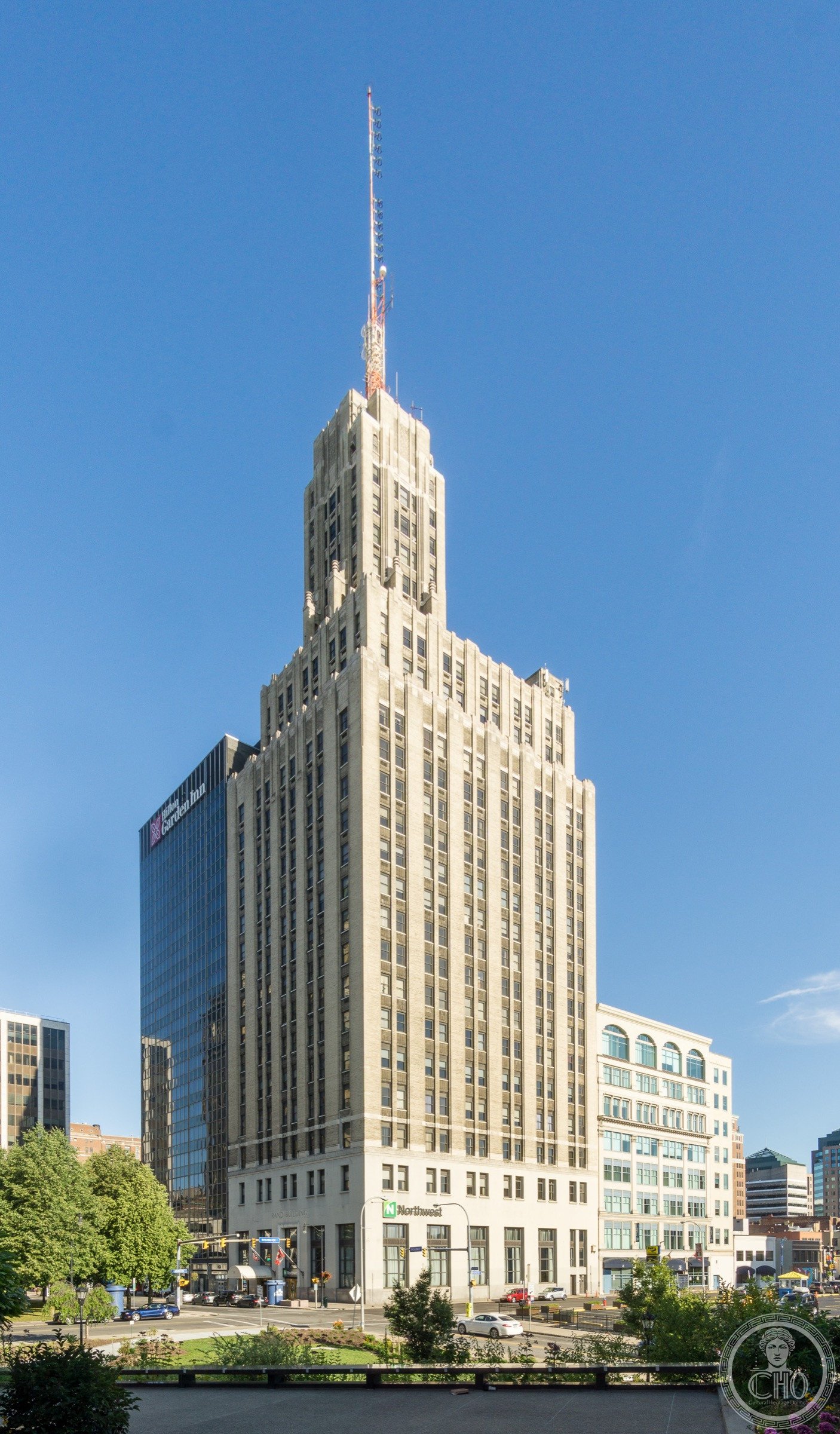
At 29 stories and 313 feet, the Rand Building dominated the Buffalo skyline from its 1929 completion until the 1970s — an Art Deco tower anchoring Lafayette Square that defined the aspirations of a Great Lakes industrial city at its commercial peak.
At a glance
The Rand Building at 14 Lafayette Square stands at the center of downtown Buffalo’s civic core, rising to 29 floors in an Art Deco tower completed in 1929. The building held the title of Buffalo’s tallest structure for over four decades and remains one of the most recognizable landmarks on the Lake Erie skyline. Listed on the National Register of Historic Places, the Rand Building is surrounded by the civic and institutional architecture that makes Buffalo one of the richest concentrations of late-nineteenth and early-twentieth-century urbanism in the northeastern United States — including buildings by H. H. Richardson, Daniel Burnham, Louis Sullivan, and Eliel Saarinen.
Key facts
- Address: 14 Lafayette Square, Buffalo, NY 14203
- Completed: 1929
- Style: Art Deco — setback tower with terracotta ornament
- Status: NRHP Listed; mixed-use commercial building
- Height: 29 stories, 313 feet; Buffalo’s tallest building until the 1970s
- Setting: Lafayette Square, center of Buffalo’s civic district
- Theme: Art Deco USA
History
Buffalo in 1929 was the eighth-largest city in the United States, a manufacturing and distribution center whose position at the eastern terminus of the Erie Canal had made it one of the wealthiest cities in the country for a century. The Rand Building was commissioned at the height of this prosperity, during the brief window between the 1924 immigration restriction act that stabilized the city’s labor supply and the 1929 stock market crash that would initiate its long economic decline. Its completion in 1929 — the same year as the Empire State Building groundbreaking in New York — placed it squarely in the most ambitious era of American commercial construction.
Lafayette Square, on which the Rand Building fronts, was the center of Buffalo’s civic architecture: it contained the city’s post office (1901), court house, and the spire of St. Joseph Cathedral (1853). The insertion of an Art Deco skyscraper into this Victorian context was deliberate — a signal of the city’s commercial ambitions placed in the most prominent civic location available. For four decades, the Rand Building’s silhouette defined the Buffalo skyline as seen from Lake Erie, the Niagara River, and the approaching railway corridors that carried goods and passengers to the city’s port and manufacturing districts.
The post-war deindustrialization of Buffalo eroded the commercial base that had supported the Rand Building’s original office tenants. The building’s conversion to mixed residential and commercial use over subsequent decades preserved the structure through cycles of downtown disinvestment and reinvestment. Today Buffalo’s urban core is experiencing renewed interest in its exceptional stock of historic architecture, and the Rand Building benefits from its position at the center of an urban conservation district that encompasses some of the finest surviving nineteenth and twentieth-century buildings in the American Northeast.
What you see
The Rand Building’s Lafayette Square elevation is a composition of setback volumes rising from a wide base to a narrow crown, the characteristic Art Deco formula that was codified in the 1916 New York zoning resolution and had become standard practice by the late 1920s. The terracotta cladding is articulated with vertical emphasis — piers, fins, and recessed spandrels that direct the eye upward to the crown — and decorated at the upper setbacks with carved ornamental detail that becomes increasingly elaborate as it approaches the finial.
From Lafayette Square, the building is best understood in relation to its historic neighbors: the Richardsonian Romanesque bulk of the old post office; the Gothic Revival spire of St. Joseph Cathedral; and the streetscapes of Delaware Avenue and Main Street that converge on the square. The Rand Building’s Art Deco verticality is a legible response to this context — not a rupture with the Victorian city around it, but a continuation of its ambitions in a contemporary vocabulary.
Practical information
- Access: 14 Lafayette Square, downtown Buffalo; NFTA Metro Bus connections along Main Street; Metro Rail at Church/Court stop approximately 0.3 miles north
- Interior: mixed-use building; lobby viewable during business hours
- Time needed: 20–30 minutes for exterior and nearby Lafayette Square; combine with a 2-hour Art Deco and architectural walking tour of downtown Buffalo
- Best season: May–October; Buffalo winters are severe; the Lake Erie context is most dramatic in summer and early fall
Getting there
Buffalo Niagara International Airport (BUF) is approximately 8 miles northeast of downtown, with connections to major eastern and midwestern hubs. Amtrak’s Lake Shore Limited (Chicago–New York) stops at Buffalo-Depew station approximately 10 miles east of downtown, with connecting transportation available. The NFTA Metro Rail light rail system runs along Main Street through downtown Buffalo and connects to the waterfront. Niagara Falls, New York is approximately 22 miles north via I-190.
Nearby
- Buffalo City Hall (1931) — the Art Deco civic tower by Dietel & Wade at 65 Niagara Square; one of the finest American municipal Art Deco buildings, approximately 0.2 miles north along Delaware Avenue
- Guaranty Building (1896) — Louis Sullivan’s masterpiece of the Chicago School at 28 Church Street, the most important surviving Sullivan skyscraper; approximately 0.4 miles northeast
- Shea’s Performing Arts Center (1926) — Thomas Lamb’s 3,000-seat movie palace at 646 Main Street; one of the finest surviving atmospheric theatres in the country, approximately 0.5 miles north on Main Street
Sources
- National Register of Historic Places — Rand Building listing, New York State Office of Parks, Recreation and Historic Preservation
- Buffalo Architecture and History — commercial building records
- Erie County Historical Society — Lafayette Square development history
- Wikimedia Commons — Rand Building in Buffalo New York.jpg, CC BY-SA 4.0
Find it on the map
See this place and what’s around it →Record researched and written by Luigi De Marchi for Cultural Heritage Online, 2026.
📷 Become a Cultural Heritage Online photographer
Share your photos of places: they stay published under your name as the author. The more they're seen, the more you get noticed — and soon a contest will reward the most appreciated photos.
Log in or sign up free to add a photoIs this page about you?
This page is read by travellers and heritage enthusiasts who find it on Google. Tell us how you are connected to this place and we will take it from there.