
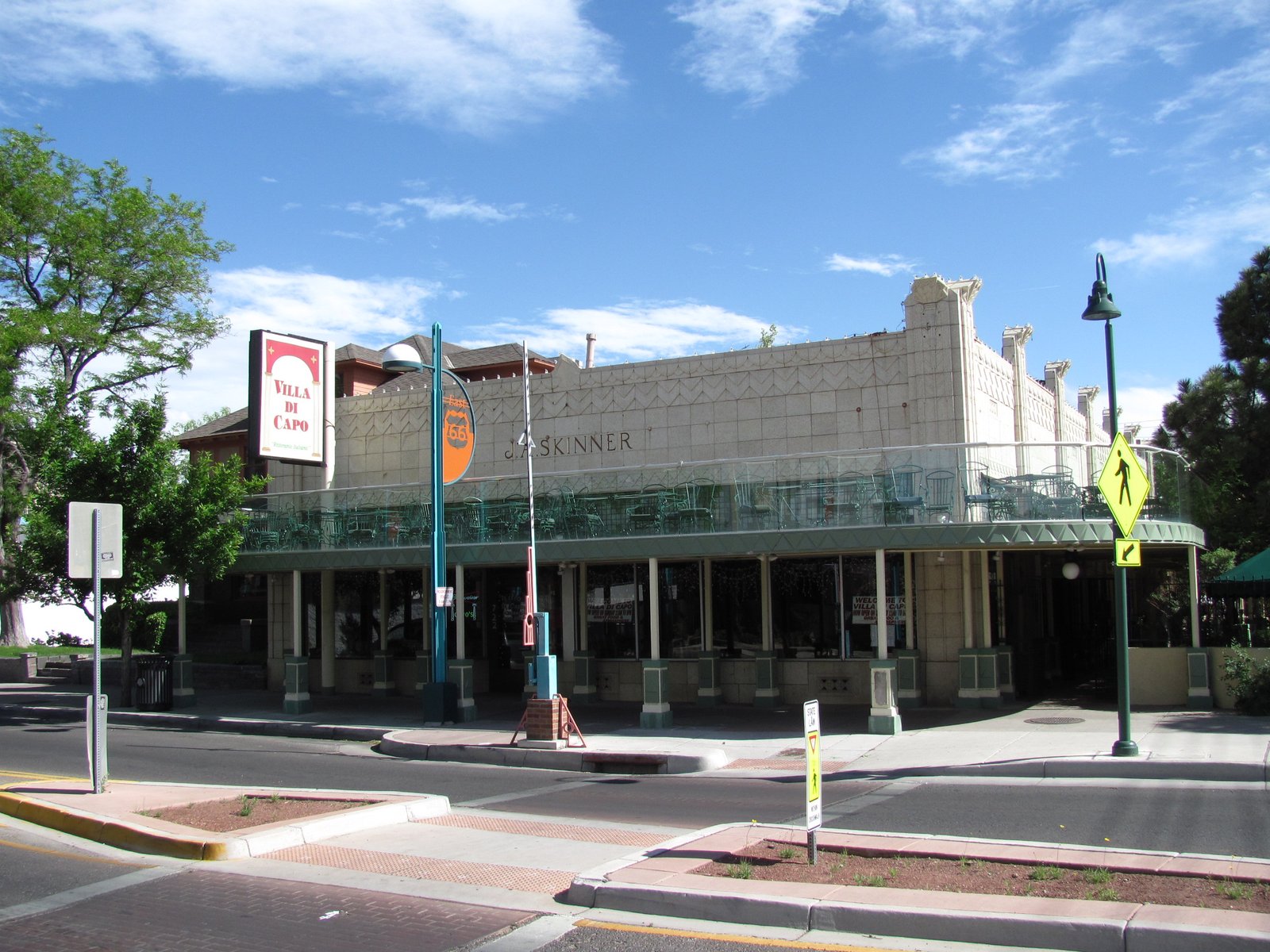
A.W. Boehning’s 1931 Skinner Building at 722 Central Avenue SW in Albuquerque stands on Route 66 as one of the most distinctive Art Deco commercial buildings in New Mexico: white terra cotta tile facades, fluted towers, ornamental grill work, and stained glass composing the Zigzag Moderne vocabulary of the 1920s on the historic highway that defined American westward mobility for a generation.
At a glance
The Skinner Building at 722 Central Avenue SW in Albuquerque, New Mexico was designed by architect A.W. Boehning and built in 1931. Listed on the National Register of Historic Places on November 22, 1980 under NRHP reference 80004485, the building is a Zigzag Moderne Art Deco commercial block on what is now Historic Route 66 (Central Avenue). The north and west facades are clad in white terra cotta tile over brick construction; the design features fluted towers, ornamental grill work, stained glass, and geometric patterns throughout. The building was constructed for the Skinner family, who operated a prominent commercial enterprise in Albuquerque, and its position on Route 66—the national highway that connected Chicago to Los Angeles and passed through Albuquerque as Central Avenue—gave it a visibility on one of the most traveled corridors in the American West.
Key facts
- Built: 1931
- Architect: A.W. Boehning
- Style: Art Deco (Zigzag Moderne)
- Address: 722 Central Avenue SW (Route 66), Albuquerque, New Mexico 87102
- NRHP: ref. 80004485, listed 22 November 1980
- Materials: White terra cotta tile (north and west facades) over brick; fluted towers; ornamental grillwork; stained glass
History
Albuquerque in 1931 was a growing city at the center of the American Southwest, its growth accelerating in the 1920s with the arrival of improved highway connections and the opening of Route 66 in 1926. The route passed through Albuquerque as Central Avenue, transforming a local commercial street into a nationally significant corridor that connected the Midwest to the Pacific Coast. The building boom along Route 66 brought the latest national architectural fashions—including the Art Deco vocabulary that dominated American commercial construction in the late 1920s and early 1930s—to cities and towns along the route that would otherwise have been too remote to participate in the mainstream of American design culture.
A.W. Boehning’s design for the Skinner Building brought the Zigzag Moderne vocabulary of the East Coast and Midwest to Central Avenue in its full ornamental ambition. The white terra cotta tile facades, fluted towers, ornamental grillwork, and stained glass are the canonical elements of the Zigzag Moderne substyle that dominated Art Deco commercial architecture in America from about 1925 to 1933, derived from the geometric abstraction of the 1925 Paris Exposition Internationale des Arts Décoratifs et Industriels Modernes that gave the Art Deco style its name.
The NRHP listing in 1980 was an early recognition of the building’s architectural significance, reflecting the preservation community’s interest in New Mexico’s Art Deco heritage in the context of Route 66 preservation that was developing at that time.
What you see
The Skinner Building presents its Art Deco character primarily through the ornamental richness of its terra cotta tile facades. The white tile cladding is an unusual material choice for the Southwest—most Albuquerque commercial buildings of the 1920s–1930s used brick or stucco in styles that reflected the regional Pueblo Revival tradition—and it marks the Skinner Building as a conscious intervention of national architectural fashion into a local building culture dominated by regional styles.
The fluted towers, ornamental grillwork, stained glass, and geometric surface patterns constitute a complete Zigzag Moderne ornamental vocabulary applied to a mid-rise commercial block. The effect on Central Avenue/Route 66 is of a building that announces its modernity through ornament rather than form, the conventional commercial box transformed by the accretion of Art Deco surface detail into something architecturally distinct from its neighbors.
Practical information
- NRHP status: Listed 1980; exterior freely viewable from Central Avenue (Route 66) at all times
- Location: Central Avenue SW in downtown Albuquerque, on Historic Route 66
- Photography: Exterior from public sidewalk freely permitted; the terra cotta ornament is visible from street level
- Time needed: 15–20 minutes exterior; Albuquerque’s Central Avenue/Route 66 district has several historic buildings within walking distance
Getting there
The Skinner Building is at 722 Central Avenue SW in downtown Albuquerque, 0.5 miles from the Albuquerque Sunport (ABQ, 4 miles south on I-25). I-25 serves Albuquerque from north (Santa Fe, 60 miles) and south (El Paso, 265 miles). Central Avenue is the main east-west artery of the city and its Route 66 designation makes it a tourism corridor for highway history. The Albuquerque Museum of Art and History is 1 mile east on Mountain Road NW; Old Town Albuquerque is 0.7 miles northwest.
Nearby
- KiMo Theatre (1927) — 0.5 miles east on Central Avenue; NRHP-listed Pueblo Deco theater (Moorish and Pueblo Revival design) by Carl Boller; the Southwest’s most inventive fusion of regional and Art Deco styles
- Albuquerque Museum of Art and History — 1 mile east; regional art and history museum in Old Town Albuquerque
- Old Town Albuquerque — 0.7 miles northwest; historic core of the city around the 1793 San Felipe de Neri Church and the Old Town Plaza
- National Museum of Nuclear Science and History — 5 miles east; Smithsonian-affiliated museum documenting the Manhattan Project, Cold War nuclear history, and the role of New Mexico in American nuclear science
Sources
- Wikipedia, “Skinner Building (Albuquerque, New Mexico)” — primary narrative source
- National Register of Historic Places, ref. 80004485 (22 November 1980)
- Wikimedia Commons, Skinner_Building,_Albuquerque_NM.jpg
Find it on the map
See this place and what’s around it →Record researched and written by Luigi De Marchi for Cultural Heritage Online, 2026.
📷 Become a Cultural Heritage Online photographer
Share your photos of places: they stay published under your name as the author. The more they're seen, the more you get noticed — and soon a contest will reward the most appreciated photos.
Log in or sign up free to add a photoIs this page about you?
This page is read by travellers and heritage enthusiasts who find it on Google. Tell us how you are connected to this place and we will take it from there.