
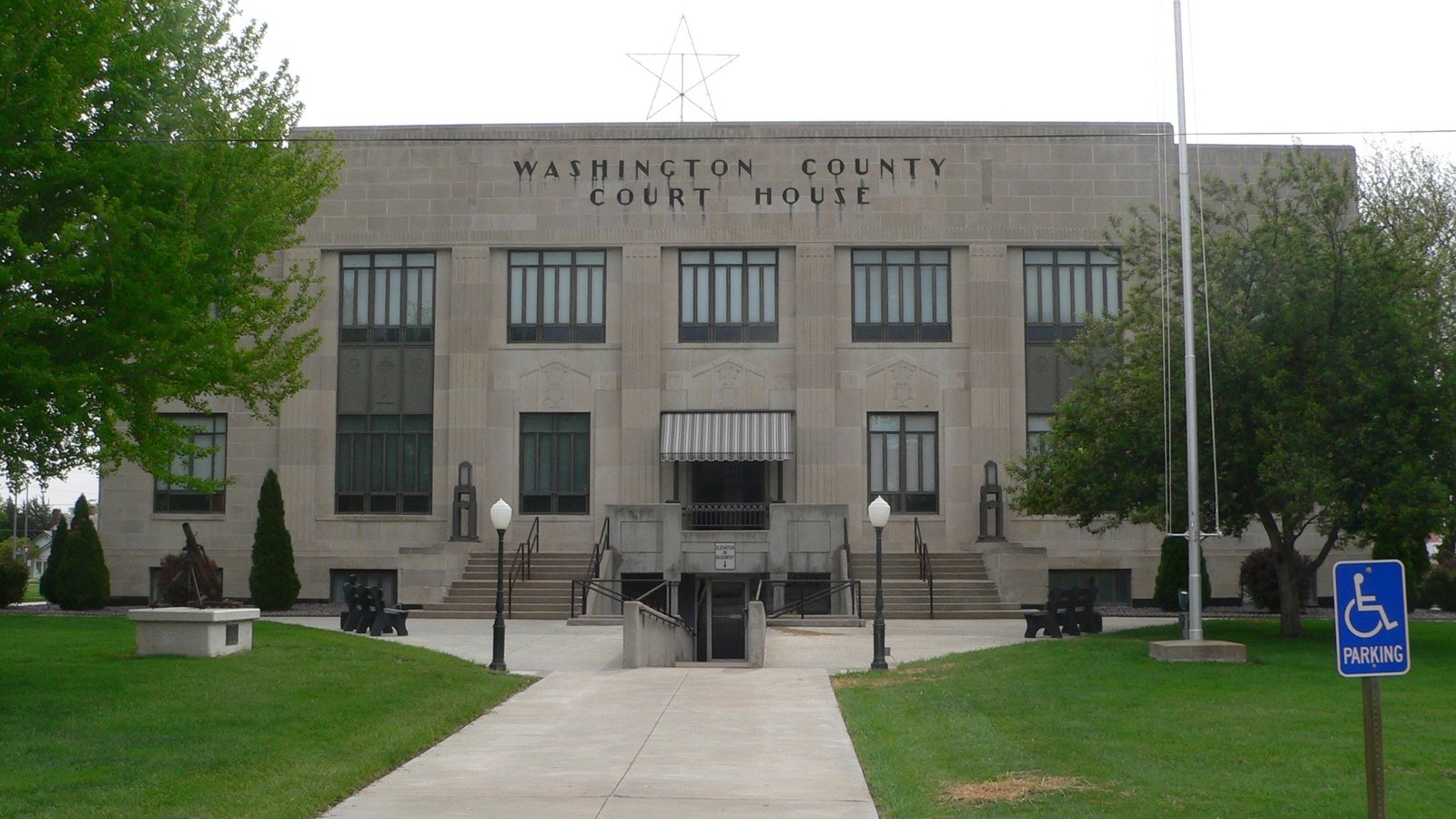
The Washington County Courthouse at 214 C Street is a 1932–1934 Art Deco building of Bedford limestone that rose on the Great Plains after a tornado destroyed its predecessor on the Fourth of July 1932—Wichita architects Overend and Boucher bringing the geometric language of Depression-era civic modernism to a Kansas county seat that had no architectural reason to expect it.
At a glance
The Washington County Courthouse is located at 214 C Street in Washington, Kansas, the county seat of Washington County in north-central Kansas. Wikipedia identifies it as an Art Deco-style courthouse built c.1932–1934, designed by Wichita architects Overend and Boucher and constructed by Blaser and Vollmer. It is a two-story building clad in Bedford (Indiana) limestone, with two-story square towers projecting from each corner that give the building its characteristic geometric profile. Listed on the National Register of Historic Places on April 6, 2000 (NRHP ref. 00000328), it replaced a predecessor courthouse damaged beyond repair by a tornado that struck Washington on July 4, 1932.
Key facts
- Built: c.1932–1934
- Architect: Overend and Boucher, Wichita, Kansas
- Builder: Blaser and Vollmer
- Style: Art Deco
- Address: 214 C Street, Washington, Kansas 66968
- NRHP: ref. 00000328, listed 6 April 2000
- Materials: Bedford (Indiana) limestone; two-story building with corner tower projections
- Precursor: Previous courthouse destroyed by tornado, July 4, 1932
History
The Fourth of July 1932 tornado that damaged the original Washington County Courthouse fell in the third year of the Great Depression and in the summer of the worst drought year the Great Plains would experience until the Dust Bowl intensified in 1934. The destruction of the courthouse — the county’s primary civic institution and the symbolic center of county government — forced a decision that many counties in Kansas were also facing in the early 1930s: whether to repair, rebuild, or consolidate. Washington County chose to rebuild, and chose a design that would have been unthinkable a decade earlier in a county of this size and agricultural economy: an Art Deco courthouse in the new vocabulary that was transforming American civic architecture from the Depression era’s urban centers to its small-town peripheries.
The commission went to the Wichita firm of Overend and Boucher, one of the regional architecture practices that brought the national design vocabulary of the 1920s and 1930s to Kansas’s county seats and smaller cities. Wichita in the early 1930s was the commercial and professional capital of south-central Kansas, and its architecture firms served clients across a wide geographic radius. The choice of Bedford limestone — the prized Indiana building stone that had been used in national monuments and major public buildings since the 1890s — signaled an investment in permanence and quality that Depression-era fiscal constraints might otherwise have discouraged. Bedford limestone’s fine, consistent grain and its capacity to hold carved detail made it the material of choice for Art Deco public buildings that expressed civic ambition through surface quality rather than ornamental excess.
The building was completed c.1932–1934 and has served as the seat of Washington County government since. The NRHP listing in 2000 recognized both its architectural quality as an Art Deco civic building and its historical significance as a document of Depression-era public construction in rural Kansas.
What you see
The Washington County Courthouse presents the Art Deco vocabulary in its most austere Great Plains register: a two-story building of buff Bedford limestone whose primary formal gesture is the pair of two-story square towers projecting from each corner of the facade. This corner-tower composition is a characteristic Art Deco civic form — the stepped, geometric massing that replaced the classical dome and portico of traditional American courthouse design with a horizontal-vertical geometry appropriate to the modernist sensibility of the 1930s. The limestone cladding is smooth-dressed, with the surface quality of the material doing much of the ornamental work that carved detail would have carried in an earlier building.
The building’s scale is proportioned to a county seat of Washington’s size — a two-story structure rather than the monumental tower of a larger county’s courthouse — but the Art Deco design vocabulary gives it an architectural ambition beyond its modest program. The corner towers create a silhouette against the flat Kansas sky that reads as monumental at the scale of a small-town main street, and the Bedford limestone’s warm buff color anchors the building in the grain-and-limestone material palette of the Great Plains landscape.
Practical information
- NRHP status: Listed 2000; the building is in active use as the Washington County courthouse
- Hours: Open during county business hours; exterior viewable at all times from C Street
- Photography: Exterior from public sidewalk freely permitted
- Context: Washington, Kansas is a small community on US-36; the courthouse is the dominant building in the downtown area
- Time needed: 15–20 minutes exterior; the downtown square has several historic commercial buildings
Getting there
Washington County Courthouse is at 214 C Street in Washington, Kansas, at the intersection of US Highway 36 (east-west) and Kansas Highway 148 (north-south). Washington is 125 miles north of Wichita and 90 miles west of Manhattan, Kansas (Kansas State University). The nearest major airport is Manhattan Regional Airport (MHK), 90 miles south. I-70 passes 65 miles south of Washington near Abilene, Kansas. The town of Washington itself has a population of approximately 1,100 and is the commercial center for the surrounding wheat-farming county.
Nearby
- Hollenberg Pony Express Station (c.1858) — 15 miles northeast near Hanover, Kansas; the only remaining unaltered Pony Express station still standing on its original site; Kansas State Historic Site and NRHP-listed
- Miltonvale Wesleyan College Gymnasium — 20 miles south; 1930s WPA building in Miltonvale, Kansas
- Belleville, Kansas — 25 miles east; seat of Republic County; the Belleville High School (1936) is a significant WPA-era building in the region
- US Highway 36 corridor — The highway west of Washington crosses the Flint Hills and High Plains, passing through a succession of small county-seat towns with Depression-era commercial architecture; Washington is among the best-preserved
Sources
- Wikipedia, “Washington County Courthouse (Kansas)” — primary narrative source (Art Deco in infobox and body)
- National Register of Historic Places nomination by Martha Hagedorn-Krass, February 17, 2000; NRHP ref. 00000328, listed April 6, 2000
- Wikimedia Commons, Washington_County,_Kansas_courthouse_from_W_2.JPG
Find it on the map
See this place and what’s around it →Record researched and written by Luigi De Marchi for Cultural Heritage Online, 2026.
📷 Become a Cultural Heritage Online photographer
Share your photos of places: they stay published under your name as the author. The more they're seen, the more you get noticed — and soon a contest will reward the most appreciated photos.
Log in or sign up free to add a photoIs this page about you?
This page is read by travellers and heritage enthusiasts who find it on Google. Tell us how you are connected to this place and we will take it from there.