
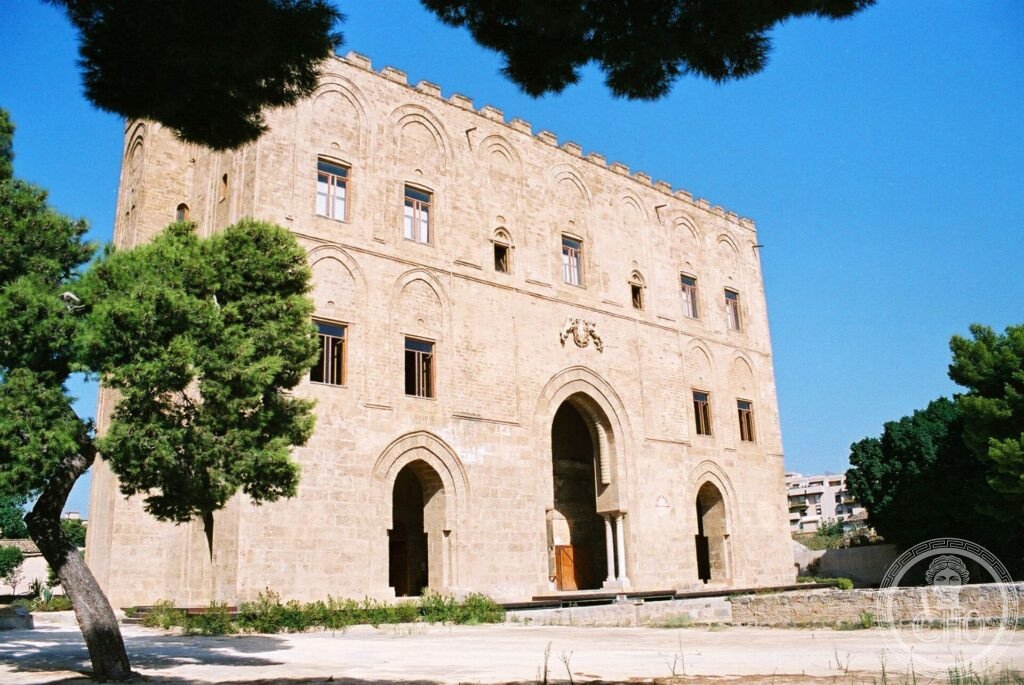
La Zisa was built between 1165 and 1180 by the Norman kings William I (“the Bad”) and William II (“the Good”) in the hunting park north of Palermo, and it is the surviving core of a monumental Norman-Islamic pleasure complex that also included La Cuba and La Cubula. The Norman kings raised these pavilions as a formal statement of their cultural synthesis — Norman feudal power, Islamic luxury aesthetic and Byzantine imperial tradition — and the result is the most complete example of Islamic-style palatial architecture surviving in Western Europe.
At a glance
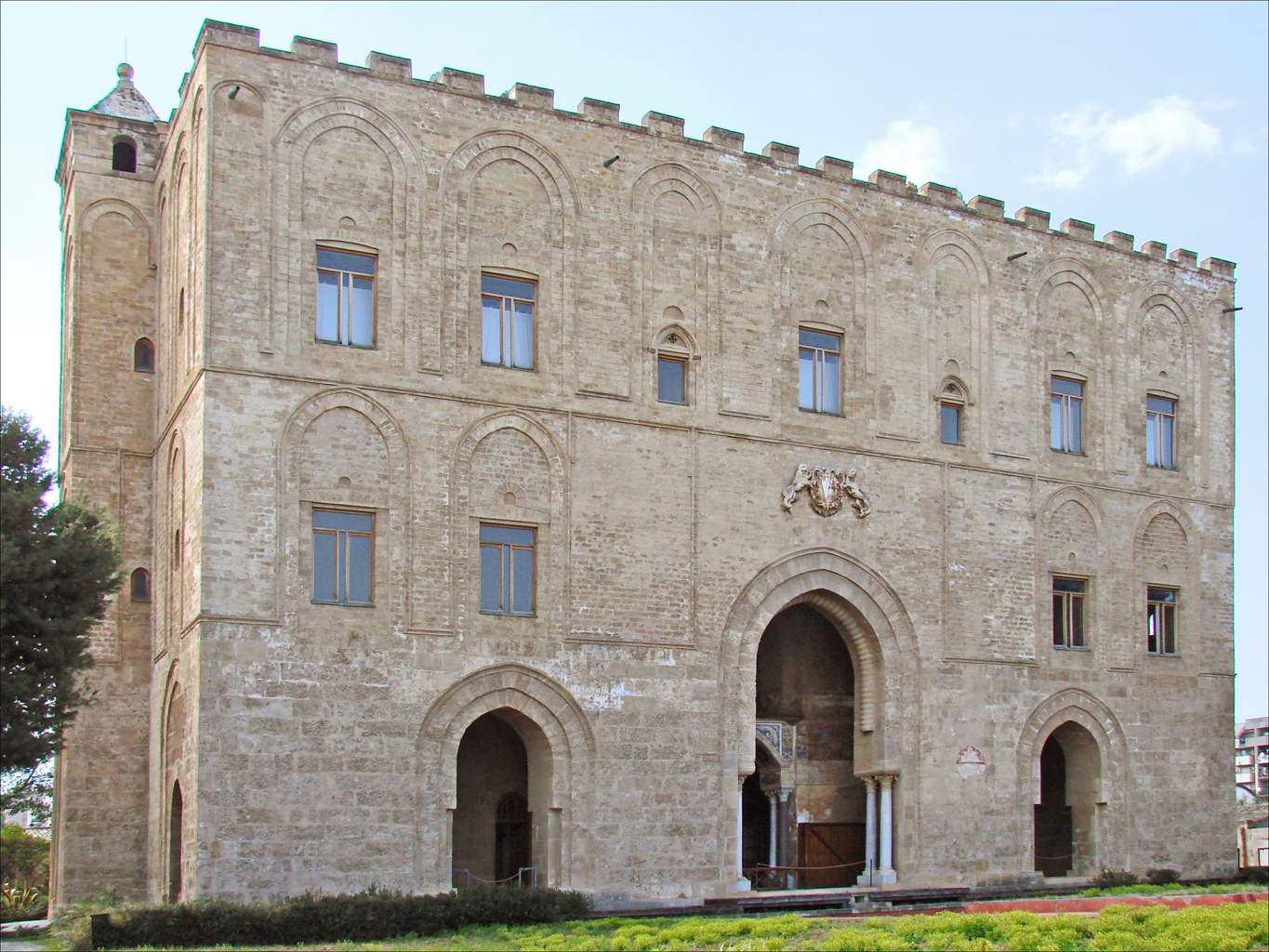
La Zisa (Palermo, Sicily; UNESCO 2015, ref. 1487, as one of the nine components of the “Arab-Norman Palermo and the Cathedral Churches of Cefalù and Monreale” inscription) is a rectangular palace (36 m × 19 m × 24 m high) built in the Norman-Islamic style perfected at the Norman Sicilian court. The WHC Outstanding Universal Value (for the Arab-Norman Palermo inscription as a whole) recognizes: (1) the unique cultural synthesis between the three civilizations coexisting in Norman Sicily (Norman-Christian, Arab-Islamic, and Greek-Byzantine), reflected in the art, architecture, and political theory of the Norman court. (2) La Zisa specifically as the most complete surviving example of Islamic-style palace architecture in the Western Mediterranean, with its intact muqarnas vault and fountain system in the Sala della Fontana (the Hall of the Fountain). The palace is now the Museo della Zisa, housing a collection of Islamic art and artifacts.
Key facts
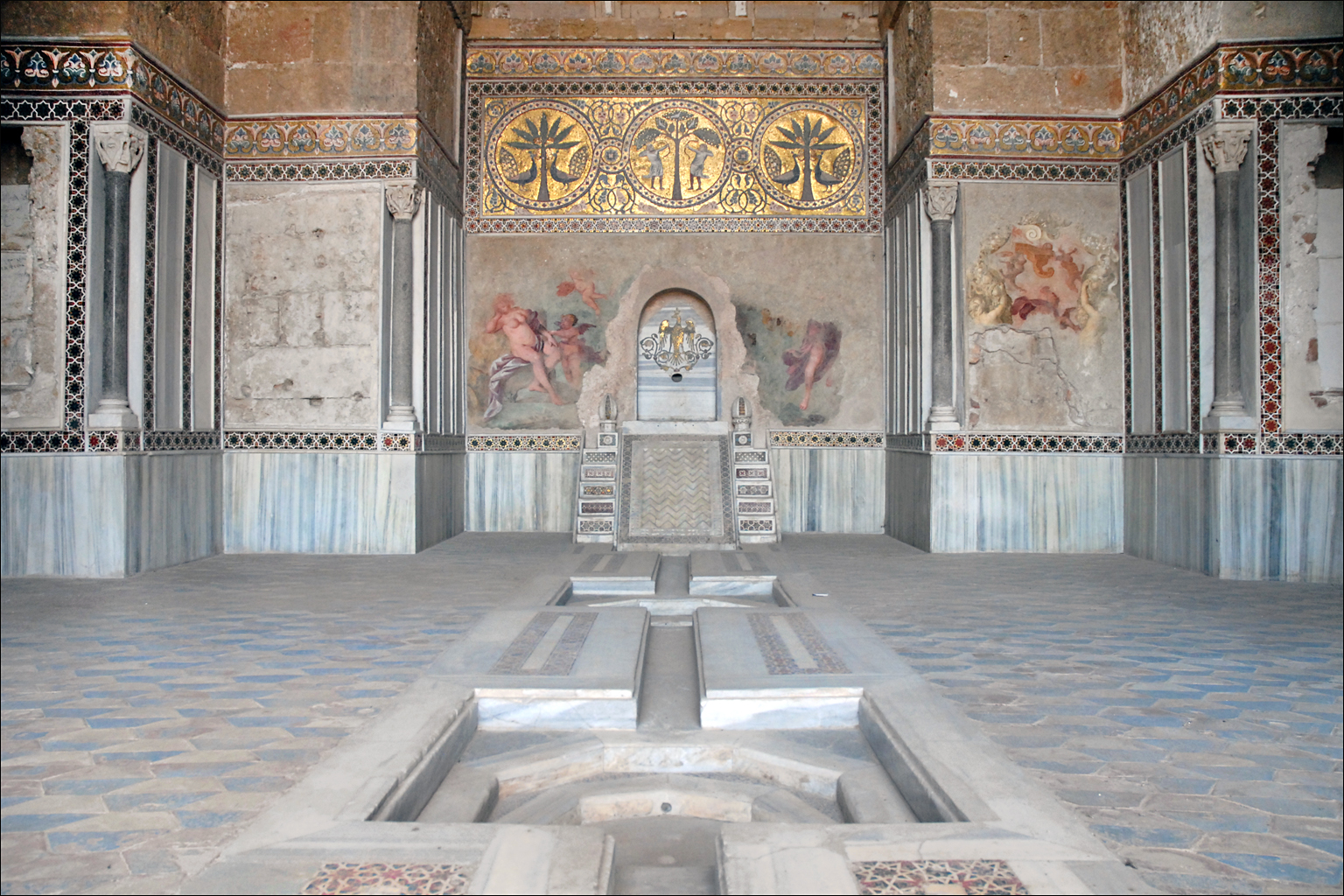
- La Sala della Fontana (Hall of the Fountain): The ground floor hall of La Zisa is its architectural masterpiece: a deep iwan (an open-fronted vaulted hall, a characteristic element of Islamic palatial architecture) with a fountain at the base of the rear wall that feeds two small channels running along the side walls of the hall and continuing outside the building into the garden (now dried). The ceiling of the hall is a 3-tiered muqarnas vault (honeycomb-like stalactite vaulting, a characteristic element of Islamic decorative architecture). The upper tier of the muqarnas is decorated with polychrome mosaic depicting falconers, peacocks, and archers in a paradise-garden iconography identical to Fatimid Egyptian palace paintings. Almost certainly the work of Egyptian craftsmen brought to Sicily by the Norman court.
- Al-Ziza and the royal park: La Zisa was not a standalone building but the centrepiece of a royal park (the Genoard, from Arabic Jannat al-Arḍ, “Paradise of the Earth”) that occupied the area north of Palermo. A walled game park with orchards, water channels, pavilions, and fishponds. Within the Genoard were also La Cuba (built by William II in 1180, now inside the grounds of the Villa del Bosco d’Alcalà), La Cubula (a small octagonal island pavilion in a now-dried fishpond), and the Norman Tower of San Giovanni degli Eremiti. The park was gradually dismembered from the 13th century onward as the city expanded northward.
- The inscription over the door: The Arabic inscription carved in stone above the main door of La Zisa (now visible inside the museum) reads: “This is Aziz, the glorious / this is the most beautiful palace in the world / in it the king of the age lives without anxiety and without anger / it is the abode of happiness and the city of joy / the house of gold and precious stones / the paradise of which you have heard tell / the sultan of the world has filled it with buildings / in which the glorious kings take refuge”. This inscription places La Zisa in the tradition of the Islamic literary genre of praise-poetry for palaces (the basmala and the praise of the palace in Arabic verse).
- UNESCO: 2015, rif. 1487 (Arab-Norman Palermo).
- GPS: 38.1168, 13.3411. Google Maps (La Zisa, Palermo).
History
La Zisa was begun by William I (Guglielmo I “il Malo”, king of Sicily 1154-1166) and completed by William II (Guglielmo II “il Buono”, king of Sicily 1166-1189). The palace is documented in an Arabic inscription over its main door. After the extinction of the Norman dynasty (1194), the palace passed to the Hohenstaufen (Frederick II used it occasionally), then to the Angevins (1266), the Aragonese (1282), and the Spanish viceroys, during which period it was gradually subdivided into apartments and its park dismembered. In 1637 a private family (Sandoval) converted it into a residence. In the 1870s the Italian state purchased it and began restoration. The thorough archaeological and architectural restoration was completed between 1971 and 1991 (Superintendence for Architectural Heritage, Sicily), which recovered the muqarnas vault, the fountain system, and the courtyard. It opened as the Museo della Zisa (Islamic Art Museum) in 1997.
What you see
The Zisa is a compact but intense monument: from the exterior, the 3-storey rectangular facade (with blind arcading, small round arched windows at ground level, and a crenellated roofline) demonstrates the “Arabian” character that the Norman court deliberately adopted as a marker of royal prestige. The interior (45 min, guided or self-guided): the Sala della Fontana on the ground floor is the essential space. Stand at the entrance of the iwan and look up at the three-tiered muqarnas vault, then at the fountain at the back wall and the two lateral water channels. The polychrome mosaic panels on the upper walls (falconers, peacocks, and vases, in the Fatimid Egyptian style) are the most sophisticated surviving examples of this art form in Europe. The museum rooms on the upper floors display Islamic art objects (bronzes, textiles, carved ivory, ceramics) from Sicily and the wider Islamic world, plus archaeological finds from the Genoard park.
Gallery
_(6889178512).jpg)
_(7035274315).jpg)
Practical information
- Museo della Zisa: Piazza Zisa 1, Palermo. Open Tue-Sat 09:00-18:00 (last entry 17:30), Sun 09:00-13:00, Mon closed. Admission ~€6 (full), free under 18 EU and first Sunday of the month. There is also a combined ticket with the Palazzo dei Normanni/Cappella Palatina and the Museo Diocesano available at the Fondazione Federico II ticket office (~€15).
- A tip: La Zisa is easily missed by the typical Palermo tourist circuit (most visitors go straight to the Cappella Palatina and skip the Norman suburban palaces). It is worth the 20-min walk from Piazza Vittorio Emanuele into the working-class Zisa quarter, which gives a strong contrast to the tourist centre of Palermo and a more authentic neighbourhood experience.
Getting there
La Zisa, Palermo (PA), Sicily. GPS 38.1168, 13.3411. Piazza Zisa. By public transport from Palermo historic centre: AMAT bus 108 from Via Roma to Piazza Zisa (15 min). Or the Palermo city train to Stazione Lolli (4 min from Palermo Centrale) + 10 min walk along Via Danisinni. By car: ZTL boundary at Via Zisa. Park on Via Selinunte or Via Cappuccini. By foot from Cappella Palatina: 25 min via Via del Bastione through the Zisa quarter.
Nearby
- Cappella Palatina, Palazzo dei Normanni. 1.5 km south-east (20 min walk). The masterpiece of Norman-Byzantine-Islamic synthesis (1132-1143), with the largest cycle of Byzantine mosaics in a palatial setting outside Istanbul. The Throne Hall of Roger II on the ground floor of the Palazzo dei Normanni has a separate cycle of mosaic hunting scenes in the pure Islamic style.
- San Giovanni degli Eremiti. 1.5 km south-east (20 min walk). The former mosque converted by Roger II to a church (1132), with the five famous red domes and the Norman cloister. The most evocative garden space in Palermo.
- La Cuba. 1.5 km south. The second surviving Norman palace of the Genoard (1180, William II). It is now enclosed within the grounds of the Caserma Tukory (military barracks) but accessible on request and during the open-monuments days (Giornate FAI, spring and autumn).
Sources
- UNESCO: whc.unesco.org/en/list/1487 (Arab-Norman Palermo and the Cathedral Churches of Cefalù and Monreale).
- Wikipedia EN: La Zisa.
- Gandolfo, Francesco: La Zisa di Palermo, Palermo: Regione Siciliana, 2008.
- Museo della Zisa: regione.sicilia.it.
Find it on the map
See this place and what’s around it →📷 Become a Cultural Heritage Online photographer
Share your photos of places: they stay published under your name as the author. The more they're seen, the more you get noticed — and soon a contest will reward the most appreciated photos.
Log in or sign up free to add a photoIs this page about you?
This page is read by travellers and heritage enthusiasts who find it on Google. Tell us how you are connected to this place and we will take it from there.