

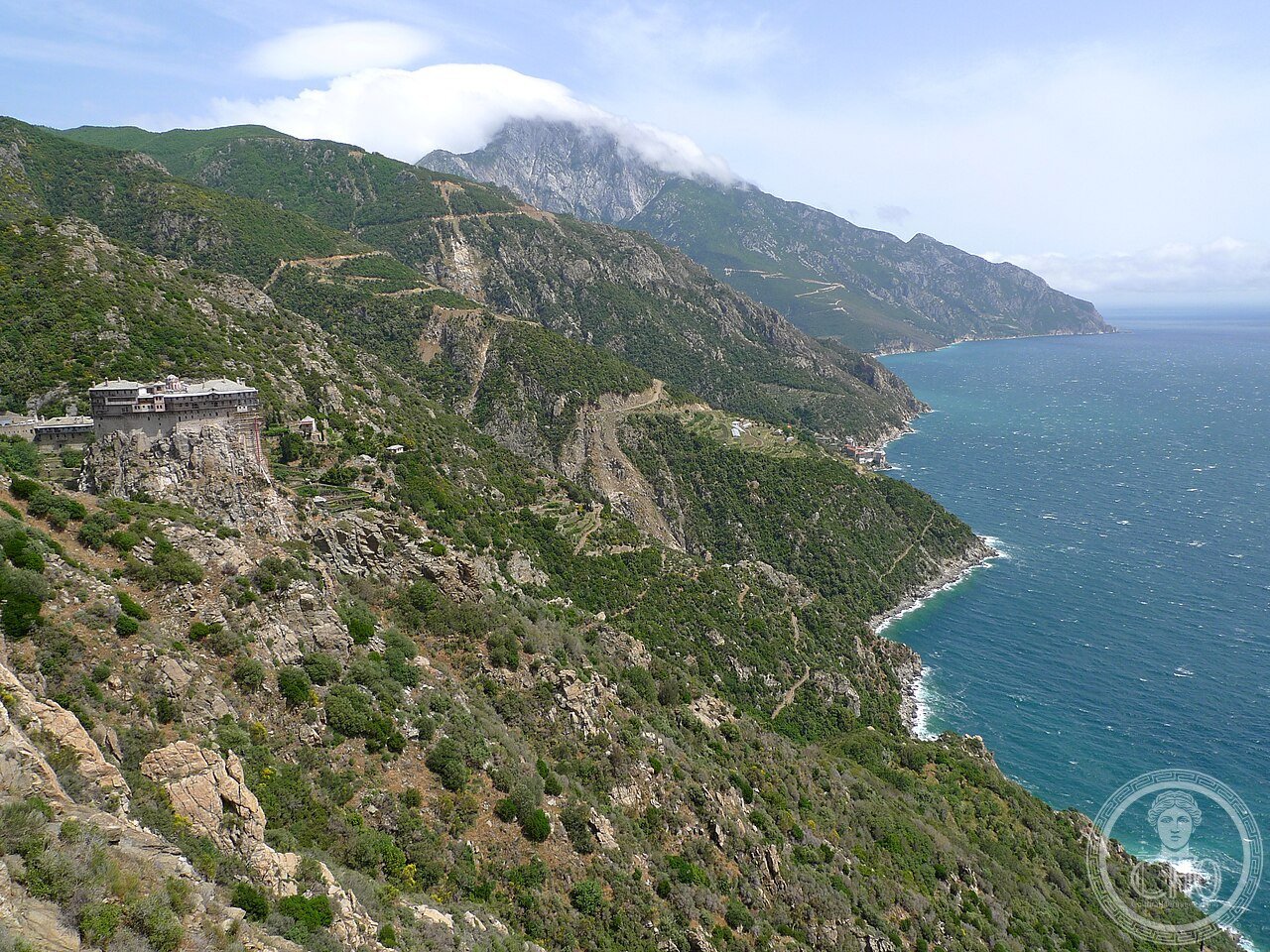
Saint Simon the Myrrh-streaming was living as a hermit in a nearby cave when, by tradition, he had a vision of the Theotokos commanding him to build a monastery on the very top of that rock. During the work, frightened by the precipice, the builders decided to abandon the site — but then they saw Simon’s disciple slip and fall into the void with the food he was bringing them. Within moments the young man reappeared on the cliff, entirely unharmed. They took it as a divine sign and went back to work.
About Simonopetra Monastery
Simonopetra Monastery, whose name literally means “Simon’s Rock,” was founded around 1257 by the monk Simon, later known as Saint Simon the Myrrh-gusher, an ascetic who had been living in a nearby cave on the southern coast of the Mount Athos peninsula, between the Athonite port of Dafni and the monastery of Osiou Grigoriou. According to tradition, Simon received a vision of the Theotokos instructing him to build a monastery directly atop the towering rock, with a promise that she would protect and provide for both him and the community to come; a bright star reportedly appeared over the site on several occasions, which Simon took as a further divine sign, leading him to name the new foundation “New Bethlehem” in honour of the Nativity of Christ. Construction proved extraordinarily difficult given the site’s dramatic and dangerous location, hanging from a cliff face rising 330 metres above the sea. According to the monastery’s founding legend, the labourers, terrified of continuing to balance along the rock’s precipitous edge each day, resolved to abandon the project entirely — until they witnessed Simon’s own disciple slip and fall from the cliff while carrying food to the workers. Moments later, the young man reappeared on the rock face completely unharmed, and the workers, taking this as unmistakable evidence of divine protection over the site, returned to complete the monastery’s construction. Simonopetra ranks thirteenth in the hierarchical order of Mount Athos’s twenty monasteries. The monastery’s history since its founding has been repeatedly marked by devastating fires, with major reconstructions following each disaster: after a fire in 1580, the western building was erected using funds gathered by Abbot Evgenios, and following a further catastrophic fire in 1891, the eastern building was rebuilt largely with funds raised in Russia, reflecting the monastery’s wide international network of Orthodox support.
Key facts
- c. 1257: founded by Saint Simon the Myrrh-gusher
- Original name: “New Bethlehem,” after a miraculous guiding star
- Founding legend: a falling disciple survives unharmed, convincing workers to continue
- Location: built on a single rock, 330 metres above the sea
- Rank: thirteenth among the twenty monasteries of Mount Athos
- 1580: western building rebuilt after a major fire
- 1891: eastern building rebuilt after another fire, largely with Russian funding
History
Simonopetra’s founding legend, in which a worker’s miraculous survival after falling from the cliff convinces terrified labourers to complete a seemingly impossible construction project, situates the monastery within a distinctive Athonite tradition of foundation stories that directly confront the extreme physical dangers of building on the peninsula’s dramatic coastal terrain. The monastery’s repeated cycle of destruction by fire and reconstruction through international Orthodox fundraising, particularly the 1891 rebuilding financed substantially from Russia, illustrates the broader pan-Orthodox network of support that has historically sustained Mount Athos’s monasteries across national and political boundaries.
The site’s continued survival, its buildings still clinging to the same sheer rock face chosen by Simon in the 13th century, stands as one of the most visually dramatic testaments anywhere on Mount Athos to the lengths medieval and later builders were willing to go in pursuit of a site believed to carry direct divine sanction.
What you see
The monastery’s multi-storey buildings rise directly from the rock face itself, their wooden balconies overhanging the 330-metre drop to the sea below, creating one of the most visually striking silhouettes of any structure on Mount Athos. The complex, largely rebuilt following the fires of 1580 and 1891, preserves its katholikon and extensive monastic quarters within this uniquely constrained and dramatic cliffside footprint.
Practical information
- Opening hours: access restricted to male visitors with a special pilgrim permit (diamonitirion), issued by the Mount Athos administration
- Address: Simonopetra, Mount Athos Autonomous Monastic State, Greece
Getting there
Simonopetra Monastery is located on the southern coast of the Mount Athos peninsula, between Dafni and Osiou Grigoriou, reachable only by boat and only with the required pilgrim permit. GPS: 40.1902° N, 24.2468° E.
Nearby
- Osiou Grigoriou Monastery — another cliffside Athonite monastery, nearby
- Dafni — the main port of the Mount Athos peninsula
- Karyes — the administrative capital of the Mount Athos monastic state
Sources
- Wikipedia — “Simonopetra” (en.wikipedia.org)
- Monastiriaka — “Simonopetra Monastery: an architectural wonder in the monastic state of Mount Athos” (monastiriaka.gr)
- OrthodoxWiki — “Simonopetra Monastery (Athos)” (orthodoxwiki.org)
Find it on the map
See this place and what’s around it →📷 Become a Cultural Heritage Online photographer
Share your photos of places: they stay published under your name as the author. The more they're seen, the more you get noticed — and soon a contest will reward the most appreciated photos.
Log in or sign up free to add a photo