

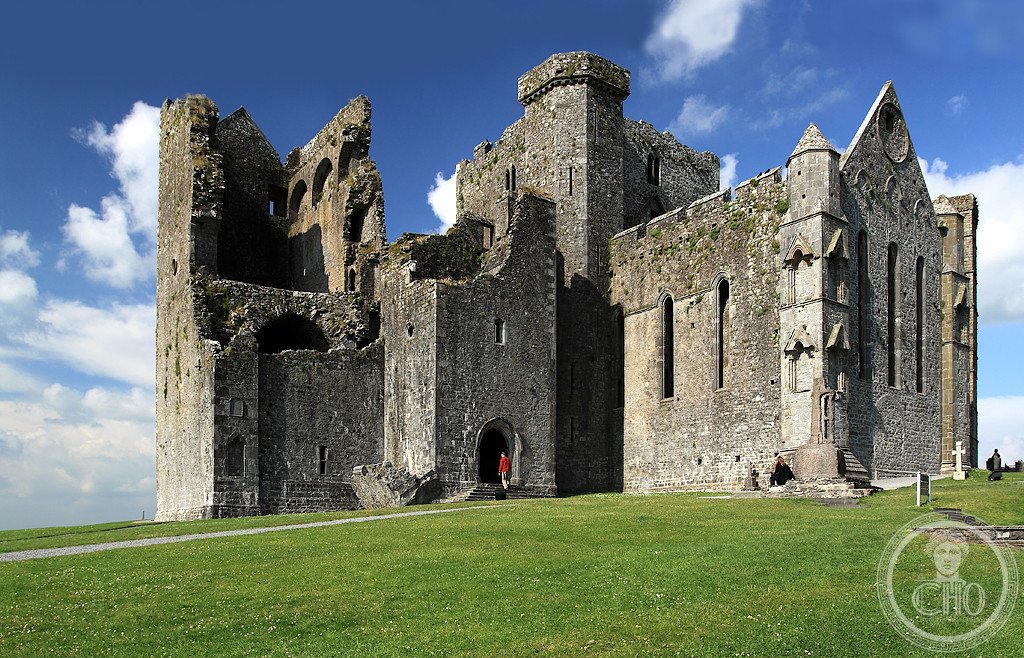
According to tradition, when Saint Patrick converted King Aengus of Munster to Christianity in the fifth century, he set the point of his crozier on the king’s foot by mistake instead of on the ground, piercing it. The king, believing that the pain was part of the baptism rite, did not say a word. Centuries later, in 1127, King Cormac Mac Carthaigh had a chapel built on this same rock that still holds the only surviving Romanesque frescoes in all of Ireland.
About the Rock of Cashel
The Rock of Cashel served as the traditional seat of the Kings of Munster from as early as the 4th century, well before the Norman invasion of Ireland, with the Eóganachta clan building a fortress atop the rock in the 5th century and maintaining supremacy over the site for hundreds of years afterward. In 977, Brian Boru — who would go on to become High King of Ireland — was crowned King of Munster at Cashel, making it his capital and cementing the site’s status as one of the most significant seats of royal power in early medieval Ireland. According to the Tripartite Life of Saint Patrick, Cashel is also reputed to be the site of the conversion of the King of Munster to Christianity by Saint Patrick in the 5th century; according to one well-known version of the legend, as Patrick performed the baptism, he inadvertently drove the sharp point of his crozier through the foot of King Aengus rather than into the ground beside him, yet the king, believing the pain to be an expected part of the sacred ritual, endured it in silence without complaint. Local tradition also connects the Rock’s very origin to a legend involving Saint Patrick and the Devil: the rock is said to derive from the “Devil’s Bit,” a mountain some 30 kilometres north of Cashel, where Patrick banished Satan from a cave, causing a great bite of rock to fly through the air and land at Cashel. The site’s most architecturally significant surviving structure is Cormac’s Chapel, built for King Cormac Mac Carthaigh, begun in 1127 and consecrated in 1134; a sophisticated building with vaulted ceilings and wide arches drawing on contemporary European architectural currents while incorporating distinctive native Irish elements, the chapel contains the only surviving Romanesque frescoes anywhere in Ireland.
Key facts
- 4th-5th century: traditional seat of the Kings of Munster, fortified by the Eóganachta clan
- 5th century: Saint Patrick reportedly converts King Aengus, piercing his foot with a crozier
- 977: Brian Boru crowned King of Munster at Cashel
- 1127-1134: Cormac’s Chapel built and consecrated
- Unique feature: Ireland’s only surviving Romanesque frescoes, in Cormac’s Chapel
- Legend: the Rock’s origin traced to the “Devil’s Bit” mountain
History
Cashel’s centuries-long role as the seat of the Kings of Munster, culminating in Brian Boru’s 977 coronation there before his later rise to High King of all Ireland, situates the Rock among the handful of truly foundational royal sites of early medieval Irish history, comparable in political significance to Tara as a seat of pre-Norman Irish kingship. The legend of Patrick’s accidental piercing of King Aengus’s foot, and the king’s stoic silence in the belief it was part of the sacred rite, has become one of the most frequently retold episodes of Irish hagiographical tradition, illustrating the blending of genuine historical conversion narratives with vivid, memorable folk embellishment.
Cormac’s Chapel’s unique status as the sole surviving example of Romanesque fresco painting in all of Ireland gives the Rock of Cashel exceptional art-historical importance far beyond its political history, preserving a fragile artistic tradition that has otherwise vanished entirely from the Irish medieval architectural record.
What you see
The Rock of Cashel complex includes the ruined 13th-century Gothic cathedral, the round tower dating to around 1100, and Cormac’s Chapel, whose vaulted Romanesque interior preserves Ireland’s only surviving medieval frescoes alongside sophisticated carved stonework blending European and native Irish decorative traditions. The site’s dramatic hilltop setting, visible for miles across the surrounding Tipperary countryside, remains one of the most recognisable silhouettes in Irish heritage tourism.
Practical information
- Opening hours: generally open daily with seasonal variation; check current hours before visiting; admission fee applies
- Address: Tipperary Heritage Way, Cashel, County Tipperary, Ireland
Getting there
The Rock of Cashel is located on a hilltop above the town of Cashel, County Tipperary, in the province of Munster, reachable by road. GPS: 52.5202° N, -7.8906° E.
Nearby
- Hore Abbey — a ruined Cistercian abbey visible from the Rock, nearby
- Cashel town centre — the surrounding historic town
- Devil’s Bit mountain — the mountain associated with the Rock’s origin legend, roughly 30 kilometres away
Sources
- Wikipedia — “Rock of Cashel” (en.wikipedia.org)
- Heritage Ireland — “The Rock of Cashel” (heritageireland.ie)
- Royal Sites of Ireland — “Rock of Cashel” (royalsites.ie)
Find it on the map
See this place and what’s around it →📷 Become a Cultural Heritage Online photographer
Share your photos of places: they stay published under your name as the author. The more they're seen, the more you get noticed — and soon a contest will reward the most appreciated photos.
Log in or sign up free to add a photo