

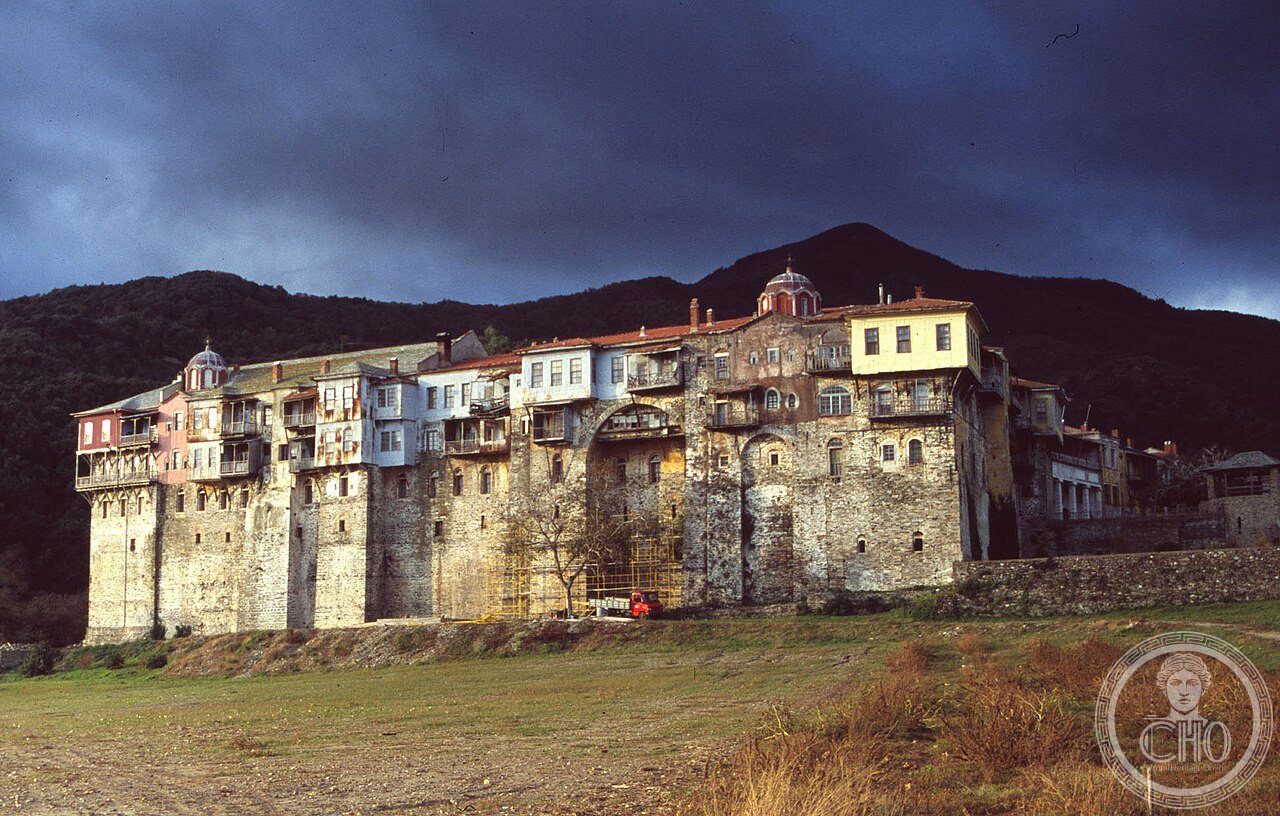
According to legend, a pious woman of Nicaea cast an icon of the Virgin into the sea to save it from destruction during the iconoclast persecutions. The icon floated for years, until in 1004 it came miraculously ashore, standing upright, before the monastery of Iviron. The monks tried several times to place it in the main church, but every morning they found it gone from the altar and standing again by the entrance gate. They took this as a sign and built a small chapel there: ever since, the icon has been venerated as the Panagia Portaitissa, the “Virgin Keeper of the Gate”.
About Iviron Monastery
The Holy Monastery of Iviron, third in the hierarchical order of the twenty monasteries of Mount Athos, was founded around 979-983 by Georgian (Iberian) monks of aristocratic descent, led by John the Iberian — son of Euthymius — together with the military officer John Tornikios. The founders had come from a group of Georgian monks associated with Great Lavra, and their new foundation was built on the site of an earlier, ruined monydrion dedicated to Saint Clement, quickly growing into a major centre of Georgian Orthodox monastic life on the peninsula and remaining, to this day, the historic Georgian monastery of Mount Athos. Among Iviron’s most treasured possessions is the icon of the Panagia Portaitissa (“Our Lady of the Gate”), whose arrival at the monastery is recounted through a celebrated legend: a pious widow in Nicaea, fearing the icon’s destruction at the hands of iconoclast persecutors, cast it into the sea to save it, and though grief-stricken at its loss, was comforted by the Virgin Mary in a dream, who promised that the icon would reach a holy place and be venerated by the faithful of every nation for centuries to come. The icon is said to have floated upright across the sea for years before arriving, still standing, directly in front of Iviron in 1004. According to tradition, the widow’s only son later became a monk and travelled to Mount Athos, spending the remainder of his life at Iviron. When the monks first attempted to place the icon within the monastery’s main church, it would repeatedly vanish overnight, only to be found again beside the monastery’s entrance gates each following morning; interpreting this as a divine sign, the monks built a small chapel at the gate itself, where the icon of the Panagia Portaitissa has remained venerated ever since.
Key facts
- 979-983: founded by Georgian monks John the Iberian and John Tornikios
- Rank: third in hierarchical order among the twenty Mount Athos monasteries
- Founding legend: a widow in Nicaea casts a Marian icon into the sea to save it from iconoclasts
- 1004: the icon miraculously arrives, floating upright, at Iviron
- The gate chapel: built after the icon repeatedly relocated itself there
- Name: Panagia Portaitissa, “Our Lady of the Gate”
- Legacy: the historic centre of Georgian Orthodox monasticism on Mount Athos
History
Iviron’s founding by Georgian aristocratic monks situates the monastery within the broader medieval network of Georgian Orthodox Christianity’s close ties to Byzantine monastic culture, making it one of the clearest surviving physical expressions of Georgian religious and cultural presence within the wider Byzantine world during the 10th and 11th centuries. The legend of the Panagia Portaitissa icon’s self-relocation to the monastery gate belongs to a distinctive category of Orthodox miracle narratives in which a sacred image itself expresses a preference for its own placement, a phenomenon recorded at several major Orthodox pilgrimage sites but rarely with such a well-documented and enduringly venerated outcome as at Iviron.
The icon’s origin story, tied to the Byzantine Iconoclasm controversy of the 8th and 9th centuries, connects Iviron directly to one of the most significant theological conflicts in the history of the Eastern Church, in which the veneration of religious images was itself violently contested — giving the Portaitissa icon a symbolic resonance extending well beyond its role as a simple object of local devotion.
What you see
The monastery’s extensive fortified complex includes its katholikon (main church) and numerous chapels, among them the small gate chapel built specifically to house the Panagia Portaitissa icon following its repeated self-relocation. Iviron’s treasury and library preserve significant collections of icons, manuscripts, and liturgical objects reflecting the monastery’s long history as a centre of Georgian and Byzantine Orthodox monastic culture.
Practical information
- Opening hours: access restricted to male visitors with a special pilgrim permit (diamonitirion), issued by the Mount Athos administration
- Address: Iviron, Mount Athos Autonomous Monastic State, Greece
Getting there
Iviron Monastery is located on the northeastern coast of the Mount Athos peninsula in northern Greece, reachable only by boat and only with the required pilgrim permit. GPS: 40.2460° N, 24.2854° E.
Nearby
- Vatopedi Monastery — the second-ranked Athonite monastery, nearby along the coast
- Karyes — the administrative capital of the Mount Athos monastic state
- Great Lavra — the oldest and first-ranked monastery of Mount Athos
Sources
- Wikipedia — “Monastery of Iviron” (en.wikipedia.org)
- Monastiriaka — “Holy Monastery Iviron: the history of the Monastery and the miraculous icon of Panagia Portaitissa” (monastiriaka.gr)
- OrthodoxWiki — “Iviron Monastery (Athos)” (orthodoxwiki.org)
Find it on the map
See this place and what’s around it →📷 Become a Cultural Heritage Online photographer
Share your photos of places: they stay published under your name as the author. The more they're seen, the more you get noticed — and soon a contest will reward the most appreciated photos.
Log in or sign up free to add a photo