
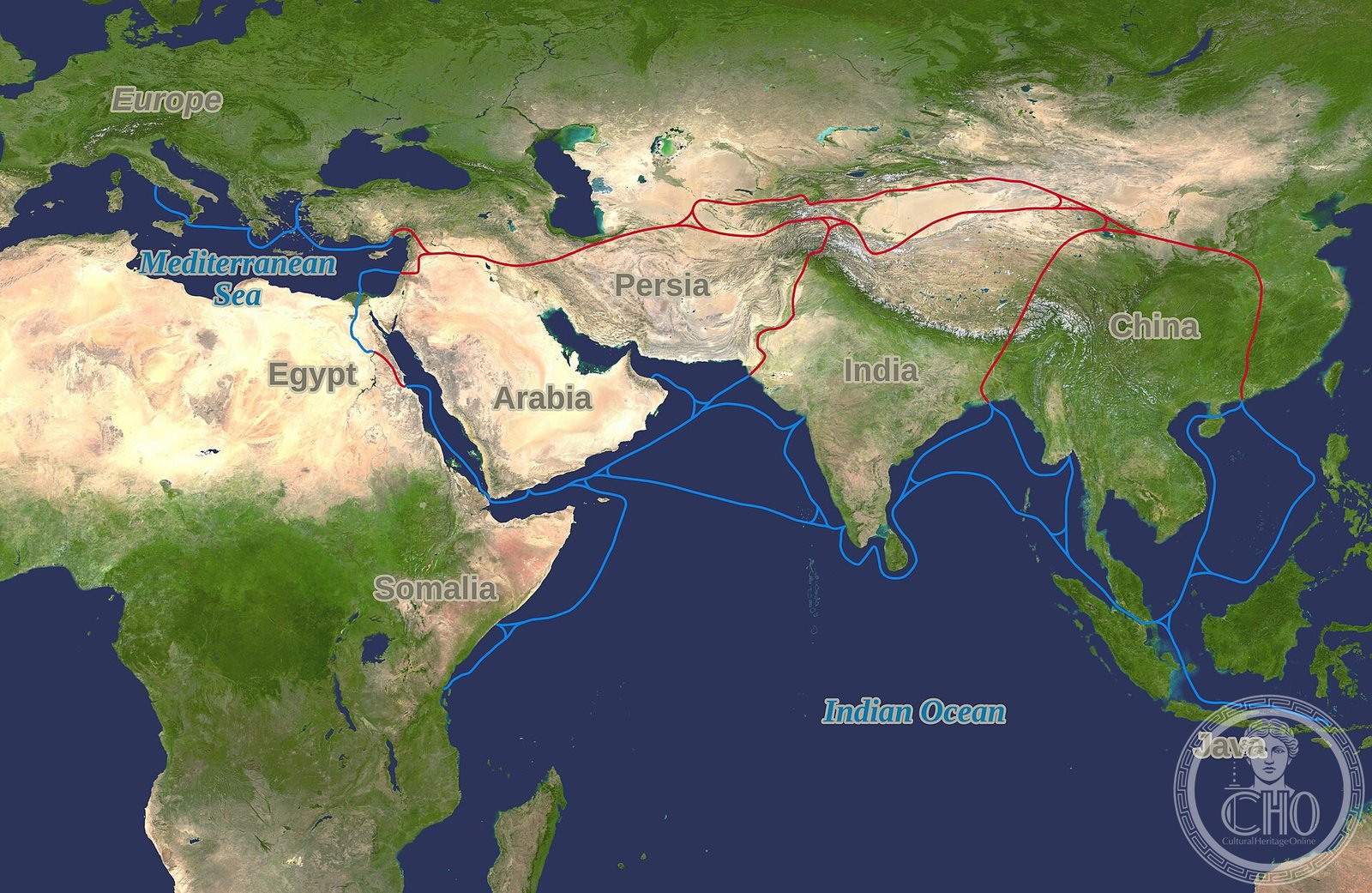
A single UNESCO World Heritage Site made of 33 separate places — palace ruins, garrison towns, Buddhist grottoes and caravan waystations — strung across roughly 5,000 km from the ancient Chinese capital of Chang’an to the Chuy Valley of Kyrgyzstan, tracing the historic corridor where the Silk Road left its densest surviving trace.
At a glance
Inscribed by UNESCO in 2014, this transnational serial site is not one location but a network: 22 component parts in China, 8 in Kazakhstan and 3 in Kyrgyzstan, jointly nominated because no single ruin can represent a trade and pilgrimage corridor that operated for over a thousand years. Together they document the movement of goods, Buddhism, and imperial power along the Chang’an-Tianshan section of the wider Silk Road network.
History
From the Han dynasty’s opening of formal relations with Central Asia in the 2nd century BCE, the corridor running west from the imperial capital of Chang’an (modern Xi’an) through the Hexi Corridor and the oasis kingdoms of the Tarim Basin into the Chuy Valley became one of the most consequential trade and cultural arteries in world history. Along it moved silk, glass, paper-making technology, Buddhist scripture and iconography, and the administrators, monks and merchants of successive Chinese, Central Asian and nomadic Turkic states.
The 33 component sites recognised by UNESCO span palace and city ruins near Xi’an (Weiyang Palace, Daming Palace), Buddhist cave complexes cut into cliffs along the Hexi Corridor and in the Tarim Basin (Bingling Temple, Maijishan, Kizil Caves), fortress and garrison towns in Xinjiang (Jiaohe, Gaochang, Beshbalik), and settlement sites in the Ili and Chuy valleys of Kazakhstan and Kyrgyzstan (Talgar, Kayalyk, Suyab, Balasagun/Burana) that mark the corridor’s westward terminus toward the wider Central Asian Silk Road network.
What you see
Because the site is a network rather than a single monument, what a visitor sees depends entirely on which component is visited: mudbrick city walls preserved by the extreme aridity of the Turpan Depression at Jiaohe and Gaochang; cliff-carved Buddhist sculpture and murals at Maijishan and Kizil; and, at the corridor’s western edge in Kyrgyzstan, the standing brick minaret of Burana Tower — the last visible remnant of the Karakhanid city of Balasagun. No single itinerary “completes” the site; heritage travellers typically choose a manageable arc of component parts rather than attempting all 33.
Cultural significance
UNESCO’s inscription recognises the corridor as physical evidence of one of history’s most significant channels of cultural, religious and commercial exchange between East Asia and Central Asia — a network whose Buddhist art, in particular, shows a traceable stylistic evolution as it moved from Gandharan and Persian influence toward distinctly Chinese forms across the string of sites from Kizil to Maijishan.
Key facts
- Countries: China, Kazakhstan, Kyrgyzstan
- Coordinates (reference point): 35.81°N, 103.04°E (central Gansu, along the Hexi Corridor)
- UNESCO World Heritage Site: Yes, inscribed 2014, transnational serial nomination
- Component parts: 33 across three countries (22 China, 8 Kazakhstan, 3 Kyrgyzstan)
Practical information & getting there
The corridor spans three countries and multiple visa regimes; realistic planning means picking one country or one arc rather than the full network. China’s component sites cluster around Xi’an, Tianshui and the Turpan/Kucha area of Xinjiang, all connected by domestic flights and high-speed rail. Kazakhstan’s and Kyrgyzstan’s sites cluster around Almaty and Bishkek respectively, roughly a day’s overland travel from the Chinese sites via Central Asian border crossings. See the linked itinerary below for a practical six-stage route through the corridor’s most accessible sites.
Sources & resources
Find it on the map
See this place and what’s around it →

📷 Become a Cultural Heritage Online photographer
Share your photos of places: they stay published under your name as the author. The more they're seen, the more you get noticed — and soon a contest will reward the most appreciated photos.
Log in or sign up free to add a photo