
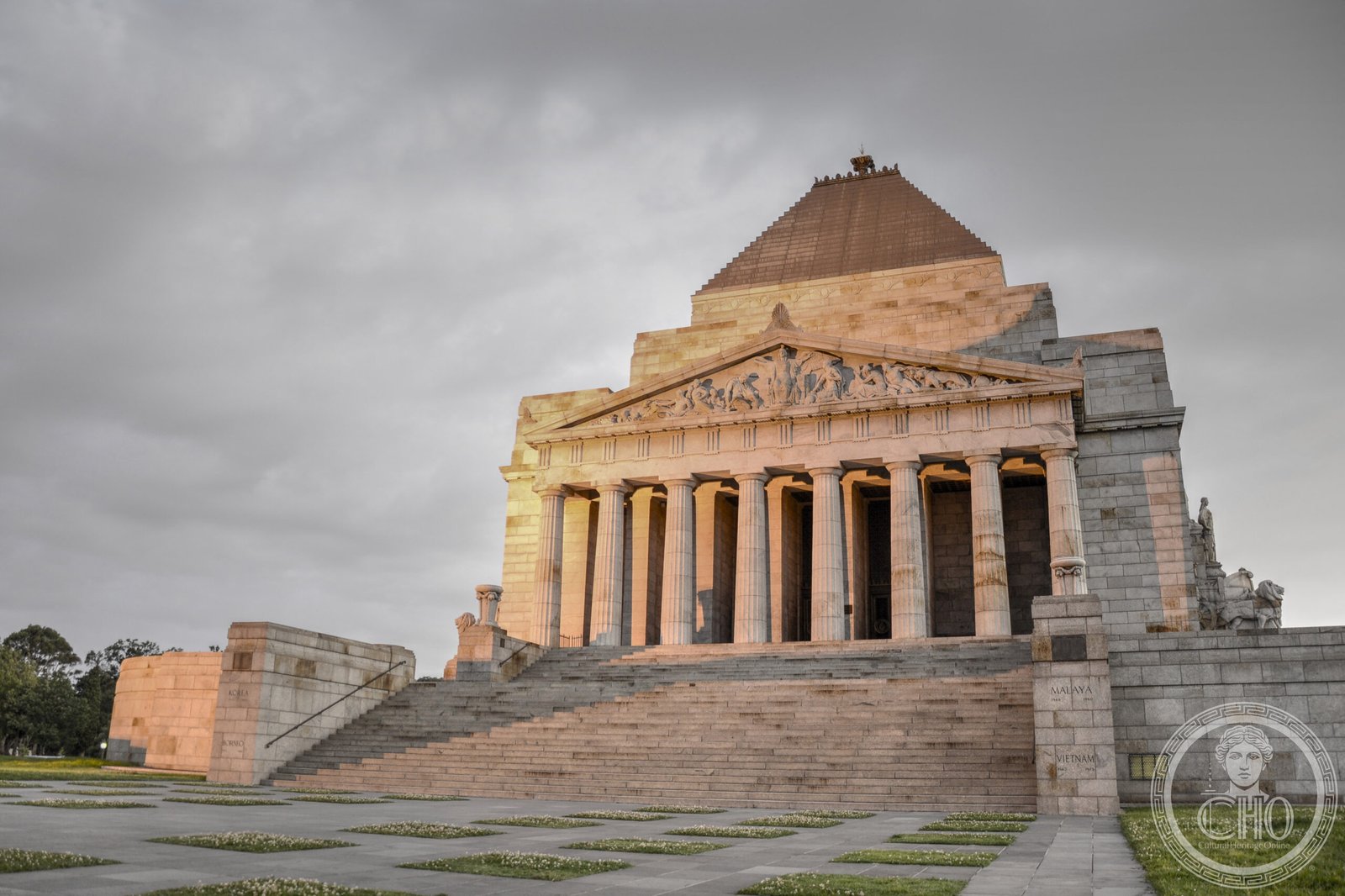
The Shrine of Remembrance is Melbourne's most solemn landmark and Australia's pre-eminent war memorial, dedicated to the men and women who served in the First World War and all subsequent conflicts. Built from Tynong granite and modelled on the great monuments of antiquity, it crowns the southern boulevard of St Kilda Road with a gravity that has shaped the city's civic identity for nearly a century.
At a glance
- Type
- War memorial / museum
- Period
- 1927–1934 (foundation stone to dedication)
- Style
- Classical / Art Deco influenced
- Location
- Birdwood Avenue, Kings Domain, Melbourne, Victoria, Australia
- Coordinates
- 37.8306° S, 144.9734° E
- Architect(s)
- Phillip Hudson and James Wardrop
Overview
Situated in the Kings Domain parkland at the head of St Kilda Road, the Shrine of Remembrance commands Melbourne's ceremonial axis from the city centre southward. Originally built to honour Victoria's 114,000 First World War servicemen and women, it now serves as a national memorial to all Australians who have served in any war or armed conflict. The building houses a visitor centre, the sacred Sanctuary, and a Crypt containing detailed records of every Australian Imperial Force unit. Each year it draws hundreds of thousands of visitors for Anzac Day and Remembrance Day ceremonies.
History
Proposals for a major Melbourne war memorial emerged in 1918, immediately after the Armistice. A design competition launched in 1922 attracted 83 entries; architects Phillip Hudson and James Wardrop — both veterans of the Western Front — were announced winners in December 1923. Their classical design provoked fierce opposition from newspaper magnate Keith Murdoch and sections of the church who found it insufficiently Christian and too austere. General Sir John Monash rallied support and secured government backing by 1927. The foundation stone was laid on Remembrance Day, 11 November 1927, and construction by contractors Vaughan and Lodge concluded in time for the dedication ceremony on 11 November 1934, witnessed by an estimated 300,000 people — roughly one-third of Melbourne's entire population at the time.
Architecture & Design
Hudson and Wardrop drew explicitly on two of antiquity's most celebrated structures: the Mausoleum at Halicarnassus and the Parthenon in Athens. The result is a square-plan building with a stepped pyramid roof, eight fluted Doric columns on north and south porticos, and four corner statuary groups representing Peace, Justice, Patriotism, and Sacrifice. The primary material is granodiorite quarried at Tynong, supplemented by Redesdale sandstone and black marble columns from Buchan. The Shrine's most celebrated design feature is an aperture in the roof of the Sanctuary: once a year, at exactly 11 a.m. on 11 November, a ray of sunlight strikes the word LOVE on the marble Stone of Remembrance — a moment aligned with the hour of the 1918 Armistice. While firmly classical in inspiration, the building's stripped geometric severity resonates with the contemporaneous Art Deco spirit of restraint and monumental abstraction.
Cultural significance
The Shrine of Remembrance is more than an architectural monument; it is the physical focus of Australia's collective memory of war and national sacrifice. The annual Anzac Day Dawn Service regularly draws more than 35,000 participants and is broadcast nationally. The building anchors Melbourne's ceremonial landscape and is listed on the Victorian Heritage Register. Its Crypt panels recording every AIF unit provide an irreplaceable genealogical and military-history resource, while the visitor centre's permanent exhibitions contextualise Australian military service from 1885 to the present day.
Visiting today
The Shrine is open daily (closed Christmas Day and Good Friday) and admission to the Shrine itself is free. The underground Visitor Centre houses permanent and temporary exhibitions with a small entry fee. Guided tours are available. The surrounding Kings Domain gardens and the commemorative avenues of honour are open to the public at all times. The annual Anzac Day Dawn Service (25 April) and Remembrance Day ceremony (11 November at 11 a.m.) are both open to the public.
Getting there
The Shrine is accessible from Melbourne CBD via tram routes 3, 3a, 5, 6, 16, 64, 67, and 72, all running south along St Kilda Road — alight at the Domain Interchange or Shrine stop. It is a 20-minute walk from Flinders Street Station through the Royal Botanic Gardens. The site has limited car parking; public transport is recommended. Bicycles may be secured at racks near the entrance forecourt.
Sources & resources
Find it on the map
See this place and what’s around it →Record researched and written by Luigi De Marchi for Cultural Heritage Online, 2026.
📷 Become a Cultural Heritage Online photographer
Share your photos of places: they stay published under your name as the author. The more they're seen, the more you get noticed — and soon a contest will reward the most appreciated photos.
Log in or sign up free to add a photoIs this page about you?
This page is read by travellers and heritage enthusiasts who find it on Google. Tell us how you are connected to this place and we will take it from there.