
The Dynastic Shrine That Launched an Empire
The Sheikh Safi al-Din Shrine Ensemble in Ardabil, northwestern Iran, is one of the most significant Sufi religious complexes in the Islamic world and the ancestral mausoleum of the Safavid dynasty — the rulers who unified Iran, established Twelver Shia Islam as the state religion, and shaped the cultural and political identity of the country from 1501 to 1736. UNESCO inscribed the site in 2010 for its outstanding architecture, decorative arts, and historical significance as the birthplace of a dynasty that defined Iranian civilisation for over two centuries.
Sheikh Safi al-Din Ardabili: The Founding Ancestor
Sheikh Safi al-Din Ishaq Ardabili (1252–1334) was a Sufi mystic and head of the Safaviyya Sufi order, whose descendants would eventually transform their spiritual authority into political power and establish the Safavid Empire. His shrine, begun during his lifetime and expanded over the following two centuries, became the spiritual heart of the order and the focal point for the loyalty of the Safavid Qizilbash tribal warriors whose military force made the empire possible. The complex is thus simultaneously a religious monument, a dynastic mausoleum, and an origin point for a major chapter in world history.
The Ensemble: A City Within a City
The shrine ensemble is not a single building but a multi-layered complex of interconnected spaces evolved over four centuries. Moving from the public entrance to the innermost sanctuary, the pilgrim passes through: the Darwish gate and its portico; the Chini-Khaneh (China House) — a room whose walls and niches once held the Ardabil Carpet and the vast imperial collection of Chinese porcelain; the Jannat-Sara (Paradise Court) with its arcaded portico; the Sahib al-Amr tower; and finally the Qandil-Khaneh (Lamp House) and the mausoleum chamber where Sheikh Safi and the Safavid ancestors are interred.
The Ardabil Carpet: The World’s Oldest Dated Carpet
The Chini-Khaneh room housed the Ardabil Carpet — one of the two oldest dated carpets in the world (inscribed 946 AH / 1539–40 CE), woven for this shrine under the patronage of Shah Tahmasp I. The carpet measures 10.5 × 5.3 metres and contains approximately 25 million knots (340 per square inch), depicting a central medallion surrounded by an arabesque field and 16 smaller pendants. Sold in the 19th century to cover restoration costs, it is now in the collection of the Victoria and Albert Museum in London. Its twin is in the Los Angeles County Museum of Art.
Safavid Architecture and Tile Decoration
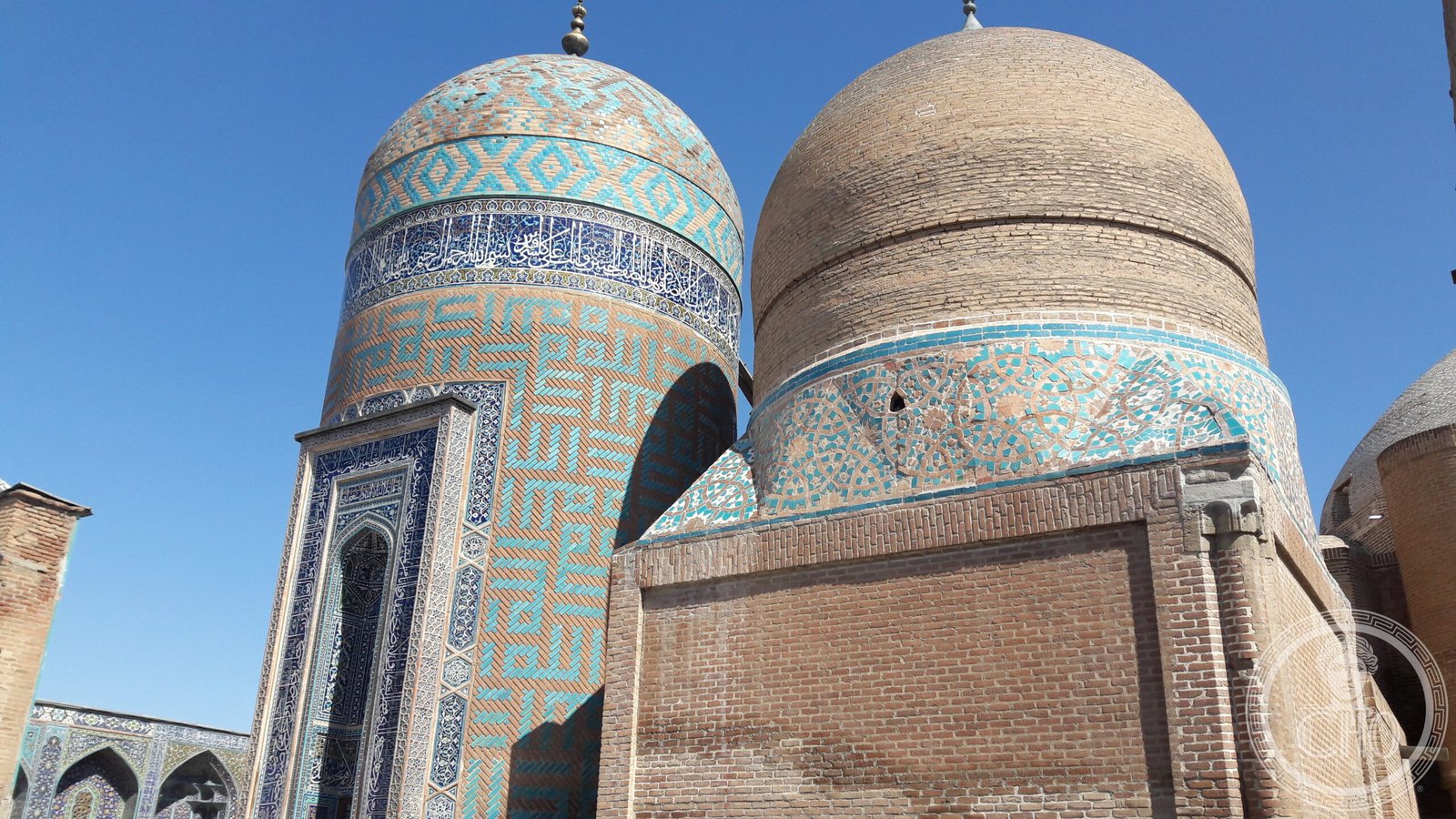
The ensemble is a showcase of Safavid decorative art at its peak. The towers and domes are clad in glazed tile mosaic (kashi-kari) in the characteristic Safavid palette of deep blue, turquoise, white, and gold. The Harun-e Vilayet tower — a conical “onion dome” rising above the mausoleum — is tiled in a double-shell construction that creates a lantern effect when lit from within. The muqarnas vaulting in the portico displays the mathematical intricacy of geometric stalactite ornament that reached its zenith in Safavid Isfahan and Ardabil.
The Library and the Intellectual Heritage
The shrine complex included a library endowed by the Safavid shahs with manuscripts, Qurans, and books on theology, philosophy, and natural science. The collection was among the most important in the Islamic world before its dispersal; individual volumes from the Ardabil library are now in the Golestan Palace library in Tehran, the British Library, and various European collections. The physical library chamber survives as part of the ensemble, its carved plasterwork niches empty but eloquent.
The Chini-Khaneh and the Imperial Porcelain Collection
Among the most remarkable spaces in the ensemble is the Chini-Khaneh (China House), a room built under Shah Abbas I (r. 1588–1629) to display the imperial collection of Chinese celadon and blue-and-white porcelain — which Shah Abbas I donated to the shrine in 1611 along with a recorded gift of 1,162 pieces. The room’s walls are articulated with shaped niches precisely fitted to display the porcelain vessels, creating an interior that was as much a display of imperial power as a devotional space. Most pieces were removed in the 19th century; the niches survive.
Ardabil and Visiting the Shrine
Ardabil is a provincial capital in northwestern Iran, approximately 650 km northwest of Tehran and accessible by air (Ardabil Airport) or road. The city is located at 1,500 metres altitude in a high plain near the Sabalan volcano, giving it a cooler climate than most of Iran. The shrine ensemble occupies a central position in the old city and is visited as a place of active religious pilgrimage as well as a heritage monument — a dual function that has characterised the site continuously since the 14th century. Visiting hours accommodate both pilgrims and tourists throughout the day.
Find it on the map
See this place and what’s around it →📷 Become a Cultural Heritage Online photographer
Share your photos of places: they stay published under your name as the author. The more they're seen, the more you get noticed — and soon a contest will reward the most appreciated photos.
Log in or sign up free to add a photoIs this page about you?
This page is read by travellers and heritage enthusiasts who find it on Google. Tell us how you are connected to this place and we will take it from there.