
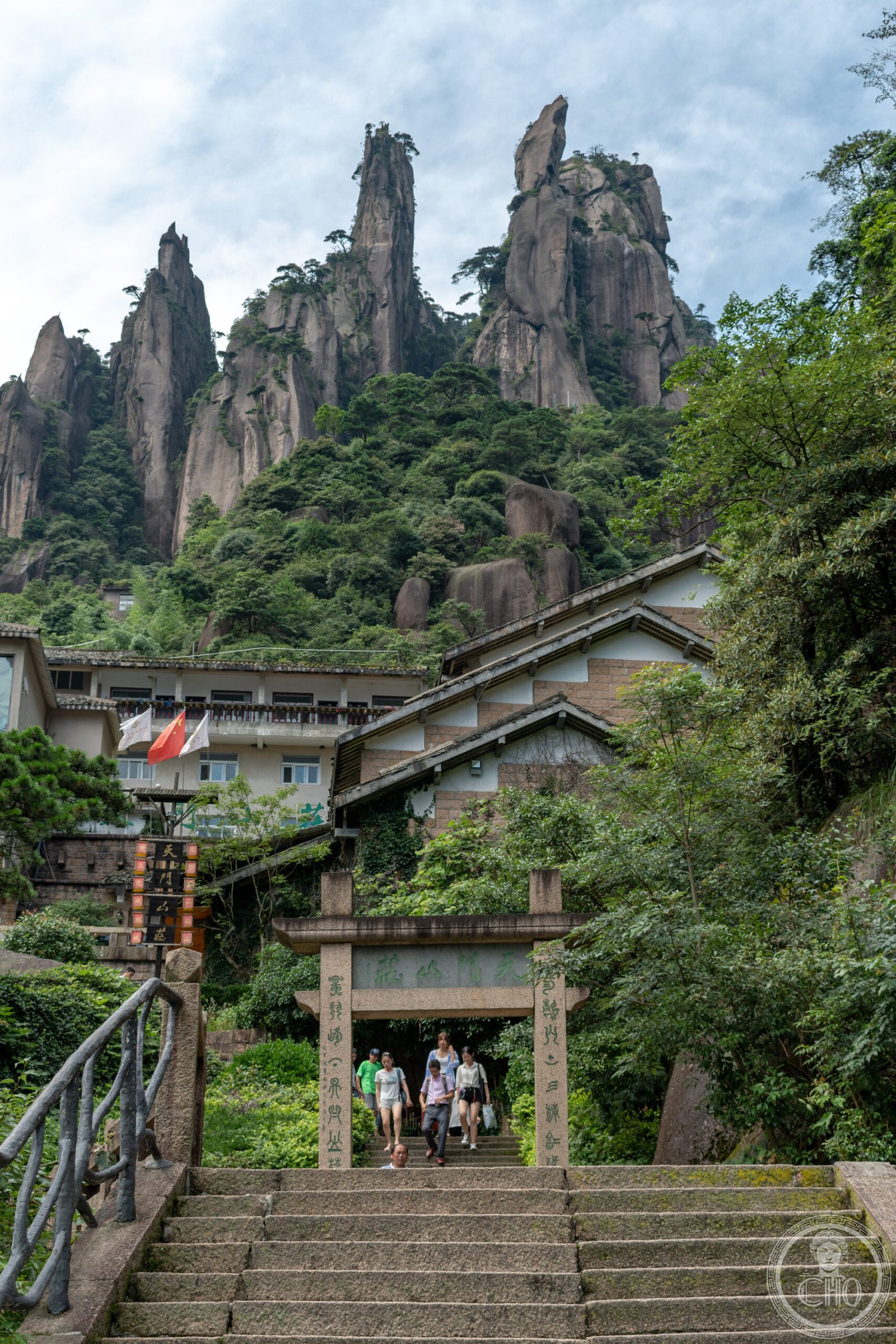
Granite Pillars in the Clouds
Mount Sanqingshan (Three Pure Ones Mountain) in Jiangxi Province, eastern China, is a landscape of breathtaking geological and aesthetic grandeur, where hundreds of vertical granite pillars and peaks emerge from dense subtropical forest and drift in and out of cloud. The mountain takes its name from the Taoist Three Pure Ones — the supreme deities of the Taoist pantheon — and has been a sacred Taoist pilgrimage site and a source of artistic inspiration for Chinese landscape painters and poets for over 1,600 years. UNESCO inscribed Mount Sanqingshan in 2008 as a natural World Heritage site of exceptional scenic value.
Geology: Granite Sculpted by Time
The granitic massif of Sanqingshan began forming approximately 820 million years ago from the crystallisation of magma deep in the Earth’s crust. Uplift over hundreds of millions of years brought the granite to the surface; subsequent erosion by water, ice, and biological processes exploited the natural fracture systems (joints) of the rock to isolate columns, pillars, and pinnacles. The result is 48 major granite peaks and 89 distinctly named pillars, carved from rock that is exceptionally resistant to weathering yet fractured along precise joint planes that create the characteristic vertical geometry of the landscape.
The Named Formations: Python and Pilgrim
Chinese landscape tradition assigns poetic names to natural rock formations based on perceived resemblances and mythological associations. At Sanqingshan, the “East China Sea Pilgrim” is a 30-metre column resembling a robed figure facing the sea; the “Giant Python Emerging from the Mountains” is a 128-metre sinuous ridge of upturned granite interpreted as a serpent in mid-emergence. These named formations are focal points for both pilgrimage and photography, and the act of naming them reflects centuries of human engagement with the landscape as a repository of meaning.
Taoism and the Sacred Mountain
Sanqingshan’s association with Taoism dates to at least the Eastern Jin Dynasty (317–420 CE), when the Taoist master Ge Hong is said to have refined alchemical pills on the mountain seeking immortality. By the Tang Dynasty (618–907 CE), temples and shrines had been built among the peaks. The Sanqing Palace complex, constructed during the Ming Dynasty (1368–1644 CE), is the spiritual centre of the mountain, housing temples dedicated to the Three Pure Ones and surrounded by 230 Taoist stone carvings and 36 pavilions and bridges — all integrated into the rocky terrain rather than imposed upon it.
Clouds and Mist: The Theatrical Atmosphere
Sanqingshan lies in a region of high humidity and complex air circulation, producing a near-constant cycle of cloud formation, mist, and atmospheric drama. The mountain averages over 200 fog days per year. The interplay of clouds with the granite pillars — obscuring and revealing them, catching light, creating depth and mystery — is the primary source of the mountain’s aesthetic power and its influence on the shanshui (mountain-water) tradition of Chinese landscape painting. Early morning in particular, when valley cloud fills the spaces between pillars while the peaks catch the first light, is considered the optimal viewing time.
Biodiversity: A Subtropical Forest Refuge
The forest cover of Sanqingshan National Park — predominantly subtropical evergreen broadleaved forest below 1,600m and coniferous forest above — supports high biodiversity in a region that served as a refugium during Quaternary glacial cycles. The park contains over 2,500 plant species, including numerous endemic ferns and orchids, and 300 bird species. Clouded leopard and South China tiger have been recorded historically, though both are now critically endangered across their range. The South China giant salamander (Andrias davidianus), the world’s largest amphibian, inhabits the mountain streams.
The Boardwalk Trail System
Access to Sanqingshan’s most dramatic formations is provided by an extraordinary system of cantilevered boardwalks built directly into the cliff faces — some sections overhanging vertical drops of hundreds of metres. The “Overhang Boardwalk on the Western Coast” traverses 3 km of near-vertical cliff face at approximately 1,600 metres elevation, offering unobstructed views of the pillar landscape. The engineering of these walkways — anchored into the granite and periodically replaced due to weathering — is itself a testament to the importance China places on public access to its extraordinary natural heritage.
Visiting: Cable Cars, Seasons, and the Summit
Mount Sanqingshan is located approximately 150 km north of Shangrao city, accessible by road and then cable car to the mountain area. Multiple cable car systems serve different sections of the park, reducing the physical demands on visitors. The peak season is summer and autumn, though spring brings azaleas in bloom against the granite. The summit area (Yujing Peak, 1,816m) is cool year-round, with temperatures 10-15°C lower than the Jiangxi basin. The park can be visited in one to two days, with a circuit of the main boardwalk system taking approximately four to six hours.
Find it on the map
See this place and what’s around it →📷 Become a Cultural Heritage Online photographer
Share your photos of places: they stay published under your name as the author. The more they're seen, the more you get noticed — and soon a contest will reward the most appreciated photos.
Log in or sign up free to add a photo