
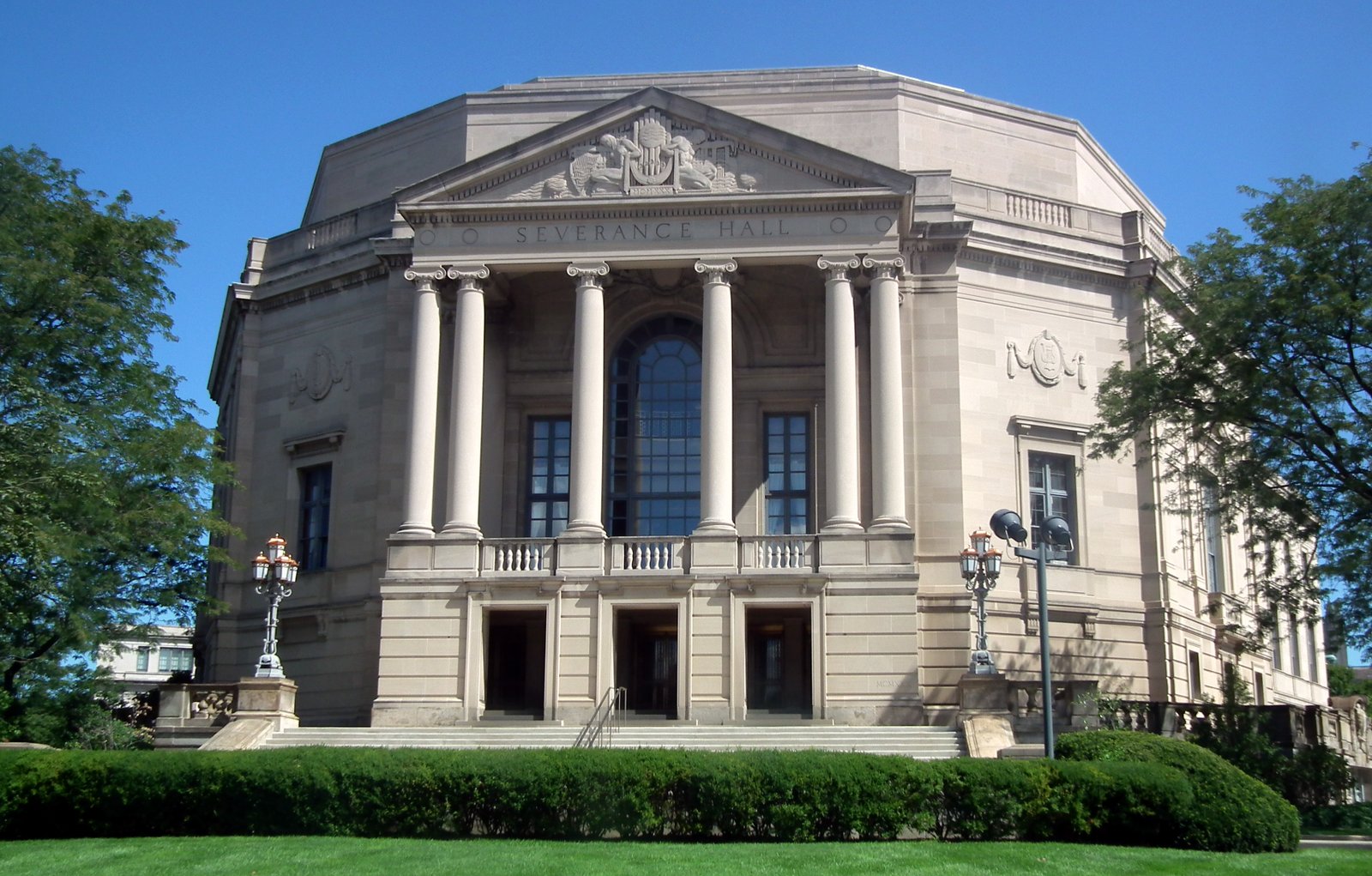
A gift from John L. Severance in memory of his wife Elisabeth, Severance Hall was designed by Walker & Weeks as a Neoclassical shell housing one of the most lavishly Art Deco concert interiors in America—the permanent home of the Cleveland Orchestra since the night it opened in February 1931.
At a glance
Severance Hall stands at 11001 Euclid Avenue in Cleveland’s University Circle, the cultural district that consolidates the Cleveland Museum of Art, Case Western Reserve University, and several other major cultural institutions within a compact area east of downtown. Designed by Walker & Weeks and opened on February 5, 1931, the hall was built as the purpose-built home of the Cleveland Orchestra—at that time already one of the finest orchestras in the United States. The exterior presents a Neoclassical limestone colonnade, but the interior—designed in the Art Deco manner with Egyptian, Greco-Roman, and Baroque ornamental registers combined in the eclectic spirit of 1930s American decorative art—is among the most richly ornamented concert hall interiors in the country. A major restoration and expansion by Skidmore, Owings & Merrill, completed in 2000, restored the original decoration and added a significant underground addition.
Key facts
- Address: 11001 Euclid Avenue, Cleveland, OH 44106
- Architects: Walker & Weeks
- Patron: John L. Severance (in memory of wife Elisabeth DeWitt Severance)
- Opened: February 5, 1931
- Style: Neoclassical exterior; Art Deco interior
- Capacity: approximately 1,890 seats
- Landmark status: Cleveland Landmark; National Register of Historic Places
- Current use: Permanent home of the Cleveland Orchestra; concerts and special events
- Major restoration: Skidmore, Owings & Merrill, completed 2000
History
The Cleveland Orchestra was founded in 1918 and by the late 1920s, under conductor Nikolai Sokoloff and then Artur Rodzinski, had grown into one of the leading orchestras in North America. It lacked, however, a purpose-built hall; performances were given in a series of commercial venues unsuited to the acoustic and operational requirements of a major symphony orchestra. John L. Severance—an heir to the Rockefeller oil fortune and a major Cleveland philanthropist—resolved to remedy this. After the death of his wife Elisabeth in 1929, he commissioned Walker & Weeks to design a concert hall as her memorial, providing the full construction cost personally.
Walker & Weeks were the leading Cleveland architects of their generation, responsible for the Cleveland Public Library and several other institutional buildings in the University Circle area. For Severance Hall, they chose a Neoclassical exterior vocabulary—a limestone colonnade with a pedimented entrance portico—consistent with the institutional buildings of the surrounding district, while entrusting the interior to an Art Deco decorative programme that drew simultaneously on Egyptian, Greco-Roman, and Baroque ornamental sources in the eclectic manner that American decorative art in 1930 took as its standard.
George Szell, who became music director in 1946, made the Cleveland Orchestra one of the most technically precise ensembles in the world during his 24-year tenure; the orchestra’s reputation for clarity of ensemble, a quality Szell attributed partly to the intimate acoustic environment of Severance Hall, made the hall famous among musicians and recording engineers internationally. The Skidmore, Owings & Merrill restoration of 2000 corrected acoustic deficiencies that had accumulated over 70 years, added an underground parking and support facility, and restored the original Art Deco ornament in the auditorium and public spaces.
What you see
The Euclid Avenue approach to Severance Hall presents a Neoclassical limestone façade of clean, precise proportions: a projecting portico with full-height engaged columns, a triangular pediment, and a rusticated base. The building reads as a public institution of permanence and civic seriousness—a consistent stylistic choice given its position in the University Circle campus and its proximity to the Cleveland Museum of Art’s similar Neoclassical mass a few hundred metres to the north.
The interior comes as a deliberate and theatrical surprise. The auditorium is finished in a programme of Egyptian lotus columns, Baroque plasterwork, and gold-leaf panels that combines ornamental vocabularies from across three thousand years of Western and Mediterranean decorative history into a unified Art Deco synthesis. The intimate horseshoe plan concentrates approximately 1,890 seats close to the stage, and the low ceiling relative to the width of the room contributes to the acoustic intimacy that Szell valued and the 2000 restoration sought to preserve. The entrance foyer, corridors, and public rooms continue the Art Deco ornamental programme at a slightly reduced intensity, creating a sequence from street to auditorium in which each space is progressively more richly decorated.
Practical information
- Cleveland Orchestra season runs approximately September–May; summer Blossom Music Center season in Cuyahoga Falls. Check the Cleveland Orchestra website for current programme
- Guided tours of Severance Hall are offered periodically—check the Cleveland Orchestra website for tour schedules; some tours are free with concert ticket purchase
- The building is accessible; all seating levels including upper balconies are accessible by elevator
- University Circle is walkable: several restaurants and the CWRU campus are within 5 minutes on foot
- Allow 30 minutes before the performance to explore the public foyer and stairway spaces; the auditorium itself is not accessible until doors open 45 minutes before curtain
Getting there
Severance Hall stands at 11001 Euclid Avenue in University Circle, approximately 5 miles east of downtown Cleveland. The RTA Red Line (Rapid Transit) stops at University Circle station, a 10–15 minute walk from the hall. Cleveland Hopkins International Airport (CLE) is approximately 15 miles southwest; by car, I-90 and University Circle exit provide the most direct route from the airport or downtown. Parking is available at the hall’s underground garage (enter from E. Boulevard) and in the University Circle surface lots.
Nearby
- Cleveland Museum of Art — approximately 400 metres north; one of the finest encyclopedic art museums in the United States, with free general admission; Neoclassical 1916 building with a 2013 Rafael Viñoly addition
- Museum of Contemporary Art Cleveland (MOCA) — approximately 0.3 miles east on Euclid Avenue; in a striking 2012 Farshid Moussavi building on the University Circle green
- Natural History Museum of Cleveland — adjacent to the Cleveland Museum of Art on Wade Oval; dinosaur galleries and the Sears “Lucy” australopithecine cast
Sources
- National Register of Historic Places nomination: Severance Hall
- Cleveland Landmarks Commission designation: Severance Hall
- Cleveland Orchestra: institutional history of Severance Hall
- Rosenberg, Donald. The Cleveland Orchestra Story: “Second to None.” Cleveland: Gray & Company, 2000 (chapter on Severance Hall’s construction and acoustic history)
- Johannesen, Eric. Cleveland Architecture, 1876–1976. Cleveland: Western Reserve Historical Society, 1979
Find it on the map
See this place and what’s around it →📷 Become a Cultural Heritage Online photographer
Share your photos of places: they stay published under your name as the author. The more they're seen, the more you get noticed — and soon a contest will reward the most appreciated photos.
Log in or sign up free to add a photoIs this page about you?
This page is read by travellers and heritage enthusiasts who find it on Google. Tell us how you are connected to this place and we will take it from there.