
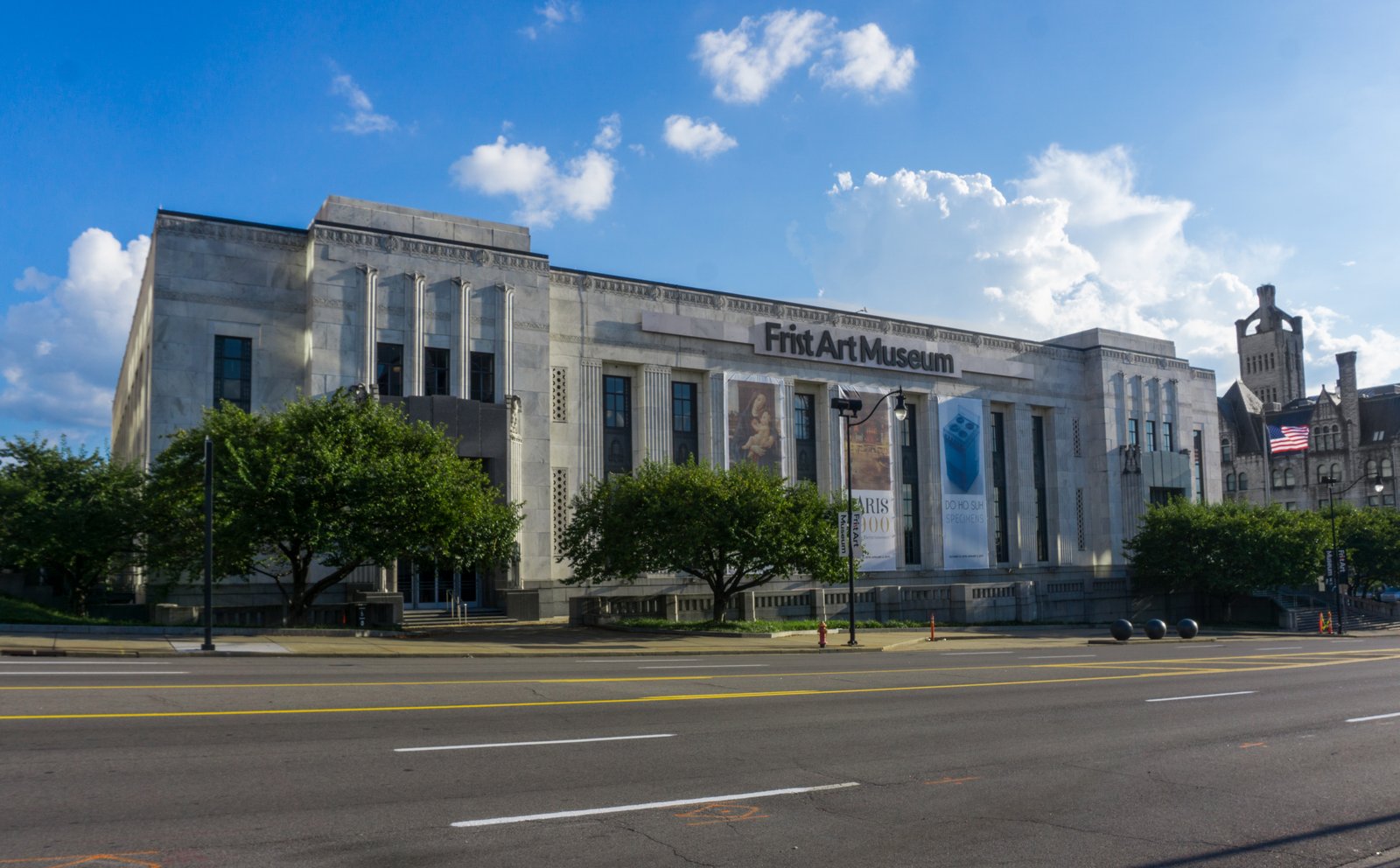
The former Nashville Main Post Office—a bold limestone Art Deco building completed in 1934 under the federal government’s Depression-era civic construction programme—was transformed into Nashville’s leading art museum in 2001, with its monumental public galleries occupying a space designed for an entirely different kind of civic transaction.
At a glance
The building that houses the Frist Art Museum was constructed in 1933–1934 as Nashville’s main post office under the direction of the Supervising Architect of the U.S. Treasury Department. Federal buildings of this era were typically designed to project civic permanence and authority through restrained but unmistakable Art Deco detail: the Nashville post office delivers this in a monumental limestone façade of vertical pilasters, geometric reliefs, and a recessed entrance portal whose proportions and ornament are entirely consistent with the federal Art Deco vocabulary developed across hundreds of comparable buildings throughout the country during the 1930s. The building became the Frist Center for the Visual Arts (later renamed Frist Art Museum) in 2001 after a major conversion that preserved the historic shell while creating flexible gallery and event spaces within.
Key facts
- Address: 919 Broadway, Nashville, TN 37203
- Original use: Nashville Main Post Office
- Completed: 1934
- Design: Office of the Supervising Architect, U.S. Treasury Department
- Style: Federal Art Deco
- Landmark status: Nashville Historic Landmark; National Register of Historic Places
- Current use: Frist Art Museum (opened 2001); no permanent collection
History
The Nashville post office was part of the federal government’s large-scale Depression-era building programme, through which the Treasury Department’s Supervising Architect constructed courthouses, post offices, and federal buildings across the country as employment-generating public works. These buildings were deliberately designed to convey stability and permanence at a moment when both were in short supply: the Art Deco vocabulary—simplified classical references expressed in clean limestone planes, geometric ornament, and large bronze fittings—struck the precise tone of restrained authority the programme required.
The Nashville post office served its original function for the better part of the twentieth century before the U.S. Postal Service relocated operations to a new facility. The vacated building was identified as an opportunity for a major arts institution that Nashville lacked: a large-scale venue for travelling exhibitions. The Frist family’s philanthropic investment, combined with federal and state grants, funded a conversion that opened in April 2001. The Frist Art Museum has operated since as Nashville’s primary venue for major temporary exhibitions—it holds no permanent collection—presenting a programme of international-calibre shows that would otherwise be inaccessible to mid-South audiences.
The building’s conversion was designed to preserve the monumental public spaces of the original post office while introducing the technical infrastructure—lighting, climate control, security—required by contemporary art exhibitions. The result maintains the reading of the historic fabric while making the interior fully functional for its new purpose.
What you see
The Broadway façade reads as a sequence of vertical limestone pilasters rising from a broad rusticated base to a projecting cornice, the rhythm interrupted only by the large window openings whose bronze frames and recessed reveals express the thickness and solidity of the wall. The ornament is concentrated at the entrance portal—carved geometric reliefs, bronze lanterns, and a monumental doorway that frames the transition from street to interior—and at the frieze between the pilaster capitals and the cornice. This restraint is characteristic of the federal Art Deco programme, which typically reserved ornamental expenditure for the entrance sequence and used plain masonry for the flanking bays.
Inside, the former sorting room occupies the full width of the ground floor and has been converted into the museum’s primary gallery suite: a large, column-free hall whose generous proportions suit the scale of temporary exhibitions. The building retains its original terrazzo floors, marble wainscoting, and bronze fittings in the public circulation spaces, giving the renovation a legible historical register against which the contemporary interventions read clearly.
Practical information
- Open Tuesday–Sunday; closed Mondays; check the Frist Art Museum website for current exhibition schedules
- Admission charged; discounted rates for students, seniors, and Nashville residents
- No permanent collection: all exhibitions are temporary; programming changes throughout the year
- The Martin ArtQuest Gallery on the lower level offers free family-oriented interactive art activities
- Allow 1.5–2 hours for a thorough visit to the current exhibition; café on site
Getting there
The Frist Art Museum stands at 919 Broadway in downtown Nashville, adjacent to the Union Station Hotel (a converted 1900 Romanesque Revival railway terminal) at the southern end of the downtown core. WeGo Public Transit bus lines serve Broadway and the surrounding downtown grid. Nashville International Airport (BNA) is approximately 8 miles southeast; the WeGo Star commuter rail connects Music City Central station, four blocks north, with the eastern suburbs. The Broadway entertainment district of honky-tonks and live music venues begins two blocks east of the museum.
Nearby
- Union Station Hotel (1900) — immediately adjacent on Broadway; a Romanesque Revival railway terminal converted to a luxury hotel, retaining the original barrel-vaulted great hall
- Country Music Hall of Fame and Museum — approximately 0.5 miles east on Demonbreun Street; the definitive collection of country music history and memorabilia
- Ryman Auditorium (1892) — approximately 0.7 miles northeast on Fifth Avenue North; the original home of the Grand Ole Opry, Victorian Gothic revival, self-guided and guided tours available
Sources
- National Register of Historic Places nomination: Nashville Main Post Office
- Tennessee Historical Commission: Nashville Historic Landmark designation documentation
- Frist Art Museum: institutional history and building conversion documentation
- Loftin, Will. Federal Courthouse and Post Office Architecture of the 1930s. Washington: U.S. General Services Administration, historic documentation series
Find it on the map
See this place and what’s around it →📷 Become a Cultural Heritage Online photographer
Share your photos of places: they stay published under your name as the author. The more they're seen, the more you get noticed — and soon a contest will reward the most appreciated photos.
Log in or sign up free to add a photoIs this page about you?
This page is read by travellers and heritage enthusiasts who find it on Google. Tell us how you are connected to this place and we will take it from there.