
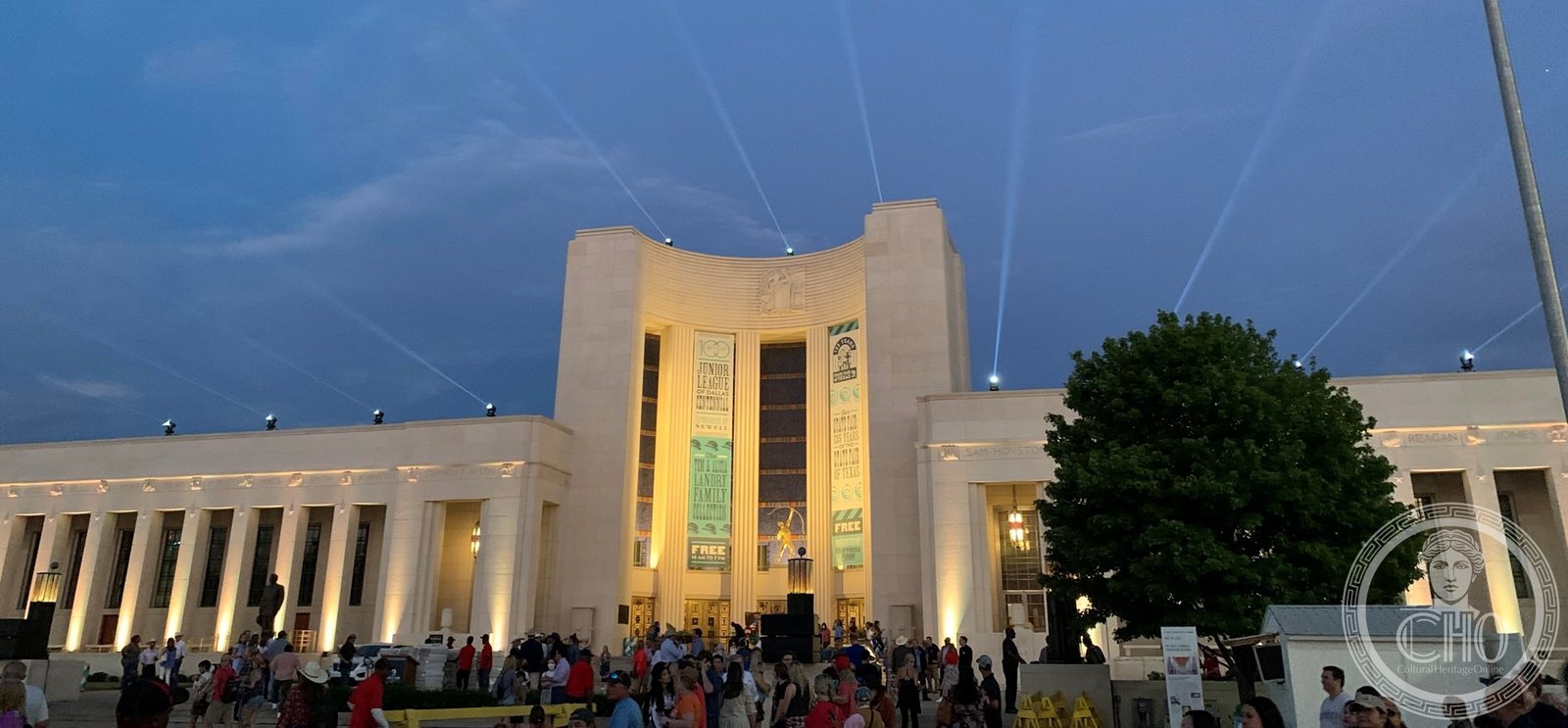
Built as the monumental centrepiece of the Texas Centennial Exposition of 1936, the Hall of State is the defining Art Deco civic building of Texas—its limestone façade of heroic reliefs, gilded interiors, and allegorical murals making it one of the most ambitious state-commissioned public buildings of the Depression era.
At a glance
The Hall of State stands at the head of the esplanade in Fair Park, the former grounds of the 1936 Texas Centennial Exposition, which was mounted to celebrate the centennial of Texas independence from Mexico. The State of Texas commissioned the building as its principal exhibition hall for the exposition and as a permanent monument to the history and culture of the state. Designed in the Art Deco style under the direction of a coordinated architectural team, the building features a facade of Texas limestone dressed with bas-relief sculptures by Allie Victoria Tennant, heroic murals by Eugene Savage and others in the Great Hall, and a gilded hall of honour that remains one of the most theatrically impressive civic interiors in the American South. Today the Hall of State is operated by the Dallas Historical Society as a museum of Texas history.
Key facts
- Address: 3939 Grand Avenue, Fair Park, Dallas, TX 75210
- Architecture: Art Deco; designed for the 1936 Texas Centennial Exposition
- Facade sculptor: Allie Victoria Tennant
- Interior muralists: Eugene Savage and colleagues
- Style: Art Deco / Monumental Civic
- Landmark status: Texas State Historical Landmark; National Register of Historic Places (Fair Park Historic District)
- Current use: Dallas Historical Society; museum of Texas history
- Site: Fair Park, the State Fair of Texas grounds; fairgrounds open annually in autumn
History
The Texas Centennial of 1936 was the largest world’s fair held in the South up to that point: a deliberate effort by the State of Texas, the city of Dallas, and a coalition of corporate sponsors to present Texas at the moment of its centennial independence from Mexico as a modern, prosperous, and culturally ambitious place. The exposition was sited at Fair Park, an existing fairgrounds east of downtown Dallas, which was comprehensively rebuilt in the Art Deco style for the occasion. Virtually all the buildings constructed for the exposition have survived, making Fair Park the largest intact collection of Depression-era Art Deco architecture in the United States.
The Hall of State was conceived as the apex of the exposition’s architectural hierarchy: the building at the head of the formal esplanade that structured the entire fair. The programme demanded a building that was simultaneously a history museum, an exhibition hall, and a symbol of Texas civic identity. The Art Deco vocabulary—monumental scale, geometric ornament, heroic reliefs, gilded interiors—was well suited to this brief, and the Texas Centennial architects applied it with a local inflection: the bas-relief sculptures on the facade depict Texas heroes and allegories of the state’s history and geography, while the interior murals trace the four centuries of European and American presence in the territory.
The State Fair of Texas has been held at Fair Park every October since 1886 (with interruptions during the world wars), and the Hall of State has served as the visual and symbolic anchor of the fair throughout the postwar period. The Dallas Historical Society has operated it as a history museum since the late twentieth century, maintaining the original murals, reliefs, and decorative programme largely intact.
What you see
The approach to the Hall of State from the Esplanade begins approximately 300 metres to the south, with the building framed at the end of a long formal axis between reflecting pools and flanking exhibition halls. The façade is a composition in Texas limestone: a central projecting portico of engaged columns frames the main entrance, which is crowned by Allie Victoria Tennant’s most famous work—the “Tejas Warrior” sculpture—and flanked by large bas-relief panels depicting allegorical figures representing the six nations whose flags have flown over Texas. The limestone’s warm colour and the relief sculpture’s flat plane make the facade legible from the far end of the esplanade as pure silhouette before the detail resolves at close range.
Inside, the rotunda Hall of Heroes is finished in gilded plaster, with gold-leaf panels and bronze fittings that contrast with the severity of the limestone exterior. The Great Hall beyond contains the large narrative murals that form the building’s principal cultural programme: panoramic paintings tracing Texas history from the Spanish missions through the Republic. The scale of these spaces—designed for a world’s fair audience measured in millions—gives the building a presence that smaller Depression-era civic buildings rarely achieve.
Practical information
- The Dallas Historical Society operates the Hall of State as a free museum; open Tuesday–Saturday; confirm current hours on the DHS website
- The State Fair of Texas typically runs October 1–3 weeks; admission to Fair Park is charged during the fair; free at other times
- Fair Park is a large complex: allow 3–4 hours to explore the Hall of State plus the surrounding Art Deco exhibition buildings, reflecting pools, and sculpture
- The Texas Discovery Gardens and the African American Museum of Dallas are also in Fair Park
- Photography of the exterior and public interior spaces is permitted
Getting there
Fair Park is approximately 1.5 miles east of downtown Dallas. The DART Green Line light rail stops at Fair Park station, a 5–10 minute walk from the Hall of State esplanade. Dallas Love Field (DAL) is approximately 7 miles northwest; Dallas/Fort Worth International Airport (DFW) is approximately 18 miles northwest. By car from downtown Dallas, take I-30 east to the Fair Park exits.
Nearby
- African American Museum of Dallas — immediately adjacent in Fair Park; permanent collection of African American fine art and cultural artefacts, the largest such collection in the Southwest
- Perot Museum of Nature and Science — approximately 2 miles west in Uptown Dallas; Thom Mayne’s 2012 building with permanent natural history and science collections
- Dallas Museum of Art — approximately 2 miles west in the Dallas Arts District; encyclopedic collection, free general admission
Sources
- National Register of Historic Places nomination: Fair Park Historic District, Dallas
- Texas Historical Commission: State Antiquities Landmark designation file for Fair Park
- Dallas Historical Society: institutional history and building documentation
- Dillon, David. Dallas Architecture 1936–1986. Austin: Texas Monthly Press, 1985
- Wilson, Richard Guy. The American Renaissance 1876–1917. New York: Brooklyn Museum, 1979 (context for monumental civic Art Deco)
Find it on the map
See this place and what’s around it →📷 Become a Cultural Heritage Online photographer
Share your photos of places: they stay published under your name as the author. The more they're seen, the more you get noticed — and soon a contest will reward the most appreciated photos.
Log in or sign up free to add a photoIs this page about you?
This page is read by travellers and heritage enthusiasts who find it on Google. Tell us how you are connected to this place and we will take it from there.