

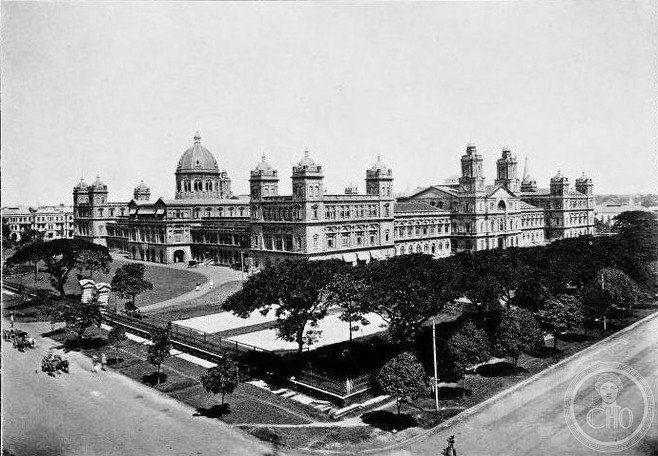
Few buildings in Southeast Asia carry as much historical weight as the Secretariat in Yangon. Built by the British colonial government between 1889 and 1905, this vast red-and-yellow brick complex served as the nerve centre of British Burma — the place from which an empire administered a nation. Its Victorian Gothic silhouette, with eight surviving cupolas and a design said to echo the Crown of Queen Victoria, dominated the colonial capital for generations. On 19 July 1947, in a second-floor meeting room of the South Wing, General Aung San — the father of modern Burma — and eight cabinet ministers were assassinated in a moment that shook the nation’s path to independence and is commemorated annually as Martyrs’ Day. Abandoned by the government in 2005, the building sat in studied decay for nearly two decades before restoration began. Today it is re-emerging as a museum, heritage hotel and cultural complex, its double spiral staircase and Glasgow-steel bones being brought back to public life.
At a glance
- Type
- Former colonial administrative headquarters / heritage complex
- Period
- 1889–1905 (central block 1902, wings 1905)
- Style
- Victorian Gothic / British Colonial
- Location
- Botataung Township, Yangon, Myanmar
- Coordinates
- 16.7756° N, 96.1658° E
- Architect(s)
- Henry Hoyne-Fox (executive engineer, Public Works Department)
Overview
The Secretariat occupies 6.5 hectares in Botataung Township, bounded by Anawrahta Road to the north and Maha Bandoola Road to the south — a U-shaped ensemble of red-and-yellow brick buildings arranged around a large central courtyard. Construction began in late 1889; the central block was completed in 1902 and the eastern and western wings in 1905. The structural steel skeleton was shipped from Glasgow; roof tiles were imported from France; bricks and teak were sourced locally. The building originally featured 16 cupolas, of which eight survive. At full operation it housed every major government department of British Burma, from finance and law to the Governor’s own secretariat.
History
Commissioned as the administrative heart of British Burma, the building served successive colonial administrations from its completion until the Second World War. Japanese forces occupied it during 1942–1945. After Burma’s post-war path to independence began, the building reverted to use by the transitional Burmese government. The pivotal event in its history occurred on 19 July 1947, when armed men burst into the Executive Council chamber and shot General Aung San along with eight ministers. The date is now Martyrs’ Day, a national day of mourning. Burma gained independence on 4 January 1948. The building continued as a government secretariat until 2005, when the military government moved the capital to Naypyidaw and the complex was vacated. Restoration work — aimed at converting it into a museum, hotel and cultural venue — began in the 2010s and is ongoing.
Architecture & Design
Henry Hoyne-Fox designed the Secretariat in a Victorian Gothic idiom adapted to colonial Burma’s climate and resources. The characteristic red-and-yellow brickwork — a polychromatic palette associated with High Victorian public buildings in Britain — reads boldly under tropical light. The eight surviving cupolas define the Yangon skyline as seen from Maha Bandoola Park; originally sixteen, they were described by contemporaries as echoing the Crown of Queen Victoria. The interior is notable for a double spiral staircase in the South Wing, made possible by the Glasgow-fabricated steel framework. Teak was used extensively for floors, window frames and doors, while French roof tiles have been replaced through successive repairs. Despite decades of deferred maintenance, the structural shell remains remarkably intact.
Cultural significance
The Secretariat is simultaneously the most potent symbol of British colonial rule in Burma and the site of the founding trauma of independent Myanmar. The assassination of Aung San in 1947 is inscribed into national memory as a wound that shaped the republic’s turbulent post-independence politics. For heritage advocates, it is the centrepiece of downtown Yangon’s colonial streetscape — one of the largest intact Victorian public buildings in Southeast Asia — and a test case for whether historic preservation can co-exist with rapid urban development. Its ongoing restoration has drawn significant international conservation attention.
Visiting today
The Secretariat is open to guided tours daily from 9:30 am to 4:30 pm on an hourly schedule. The site is managed as a heritage attraction; check current entry fees locally. A section of the South Wing houses a museum dedicated to Aung San and the independence struggle. Long-term plans include a heritage hotel within the complex. The courtyard and exterior can be photographed freely on guided visits.
Getting there
The Secretariat is in Botataung Township in downtown Yangon, walkable from Sule Pagoda (roughly 700 metres) and easily reachable from Maha Bandoola Garden. Taxis and Grab Myanmar are widely available. The building is approximately 30–40 minutes from Yangon International Airport by road. The surrounding downtown area is best explored on foot, given the density of colonial-era architecture nearby.
Sources & resources
Find it on the map
See this place and what’s around it →Record researched and written by Luigi De Marchi for Cultural Heritage Online, 2026.
📷 Become a Cultural Heritage Online photographer
Share your photos of places: they stay published under your name as the author. The more they're seen, the more you get noticed — and soon a contest will reward the most appreciated photos.
Log in or sign up free to add a photoIs this page about you?
This page is read by travellers and heritage enthusiasts who find it on Google. Tell us how you are connected to this place and we will take it from there.