
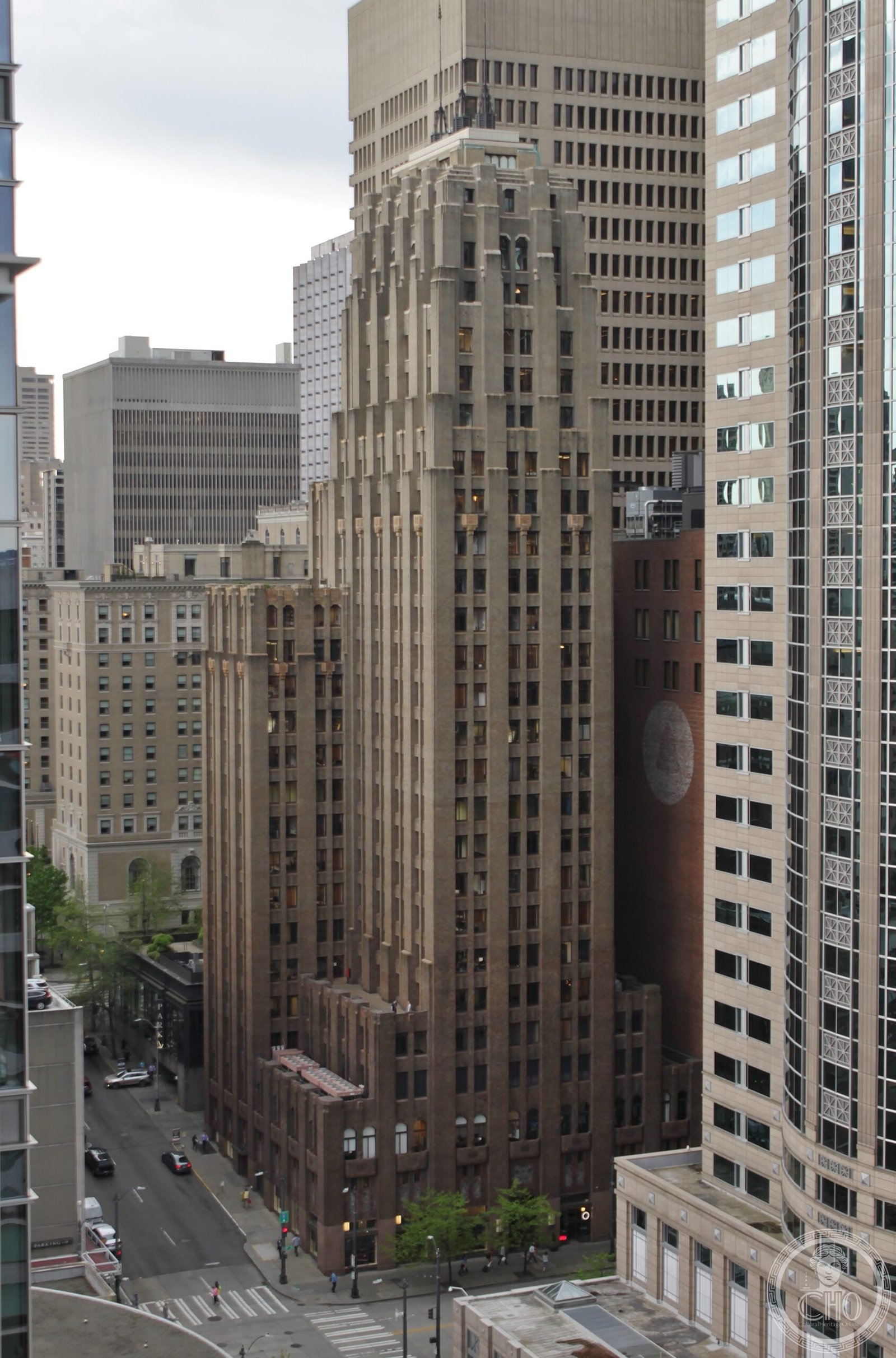
The most compositionally inventive of Seattle’s 1920s skyscrapers: its brick cladding graduates from dark at the base to cream-white at the crown, a deliberate effect designed to make the tower appear to dissolve into the overcast Pacific Northwest sky.
At a glance
A 27-story Art Deco office tower at 1218 Third Avenue, completed in 1929 for the Northern Life Insurance Company. Designed by the Seattle firm of Albertson, Wilson & Richardson, it fused Gothic revival crown ornament with an Art Deco verticality and a unique tonal graduation in brick cladding that remains its most recognized formal characteristic. The building is listed on the National Register of Historic Places (1983) and is now known as the Seattle Tower.
Key facts
- Address: 1218 Third Avenue, Seattle, WA 98101
- Year completed: 1929
- Architects: Albertson, Wilson & Richardson (Joseph Leland Albertson, principal designer)
- Height: 27 stories
- Original name: Northern Life Tower
- Current name: Seattle Tower
- Distinctive feature: Graduating brick cladding, dark at base to cream at crown
- Designation: National Register of Historic Places (1983)
History
The Northern Life Insurance Company commissioned the tower from the Seattle firm of Albertson, Wilson & Richardson in 1928. Joseph Leland Albertson, the design principal, pursued a formal idea uncommon in American commercial architecture: a tonal graduation in brick color that would make the building read differently at different heights — heavier and more grounded at street level, lighter and more atmospheric near the crown. The brick was selected and laid in a sequence ranging from dark brown at the lower floors through mid-tones to a pale cream at the upper stories and terracotta-crowned pinnacles.
The result drew comparisons to Eliel Saarinen’s Helsinki Railway Station (1919) and to the Finnish National Romantic tradition of romantic-expressionist brick architecture, though filtered through an American commercial context. Construction completed in 1929, making the Northern Life Tower one of the last major commercial buildings completed in Seattle before the Depression brought construction to a near halt. The original tenant departed in later decades; the building was renamed the Seattle Tower as subsequent tenants took occupancy.
What you see
From Third Avenue, the tower reads as a series of vertical piers that narrow and lighten as they ascend. The tonal graduation from dark brown at the base to pale cream-buff at the crown creates a visual effect of upward weightlessness; the building appears to taper more dramatically than its actual setbacks would suggest. Gothic-style tracery and pinnacles at the crown carry the ornamental program to its conclusion in carved terracotta against pale brick.
At street level, the original lobby entrance features bronze grillwork, marble detailing, and a coffered ceiling that survives in recognisable form. The building occupies a mid-block site on Third Avenue; the full compositional effect of the tonal graduation is best read from a distance of at least half a block, where the full height is visible against the sky. On overcast days — the characteristic Seattle condition — the cream-white upper stories merge almost seamlessly with the cloud cover, realising Albertson’s compositional intention.
Practical information
- The building is commercial office space; the ground-floor lobby is accessible during business hours (Monday–Friday).
- No public observation deck.
- Seattle’s mild, rainy climate means the building is best visited for photography on overcast days when the graduating brick effect is most apparent.
- The Third Avenue corridor is served by multiple Metro bus routes and is within 10 minutes’ walk of Pike Place Market and the Seattle waterfront.
Getting there
King Street Station (Amtrak Cascades and Coast Starlight) is approximately 0.6 miles south. Seattle–Tacoma International Airport (SEA) is approximately 13 miles south via Link Light Rail (University Street station, one block east of the building, or Westlake station, 0.2 miles north). The 1 Line light rail stops at University Street station approximately one block east. Pike Place Market is approximately 0.4 miles northwest; Pioneer Square Historic District is approximately 0.5 miles south.
Nearby
- Seattle Art Museum (1991) — Venturi, Scott Brown & Associates, approximately 0.3 miles north at First Avenue and University Street
- Columbia Center (1985) — Seattle’s tallest building, 76 stories, approximately 0.2 miles south on Fifth Avenue
- Pike Place Market (1907, expanded 1911) — Seattle’s landmark public market, approximately 0.4 miles northwest on Pike Street
- Pioneer Square Historic District — Victorian-era commercial architecture, approximately 0.5 miles south
Sources
- National Register of Historic Places, Seattle Tower (Northern Life Tower), listed 1983
- NRHP nomination form, Seattle Tower / Northern Life Tower
- Ochsner, Jeffrey Karl, ed. Shaping Seattle Architecture: A Historical Guide to the Architects. University of Washington Press, 1994
- Woodbridge, Sally B., and Roger Montgomery. A Guide to Architecture in Washington State. University of Washington Press, 1980
- Landmarks Preservation Board of Seattle, designation records
Find it on the map
See this place and what’s around it →📷 Become a Cultural Heritage Online photographer
Share your photos of places: they stay published under your name as the author. The more they're seen, the more you get noticed — and soon a contest will reward the most appreciated photos.
Log in or sign up free to add a photoIs this page about you?
This page is read by travellers and heritage enthusiasts who find it on Google. Tell us how you are connected to this place and we will take it from there.