

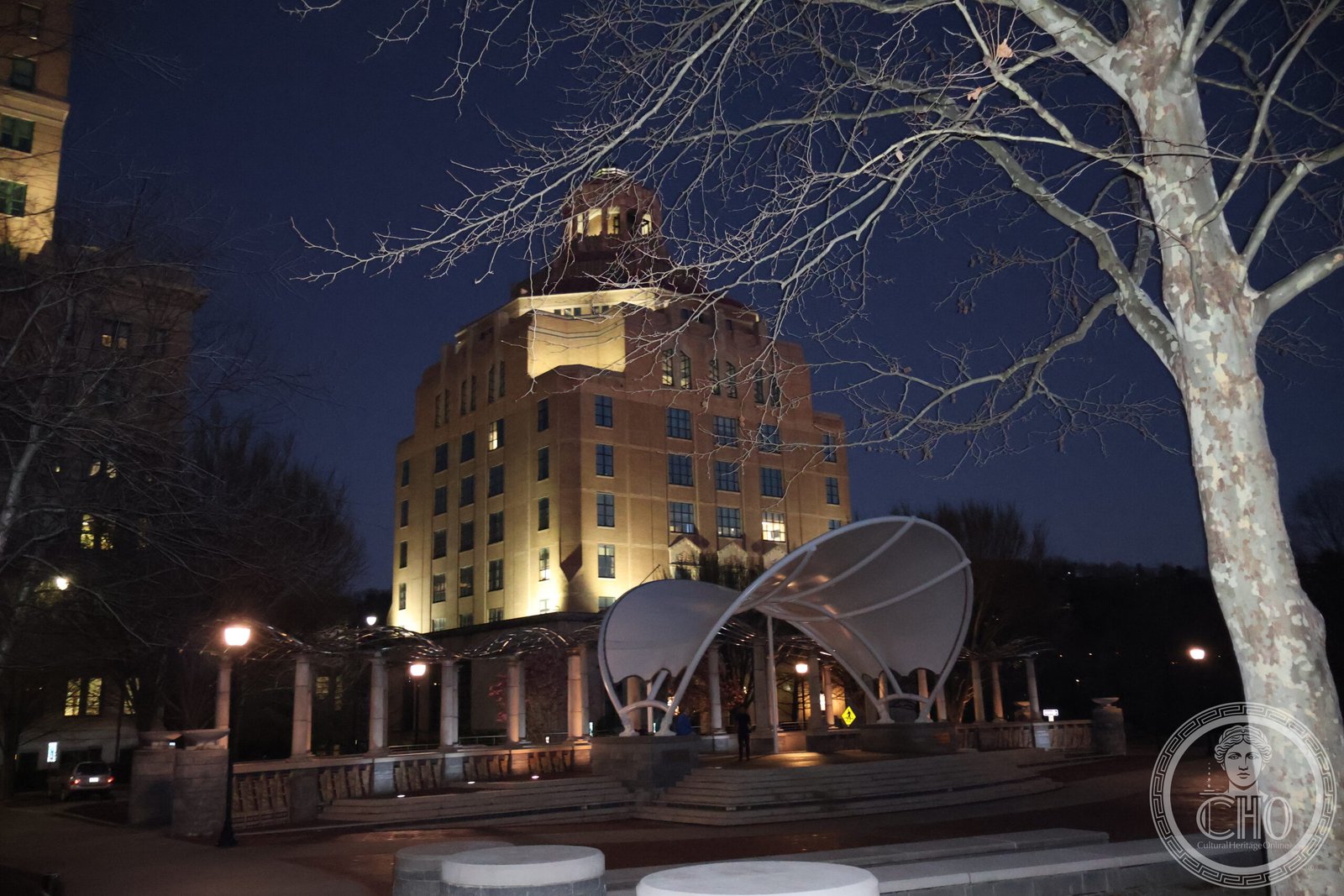
One of the most inventive civic buildings of the American Art Deco era: Douglas Ellington wrapped Asheville’s city government in polychrome terracotta tile and salmon-tinted brick, producing an octagonal dome in pink, blue, and green that reads more Florentine than municipal from a distance.
At a glance
Completed in 1928 to designs by Douglas D. Ellington — the North Carolina-born, École des Beaux-Arts trained architect who shaped Asheville’s architectural identity in the 1920s — City Hall sits at the head of Pack Square in the heart of downtown. Its octagonal drum and polychrome tile dome, its salmon-tinted brick walls ornamented with Art Deco terra cotta panels, and its setback profile make it one of the most distinguished small-city civic buildings in the American South.
Key facts
- Address: 70 Court Plaza, Asheville, NC 28801
- Year completed: 1928
- Architect: Douglas D. Ellington
- Style: Art Deco with Renaissance and Romanesque inflections
- Feature: Octagonal drum and dome in polychrome terracotta tile (pink, blue, lavender, green)
- Function: Municipal government (still in active civic use)
- Designation: National Register of Historic Places; Asheville Historic District
History
Douglas Ellington arrived in Asheville in 1926, drawn by the city’s extraordinary building boom. Asheville in the 1920s was capitalizing on its reputation as an Appalachian health resort — the altitude and cool air had drawn visitors since before the Civil War — and now, connected to Atlanta and Charlotte by rail, was transforming its downtown with ambition that would prove to outpace its finances. The City Hall commission, awarded in 1926, gave Ellington his most public canvas.
Ellington’s design drew on multiple sources: the stepped silhouette of Art Deco towers; the polychrome tile traditions of Italian Renaissance church domes; and the decorative vocabulary of the emerging Art Deco movement, which he had encountered in his studies in Paris. The building was completed and dedicated in 1928. Within three years, Asheville had defaulted on its municipal debt — the boom had become a bust — but the City Hall survived as both a working government building and an architectural monument to one of the most remarkable episodes in American small-city development.
What you see
From Pack Square the building rises in a sequence of setbacks that culminates in the octagonal drum and dome. The dome’s polychrome terracotta tile — combining pink, blue, lavender, and green in a geometric pattern — is visible from much of downtown Asheville and from the surrounding ridgelines. At street level, the entry portal carries Art Deco ornament in the salmon-tinted local brick; terra cotta panels with stylized floral and geometric motifs fill the spandrels and frieze.
The interior public spaces retain their original ornamental plasterwork, bronze hardware, and mosaic floor details. The council chamber on an upper floor maintains its period fixtures. Ellington’s civic buildings — City Hall, the S&W Cafeteria (1929) nearby, and First Baptist Church (1927) — can be read as a unified statement of progressive ambition expressed in the formal language of the machine age.
Practical information
- The building is in active civic use; the lobby and public-facing areas are accessible during business hours (Monday–Friday).
- Pack Square Park directly in front of City Hall provides the best views of the dome.
- Asheville’s other Ellington buildings — S&W Cafeteria (now S&W Market) on Haywood Street and First Baptist Church on Oak Street — are a short walk away and together constitute a remarkable concentration of 1920s Art Deco.
- The city is a walkable destination; the downtown historic district is compact and well-preserved.
Getting there
Asheville is served by Asheville Regional Airport (AVL) approximately 12 miles south; American Airlines and Delta operate direct routes to major hub cities. Amtrak does not serve Asheville directly (the nearest station is Gastonia, approximately 90 miles east, or Greenville, SC via bus connection). By car, Asheville sits at the junction of I-26 and I-40 in the Blue Ridge Mountains; the drive from Charlotte takes approximately 2 hours, from Atlanta approximately 2.5 hours. Pack Square is in the heart of downtown, served by the Asheville Transit (ART) bus network.
Nearby
- S&W Cafeteria / S&W Market (1929) — Douglas Ellington Art Deco commercial building, 0.2 miles west on Haywood Street
- Biltmore Estate (1895) — George Washington Vanderbilt II Châteauesque mansion, Richard Morris Hunt architect, approximately 3 miles south
- Pack Square Park — downtown civic green directly at City Hall’s door
- Grove Park Inn (1913) — historic resort in Arts and Crafts style on Macon Avenue, approximately 2 miles north
Sources
- National Register of Historic Places nomination form, Asheville City Hall
- Bishir, Catherine W. Architects and Builders in North Carolina. UNC Press, 1990
- Van Noppen, John James, and Ina Woestemeyer Van Noppen. Western North Carolina Since the Civil War. Appalachian Consortium Press, 1973
- Mattson, Richard L. “Douglas D. Ellington and the Asheville Civic Architecture of the 1920s.” North Carolina Historical Review, 1989
- Asheville Historic Resources Commission, building records
Find it on the map
See this place and what’s around it →📷 Become a Cultural Heritage Online photographer
Share your photos of places: they stay published under your name as the author. The more they're seen, the more you get noticed — and soon a contest will reward the most appreciated photos.
Log in or sign up free to add a photoIs this page about you?
This page is read by travellers and heritage enthusiasts who find it on Google. Tell us how you are connected to this place and we will take it from there.