

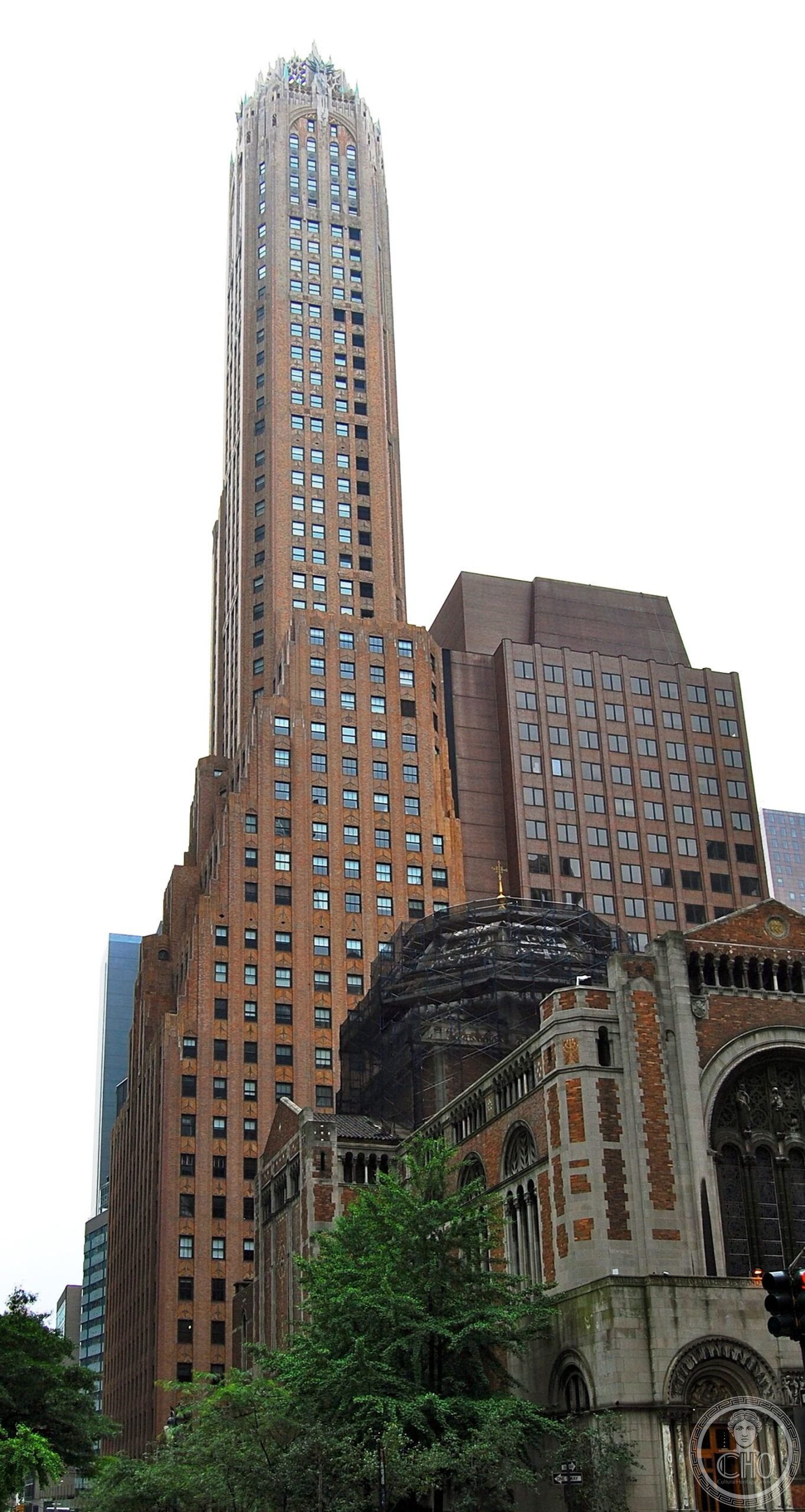
Originally the RCA Victor Building, this 50-story tower carries one of Midtown’s most unusual crowns: Gothic spires interlaced with terracotta lightning bolts, gears, and transmission arcs — electricity made permanent in fired clay.
At a glance
A 50-story Art Deco skyscraper on Lexington Avenue at 51st Street, completed in 1931 for RCA Victor. Architects Cross & Cross charged the building’s crown with ornamental imagery drawn directly from their client’s business — radio transmission, electrical machinery, broadcasting signals — producing a Gothic-inflected steeple that reads, up close, as a celebration of the electrical age unlike any other skyscraper in the city.
Key facts
- Address: 570 Lexington Avenue, New York, NY 10022
- Year completed: 1931
- Architects: Cross & Cross (John Walter Cross, Eliot Cross)
- Height: approximately 640 ft (195 m), 50 stories
- Original name: RCA Victor Building
- Later name: General Electric Building (distinct from 30 Rockefeller Plaza)
- Designation: New York City Landmark; National Register of Historic Places
History
Cross & Cross — the firm of brothers John Walter Cross and Eliot Cross — received the commission from RCA Victor in the late 1920s with a brief to create a building whose exterior would proclaim its tenant’s identity without conventional signage. The solution was an ornamental crown in the Gothic mode, then fashionable for skyscrapers, but charged with imagery drawn from RCA Victor’s business: lightning bolts symbolising radio transmission, interlocked gears representing electrical machinery, and arcs suggesting the broadcasting signal itself.
The building opened in 1931, the same year as the Empire State Building, at the height of Manhattan’s Art Deco construction boom. General Electric eventually became the tower’s primary occupant, and the building acquired the GE name by mid-century — creating persistent confusion with 30 Rockefeller Plaza, which carried an identical GE designation from 1988 to 2015. Cross & Cross later designed the Tiffany & Co. flagship at 727 Fifth Avenue (1940) in a cleaner, more restrained idiom; the 570 Lexington ornamental programme remains the firm’s most exuberant statement.
What you see
The lower floors are clad in Indiana limestone with Art Deco spandrels and chamfered corners. Above the thirtieth floor the massing steps back before expanding into the ornamental crown. That crown is 570 Lexington’s distinguishing feature: Gothic-derived pinnacles carry terracotta panels depicting electricity in abstract form — gears, bolts, and arcs press together with an almost medieval intensity, as though the craftsmen who executed them had been shown an electrical engineering diagram and asked to make it devotional.
The effect is deliberately different from the cool restraint of Rockefeller Center, several avenue blocks west, or the sleek stainless geometry of the Chrysler Building twelve blocks north. Look for the lobby entrance on Lexington, where original bronze metalwork and marble cladding survive in recognisable form. The building’s setback profile is best read from the corner of 51st Street and Lexington, where the full crown is visible above the mid-rise buildings to the north.
Practical information
- The building is commercial office space; the ground-floor lobby is accessible during business hours (Monday–Friday).
- No public observation deck.
- Midtown East is walkable year-round. The block between 51st and 52nd Streets on Lexington is among the densest in Manhattan; allow extra time during rush hours.
- The crown ornament is best observed from street level with binoculars or a zoom lens, as the terracotta detail is approximately 550–640 feet above the sidewalk.
Getting there
The 6 subway line stops at 51st Street station on Lexington Avenue, half a block from the entrance. The E and M lines stop at Lexington Avenue–53rd Street station, one block north. JFK International Airport is approximately 16 miles east via the E train or taxi. Newark Liberty (EWR) is approximately 13 miles west. St. Patrick’s Cathedral is approximately 0.3 miles west at Fifth Avenue and 50th Street; Rockefeller Center is approximately 0.4 miles west spanning Fifth to Sixth Avenue; the Waldorf Astoria Hotel is on Park Avenue approximately one block west at 49th–50th Streets.
Nearby
- St. Patrick’s Cathedral (1879) — James Renwick Jr. Gothic Revival, approximately 0.3 miles west at Fifth Avenue and 50th Street
- Rockefeller Center (1930–1940) — Raymond Hood Art Deco complex, approximately 2 blocks west on Fifth/Sixth Avenue
- Waldorf Astoria Hotel (1931) — Schultze & Weaver Art Deco landmark, approximately 2 blocks east on Park Avenue
- Lever House (1952) — Gordon Bunshaft / SOM International Style landmark, approximately 0.3 miles north on Park Avenue
Sources
- NYC Landmarks Preservation Commission designation report, 570 Lexington Avenue
- National Register of Historic Places, 570 Lexington Avenue
- Dolkart, Andrew S. Guide to New York City Landmarks. 4th ed. Wiley, 2009
- White, Norval, and Elliot Willensky. AIA Guide to New York City. 5th ed. Oxford University Press, 2010
- Stern, Robert A.M., et al. New York 1930. Rizzoli, 1987
Find it on the map
See this place and what’s around it →📷 Become a Cultural Heritage Online photographer
Share your photos of places: they stay published under your name as the author. The more they're seen, the more you get noticed — and soon a contest will reward the most appreciated photos.
Log in or sign up free to add a photoIs this page about you?
This page is read by travellers and heritage enthusiasts who find it on Google. Tell us how you are connected to this place and we will take it from there.