
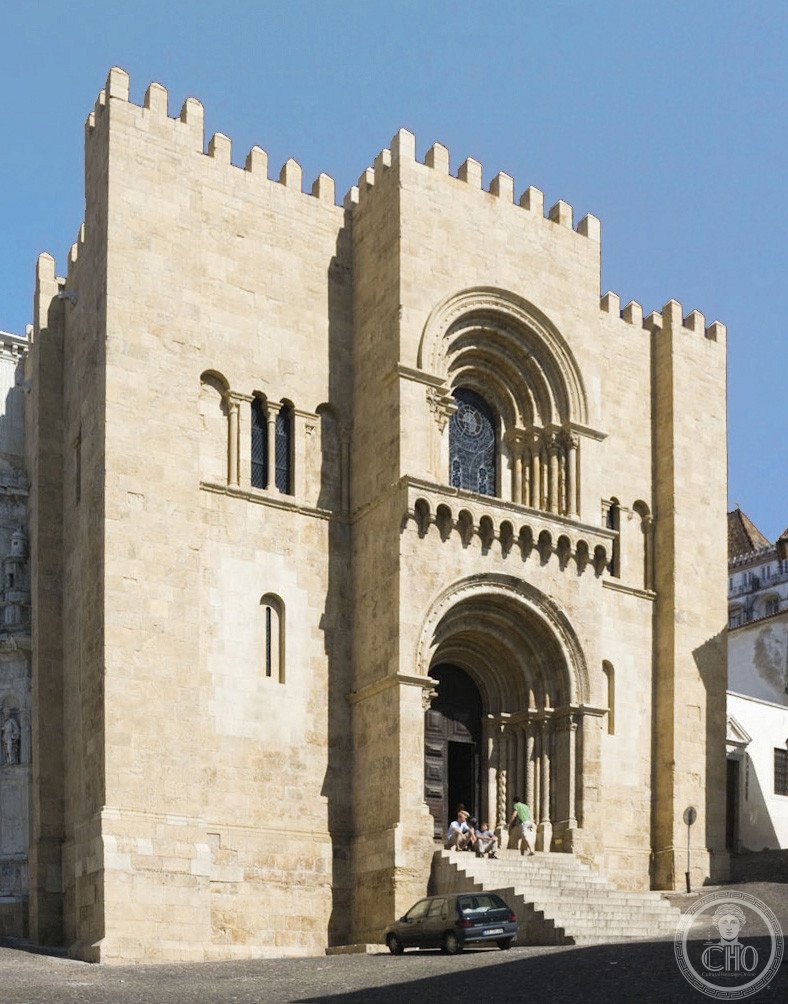
After the battle of Ourique in 1139, when prince Afonso Henriques proclaimed himself king of Portugal and chose Coimbra as his capital, bishop Miguel Salomão began in 1164 the building of a new cathedral. Consecrated in 1184, it was the place where, the following year, Sancho I, second king of Portugal, was crowned. With its high battlemented walls and narrow windows, the Sé Velha looks more like a fortress than a church — and it is today the only Portuguese Romanesque cathedral of the Reconquista period to have survived almost intact.
About the Sé Velha de Coimbra
Coimbra, the Roman city of Aeminium, had already served as the seat of a bishopric since the 5th century, after the neighbouring Roman settlement of Conimbriga was invaded and partially destroyed by the Suebi in 468. Following the Battle of Ourique in 1139, when Prince Afonso Henriques declared himself King of Portugal and chose Coimbra as his capital, construction of a new cathedral dedicated to Santa Maria began in 1164 at the initiative of Bishop Miguel Salomão. The cathedral was consecrated in 1184, even though the rest of the building remained unfinished, and in 1185 the second King of Portugal, Sancho I, was crowned within its walls, cementing the cathedral’s early significance as a site of national royal ceremony. The building’s design is attributed to Master Roberto, an architect of French origin who directed construction of Lisbon Cathedral at the very same time, visiting Coimbra only sporadically to oversee progress on this second project. The Sé Velha holds particular architectural significance as the only Portuguese Romanesque cathedral from the Reconquest period to survive to the present day in a relatively intact state; from the outside, the building presents the appearance of a small fortress, its high, crenellated walls pierced by only a few narrow windows, reflecting the genuine defensive concerns of a still-unsettled frontier region during the Reconquista. The cathedral’s cloister began construction in 1218, under King Afonso II, and stands among the earliest Gothic works built anywhere in Portugal. At the turn of the 15th to 16th centuries, Bishop Jorge de Almeida sponsored a major decorative campaign, during which the huge wooden retable of the main chapel was carved between 1498 and 1502 by the Flemish artists Olivier de Gand and Jean d’Ypres.
Key facts
- 5th century: Coimbra already a bishopric seat
- 1139: Afonso Henriques declares himself King of Portugal at Ourique, choosing Coimbra as capital
- 1164: cathedral construction begins under Bishop Miguel Salomão
- 1184: cathedral consecrated
- 1185: Sancho I, second King of Portugal, crowned in the cathedral
- 1218: Gothic cloister construction begins under Afonso II
- 1498-1502: main chapel’s wooden retable carved by Flemish artists Olivier de Gand and Jean d’Ypres
- Unique status: the only intact Portuguese Romanesque Reconquest-era cathedral
History
The cathedral’s fortress-like Romanesque architecture, built while Portugal’s frontier with Moorish-controlled territory remained genuinely contested, reflects the same defensive-ecclesiastical hybrid tradition seen at other Iberian Reconquest-era cathedrals such as Évora, though the Sé Velha’s survival in relatively unaltered form makes it an unusually complete surviving example of this specific architectural moment in Portuguese history. Master Roberto’s simultaneous direction of both the Coimbra and Lisbon cathedral projects situates the Sé Velha within a small, closely connected network of French-influenced architects shaping the earliest monumental Gothic and Romanesque church building of the newly founded Kingdom of Portugal.
Sancho I’s 1185 coronation within the cathedral, so soon after its consecration, gave the Sé Velha an early and lasting association with Portuguese royal ceremony, reinforcing Coimbra’s status as the kingdom’s first capital during the formative decades of Portuguese statehood.
What you see
The cathedral’s fortress-like Romanesque exterior, with its high crenellated walls and narrow windows, remains the building’s most distinctive feature, largely unaltered since the 12th century. The early Gothic cloister, begun in 1218, offers one of the oldest surviving examples of that style in Portugal, while the main chapel’s elaborate wooden retable, carved 1498-1502 by Flemish artists, introduces a later, richly decorated artistic layer within the otherwise austere Romanesque interior.
Practical information
- Opening hours: generally open daily with seasonal variation; check current hours before visiting; admission fee applies
- Address: Largo da Sé Velha, 3000-383 Coimbra, Portugal
Getting there
The Sé Velha de Coimbra is located in the historic Alta district of Coimbra, central Portugal, easily reachable on foot. GPS: 40.2088° N, -8.4270° E.
Nearby
- University of Coimbra — the historic university, including the Biblioteca Joanina, nearby
- Sé Nova de Coimbra — the “New Cathedral,” Coimbra’s later cathedral, nearby
- Coimbra Alta district — the surrounding historic hilltop quarter
Sources
- Wikipedia — “Old Cathedral of Coimbra” (en.wikipedia.org)
- Visit Portugal — “Sé Velha de Coimbra” (visitportugal.com)
- Center of Portugal — “Coimbra Old Cathedral – Sé Velha de Coimbra” (centerofportugal.com)
Find it on the map
See this place and what’s around it →
📷 Become a Cultural Heritage Online photographer
Share your photos of places: they stay published under your name as the author. The more they're seen, the more you get noticed — and soon a contest will reward the most appreciated photos.
Log in or sign up free to add a photo