

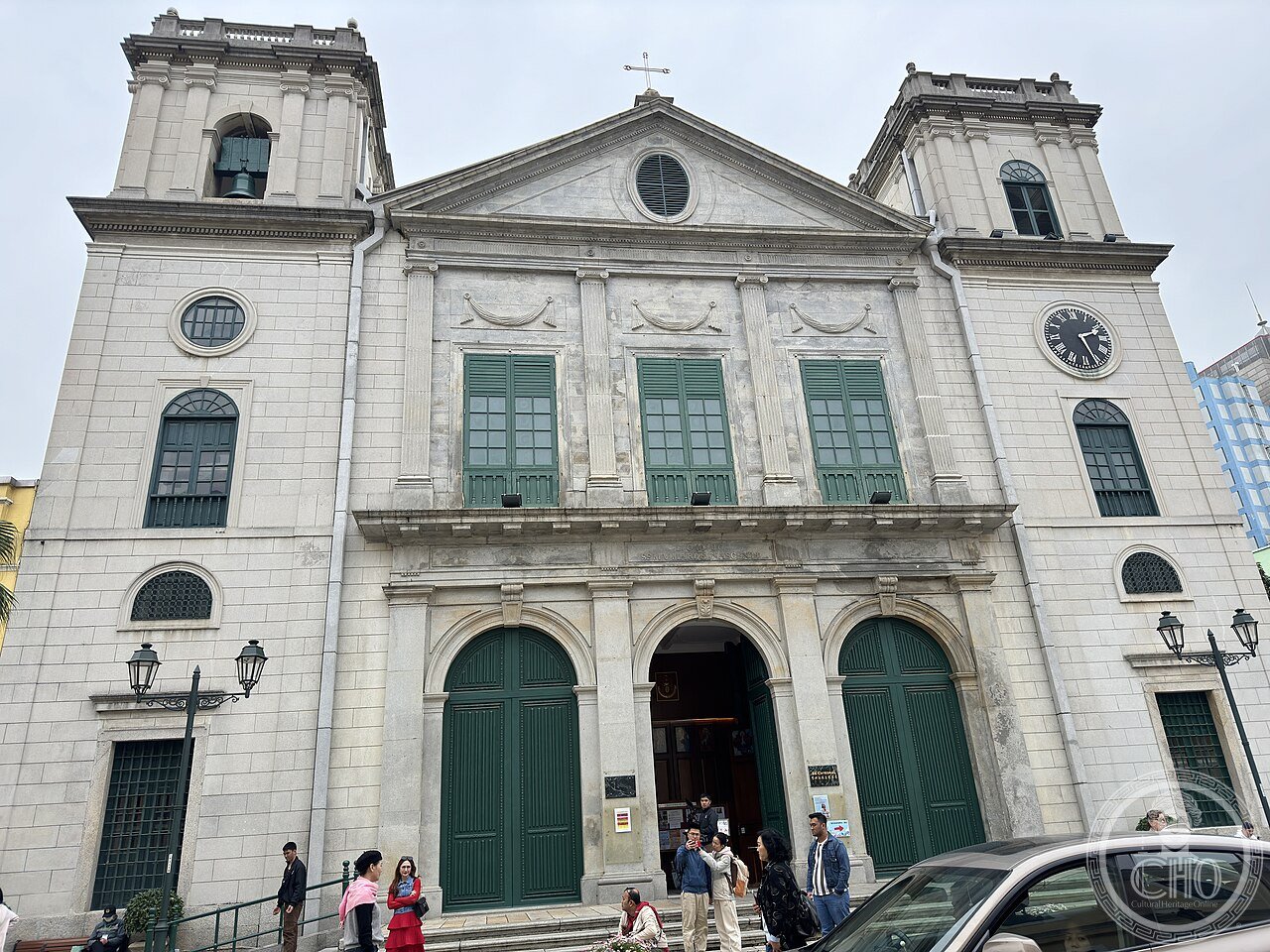
In Macau, China, the Cathedral of the Nativity of Our Lady (Sé Catedral da Natividade de Nossa Senhora, commonly Igreja da Sé) began as a small wooden chapel in the early seventeenth century. It was rebuilt, around 1622 according to the official Macau government source, and raised to cathedral status in 1622 or 1623 depending on the source, replacing the Church of St. Lazarus as the diocesan seat. A major stone rebuild was carried out between 1844 and 1850, turning the main façade from west to north. Bishop Jerónimo José da Mata consecrated it in 1850. According to secondary sources, a typhoon nearly destroyed the stone building some 24 years after the consecration, around 1874. A complete reconstruction in concrete followed in 1937, at a cost of around 100,900 patacas. The architect Tomás d’Aquino, sometimes named as the building’s designer, died in 1852; he can therefore be linked only to the 1844-1850 rebuild, not to the 1937 reconstruction, for which no source identifies an architect. Neoclassical in style, with a tripartite façade and two side bell towers, the cathedral houses in one tower a large clock ordered from the United Kingdom in 1857 to commemorate the coronation of King Peter V of Portugal. The building’s seating capacity is not documented. Every year, on the first weekend of Lent, the cathedral hosts the Procession of Our Lord Bom Jesus dos Passos, a tradition that the official Macau source dates to 1708. It must be stated clearly that the Sé Cathedral has no architectural connection with the famous Ruins of St. Paul’s. Those are the remains of the Jesuit church of Mater Dei, built between 1602 and 1640 beside St. Paul’s College, destroyed by fire during a typhoon on 26 January 1835 and never rebuilt: a completely separate building and institution, on a different site from the Sé, which is instead the seat of the secular diocesan clergy. The Jesuit missionary network towards Japan and China, including the link with Matteo Ricci, who reached Macau in August 1582, belongs historically to St. Paul’s College, not to the Sé Cathedral, and no source consulted links Ricci directly to this building. The diocese of Macau was established by Pope Gregory XIII on 23 January 1576, with an original jurisdiction stretching over China, Japan, Korea and much of Southeast Asia. It is today more accurately described as the oldest Asian diocese still in continuous existence, rather than the very first, since earlier dioceses in China (Beijing from 1307, Quanzhou from 1313) died out for lack of missionaries. Over a hundred dioceses have become independent from Macau over the centuries. The “Historic Centre of Macao” was inscribed on the UNESCO World Heritage List on 15 July 2005, with some 22-23 monuments as well as streets, a garden and several squares. The Sé Cathedral is among the classified monuments that make up the historic centre according to the official Macau government source, although the exact wording of the UNESCO nomination file could not be verified. No source documents direct war damage to the cathedral during the Second World War, when Macau remained a neutral Portuguese colony, nor any specific papal visit to the building. The cathedral’s bells rang on 6 April 2005 in mourning for the death of Pope John Paul II, a commemorative gesture at a distance, not a visit. The present bishop of Macau is Monsignor Stephen Lee Bun-sang, in office since 2016, the diocese’s third bishop of Chinese ethnicity.
About Sé Cathedral
In Macau, China, the Cathedral of the Nativity of Our Lady (commonly Sé Cathedral) originated as a small wooden chapel in the early 17th century; rebuilt around 1622 per the official Macau government source, it was elevated to cathedral status in either 1622 or 1623 depending on the source, replacing the Church of St. Lazarus as the diocesan seat. A major stone reconstruction was carried out between 1844 and 1850, changing the main façade’s orientation from west to north, with consecration in 1850 by Bishop Jerónimo José da Mata; secondary sources report a typhoon nearly destroyed the stone building roughly 24 years after its consecration, around 1874. A complete concrete reconstruction followed in 1937, at a cost of roughly 100,900 patacas; the architect Tomás d’Aquino, sometimes credited with designing the building, died in 1852 and can therefore only be associated with the 1844-1850 rebuild, not the 1937 reconstruction, for which no source identifies an architect.
Key facts
- 1622/1623: the church rebuilt and elevated to cathedral status.
- 1844-1850: a major stone reconstruction, consecrated in 1850.
- 1937: a complete concrete reconstruction, architect unrecorded.
- 1857: a bell-tower clock installed, commemorating King Peter V of Portugal’s coronation.
- 15 July 2005: included in the UNESCO-listed Historic Centre of Macao.
- Not the same building as the nearby Ruins of St. Paul’s, a separate Jesuit church destroyed by fire in 1835.
History
Rebuilt at least twice — in stone in the 1840s and again in concrete in 1937 — the Sé Cathedral has served as the seat of one of Catholic Asia’s oldest continuously existing dioceses since 1576, though it is frequently confused by visitors with the much more photographed Ruins of St. Paul’s nearby, a genuinely separate Jesuit church destroyed by fire in 1835 and never rebuilt. Its Jesuit-adjacent history — the missionary network that brought Matteo Ricci to Macau in 1582 — in fact belongs institutionally to that ruined church and its associated college, not to the Sé itself, which has always been the seat of the diocesan clergy rather than the Jesuit order.
What you see
A neoclassical, tripartite façade flanked by twin bell towers stands over Largo da Sé, one tower housing a large clock ordered from Britain in 1857 to mark King Peter V of Portugal’s coronation. The cathedral hosts the annual Procession of the Passion of Our Lord each first weekend of Lent, a tradition dated by Macau’s official heritage source to 1708.
Practical information
- Opening hours: generally open daily outside services; check current hours before visiting.
- Address: Largo da Sé, Macau, China.
Getting there
The cathedral stands on Largo da Sé in central Macau, within the UNESCO-listed historic center and easily reached on foot from the Ruins of St. Paul’s. GPS: 22°11′37″N, 113°32′30″E.
Nearby
- Ruins of St. Paul’s — the separate, ruined Jesuit church, a short walk away, not to be confused with this cathedral.
Sources
- Wikipedia — “Cathedral of the Nativity of Our Lady, Macau” and “Roman Catholic Diocese of Macau” (en.wikipedia.org).
- Cultural Affairs Bureau, Macau SAR Government — official heritage listing (culturalheritage.mo).
- Wikipedia — “Ruins of Saint Paul’s” and “Historic Centre of Macau”
Find it on the map
See this place and what’s around it →📷 Become a Cultural Heritage Online photographer
Share your photos of places: they stay published under your name as the author. The more they're seen, the more you get noticed — and soon a contest will reward the most appreciated photos.
Log in or sign up free to add a photo