

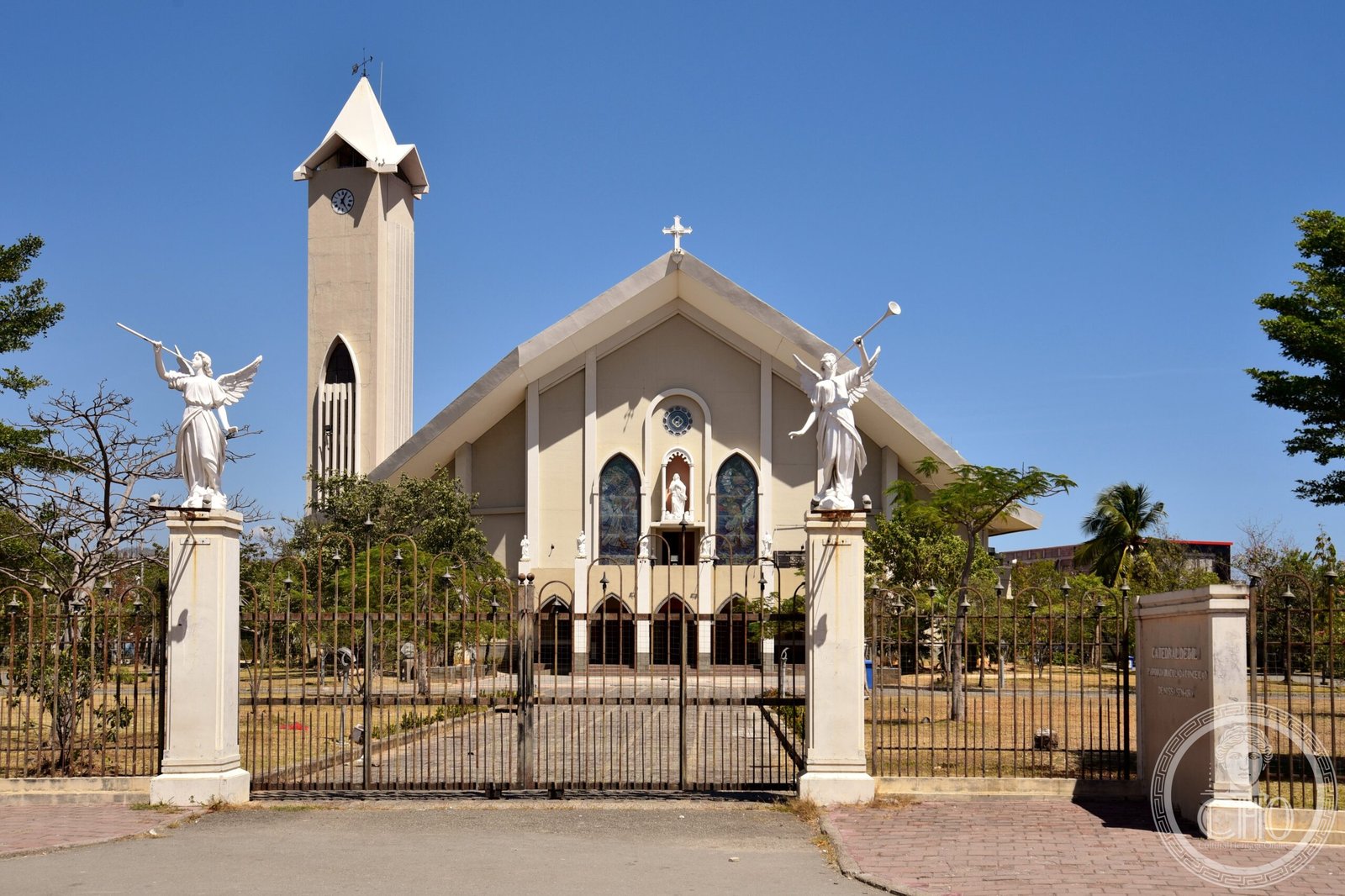
In Dili, the capital of Timor-Leste, an earlier Portuguese colonial cathedral, inaugurated in 1937 after works begun in 1933 to replace an 1876-77 parish church, was deliberately bombed by the Allies on 3 November 1942, during the Second World War, in the mistaken belief that Japanese forces were occupying it, leaving only a roofless shell that was later demolished — a detail reported by only one non-academic source, to be treated with caution. Until 1988 it was the Church of St. Anthony of Motael, Dili’s oldest Catholic church, that served de facto as cathedral. Planning for the present cathedral began in 1984, with construction funded by the Indonesian government, then the occupying power in East Timor, for around US$235,000, on a plot of 10,000 square metres with a built footprint of 1,800. Indonesian President Suharto officially inaugurated it on 2 November 1988, while Pope John Paul II blessed and consecrated it on 12 October 1989. No source identifies an architect. In a modern style, with some Portuguese-inspired elements in the bell tower and large stained-glass windows, the cathedral seats around 2,000 people and is sometimes described, without a verifiable source for the ranking, as the largest cathedral in Southeast Asia. The diocese of Dili was established on 4 September 1940 by Pope Pius XII, separated from the diocese of Macau. It gained the status of direct exemption from the Holy See in 1976, ceded territory with the erection of the diocese of Baucau in 1996, and was raised to a metropolitan archdiocese by Pope Francis on 11 September 2019, with Baucau and Maliana as suffragan sees. Today it counts, according to 2022 data, 33 parishes and over 740,000 Catholics, around 94.5% of the population. During the Indonesian occupation (1975-1999), the Catholic Church became one of the few institutions through which East Timorese could assert a national identity distinct from the Muslim-majority Indonesian state. Bishop Carlos Filipe Ximenes Belo, who led the diocese from 1988 to 2002, was a central moral figure in that period, sharing the 1996 Nobel Peace Prize with José Ramos-Horta — though his legacy was later marked by serious accusations of sexual abuse, reported by the Associated Press in 2022. Pope John Paul II, visiting Dili on 12 October 1989, celebrated an open-air mass on the Tasitolu plain, with an estimated attendance of between 200,000 and 400,000 people according to conflicting sources, urging reconciliation rather than direct condemnation of human rights violations, as some East Timorese activists had hoped. After the independence referendum of 30 August 1999 (78.5% in favour, announced on 4 September by UN Secretary-General Kofi Annan), pro-Indonesian militias destroyed around 80% of Dili’s infrastructure and looted and burned the diocesan offices, while elsewhere in the country the massacre at the church of Suai took place on 6 September 1999, with over 50 victims. No specific direct damage to this cathedral building is documented, however. On 10 September 2024 Pope Francis visited the cathedral to meet bishops, priests, deacons, religious, seminarians and catechists, celebrating a mass that same evening on the same Tasitolu plain before an estimated crowd of around 750,000 people, almost two-thirds of the national population. The present archbishop of Dili is Cardinal Virgílio do Carmo da Silva, archbishop since 2019 and made a cardinal on 27 August 2022, the first cardinal in the history of Timor-Leste. No formal heritage protection for the building is documented in the sources consulted.
About the Cathedral of the Immaculate Conception
In Dili, the capital of Timor-Leste, an earlier Portuguese colonial cathedral, inaugurated in 1937 after construction begun in 1933 to replace an 1876-77 parish church, was deliberately bombed by Allied forces on 3 November 1942 during the Second World War, on the mistaken belief Japanese forces were occupying it, leaving only a roofless shell later demolished — a detail reported only by a non-scholarly source and treated with caution. Until 1988, the Church of St. Anthony of Motael, Dili’s oldest Catholic church, served as the de facto cathedral. Planning for the current cathedral began in 1984, with construction funded by the Indonesian government, then the occupying power in East Timor, at a cost of roughly US$235,000; Indonesian President Suharto officially inaugurated it on 2 November 1988, and Pope John Paul II blessed and consecrated it on 12 October 1989.
Key facts
- 1984-1988: the cathedral built with Indonesian government funding.
- 12 October 1989: blessed and consecrated by Pope John Paul II.
- 1988-2002: Bishop Carlos Filipe Ximenes Belo leads the diocese, sharing the 1996 Nobel Peace Prize.
- 1999: independence-referendum violence devastates Dili, though no direct cathedral damage is documented.
- 11 September 2019: elevated to the seat of the Metropolitan Archdiocese of Dili.
- 10 September 2024: visited by Pope Francis, who later drew a crowd of roughly 750,000 nearby.
History
Built and funded by Indonesia during its occupation of East Timor, then blessed within a year by Pope John Paul II, the Cathedral of the Immaculate Conception embodies the paradox at the heart of Timor-Leste’s Catholic Church during those decades — an institution simultaneously entangled with and standing apart from the occupying state, becoming one of the few vehicles for East Timorese national identity under Bishop Carlos Belo’s leadership. Pope Francis’s own 2024 visit, drawing nearly two-thirds of the entire nation to Mass, extended a papal relationship with this cathedral now spanning 35 years and two of Timor-Leste’s defining political moments.
What you see
A modern building with Portuguese-influenced elements in its bell tower holds roughly 2,000 worshippers beneath stained-glass windows that color the cathedral’s otherwise comparatively austere interior. Sometimes described, without a verifiable ranking source, as the largest cathedral in Southeast Asia, it stands on a 10,000-square-metre plot along Avenida de Portugal near Dili’s waterfront.
Practical information
- Opening hours: generally open daily outside services; check current hours before visiting.
- Address: Avenida de Portugal, Dili, Timor-Leste.
Getting there
The cathedral stands on Avenida de Portugal near Dili’s waterfront, easily reached on foot from the city center. GPS: 8°33′30″S, 125°34′03″E.
Nearby
- Church of St. Anthony of Motael — Dili’s oldest Catholic church, which served as the de facto cathedral before 1988.
Sources
- Wikipedia — “Immaculate Conception Cathedral, Dili” and “Archdiocese of Dili” (en.wikipedia.org).
- Vatican.va — homilies of John Paul II (12 October 1989) and speech of Pope Francis (10 September 2024) at Dili.
- Vatican News — “Timor-Leste: commemoration of John Paul II’s 1989 visit”
Find it on the map
See this place and what’s around it →📷 Become a Cultural Heritage Online photographer
Share your photos of places: they stay published under your name as the author. The more they're seen, the more you get noticed — and soon a contest will reward the most appreciated photos.
Log in or sign up free to add a photo