
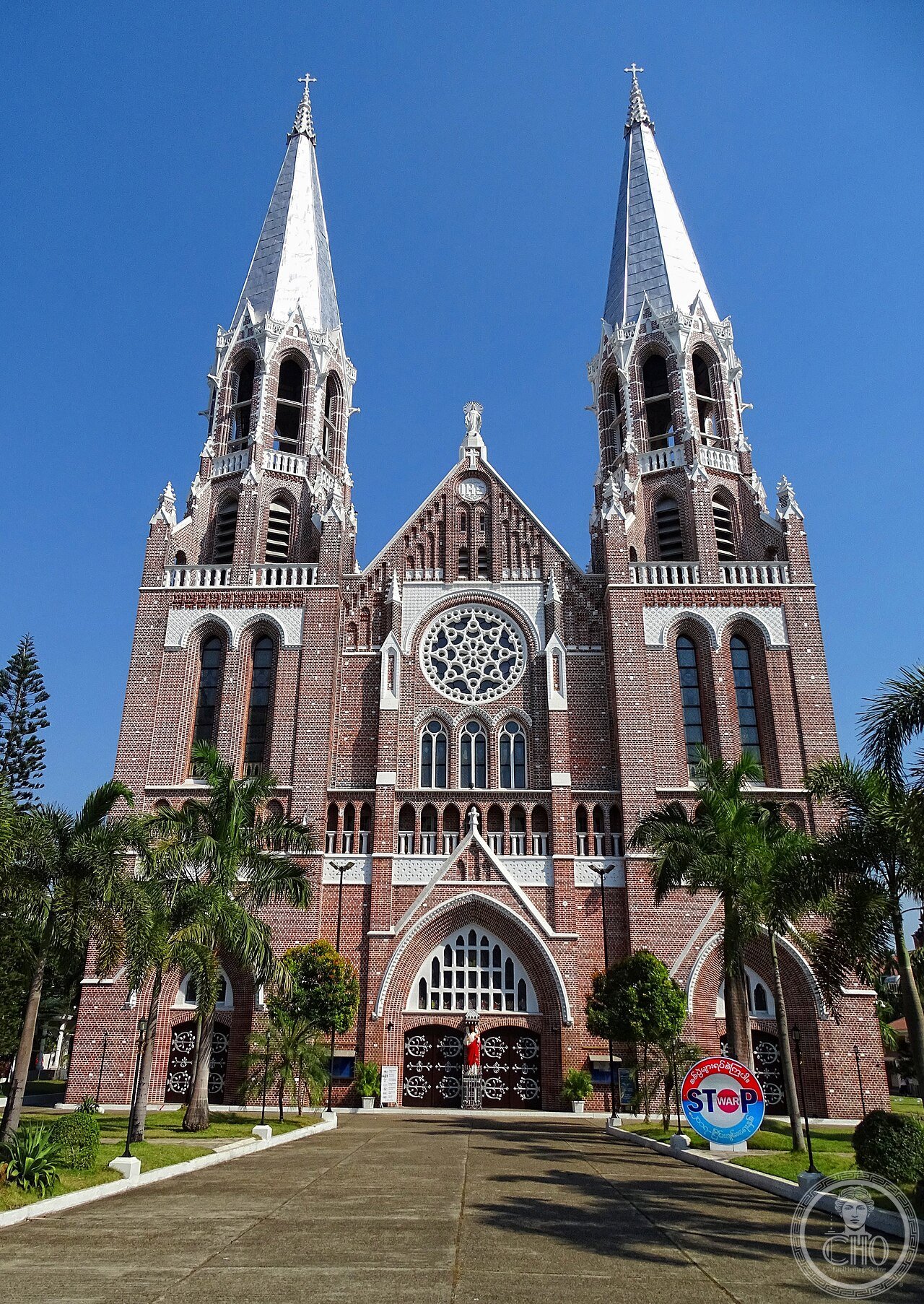
In Yangon, Myanmar, the previous cathedral — its exact location disputed between sources, either Barr Street or, per the cathedral’s own official history, No. 372 Bo Aung Kyaw Street (then Spark Street) — was sold under a Government of India authorization (granted on 23 January 1893) to help fund a new, larger cathedral championed by Bishop Paul Ambroise Bigandet, Burma’s first vicar apostolic, who died in 1894 before construction began. His successor, Bishop Alexandre Cardot, saw the project through.
Foundation work began in June 1895, and the white marble cornerstone was blessed and laid on 19 November 1899 by Cardot. The building was blessed on 21 November 1909, and finally consecrated and dedicated to Our Lady of the Immaculate Conception on 22 February 1911 — a project spanning roughly seventeen years in total. A widely repeated claim that construction was “completed” already on 19 November 1899 conflates that date with the cornerstone-laying, and is treated here as an error rather than a fact.
An initial design in the Byzantine style, by H. Hoyne-Fox, the Burmese government’s consulting architect, was rejected. The design that was actually built came instead from the Dutch architect Joseph Cuypers, son of the more famous Pierre Cuypers, who initially proposed combining his own Cathedral of Saint Bavo in Haarlem with “oriental” elements before settling on a more conventional, European Gothic Revival style. The plan was enlarged by about 30 feet from the original design, to seat 1,500 worshippers. The work on site was overseen by Father Hendrik Janzen, trained at the Cuypers studio, who added neo-Gothic spires during construction that significantly increased the building’s structural weight.
Built of red brick, a choice that gives it a livelier appearance than many contemporary colonial cathedrals, the church measures roughly 291 feet long by 101 feet wide, and was designed to seat 1,500 people. It has twin spires topped with crosses, a separate bell tower, a cruciform plan with nave, choir and transepts, and a stained-glass rose window above the main entrance, the whole surrounded by a manicured garden. It is commonly described as the largest cathedral in Myanmar, while the claim that it ranks among the largest in Southeast Asia finds no support in verifiable sources.
A 1930 earthquake caused minor damage to vaults and arches. During the Japanese occupation, the building was, according to some sources, used as a brewery, and survived the Japanese bombings of 1941-42 without serious damage. An Allied bombing raid on 14 December 1944, however, destroyed all the original stained glass, which was replaced with ordinary locally made glass. Cyclone Nargis, in May 2008, damaged the windows again; they were repaired with tarpaulins due to budget constraints. No specific incident tied to the cathedral is documented during the decades of military rule, or after the February 2021 coup.
The ecclesiastical circumscription was erected as the Apostolic Vicariate of South-West Burma on 27 November 1866 by Pope Pius IX. It was renamed the Apostolic Vicariate of South Burma in 1870, and the Apostolic Vicariate of Rangoon on 7 May 1953. It was elevated to the Metropolitan Archdiocese of Rangoon on 1 January 1955 by Pope Pius XII, and finally renamed the Archdiocese of Yangon on 8 October 1991 by Pope John Paul II.
Pope Francis visited the cathedral twice during his apostolic journey of November-December 2017. On 29 November he met Myanmar’s bishops in a hall of the cathedral, and on 30 November he celebrated a youth Mass there, his final event in Myanmar before continuing on to Bangladesh, while his public Mass for the wider crowd was held separately, at the Kyaikkasan Ground.
The current Archbishop of Yangon is Cardinal Charles Maung Bo, in office since 2003 and made a cardinal by Pope Francis on 14 February 2015. The building was declared a Yangon City Landmark in 1996, and appears on the city’s heritage list.
About St. Mary’s Cathedral
In Yangon, Myanmar, the previous cathedral — its exact location disputed between sources, either Barr Street or, per the cathedral’s own official history, No. 372 Bo Aung Kyaw Street (then Spark Street) — was sold under an 1893 Government of India authorization to help fund a new, larger cathedral championed by Bishop Paul Ambroise Bigandet, Burma’s first vicar apostolic, who died in 1894 before construction began; his successor, Bishop Alexandre Cardot, saw the project through. Foundation work began in June 1895, the white marble cornerstone was blessed and laid on 19 November 1899 by Cardot, the building was blessed on 21 November 1909, and it was finally consecrated and dedicated to Our Lady of the Immaculate Conception on 22 February 1911 — a project spanning roughly seventeen years in total. A widely repeated claim that construction was “completed” already in 1899 conflates that date with the cornerstone-laying and is treated here as an error rather than a fact.
Key facts
- 1895-1899: the cathedral built by Dutch architect Joseph Cuypers.
- 1911: dedicated to Our Lady of the Immaculate Conception.
- 14 December 1944: Allied bombing destroys all original stained glass.
- 2008: Cyclone Nargis damages windows again.
- 29-30 November 2017: Pope Francis holds his final Myanmar events at the cathedral.
- 1996: designated a Yangon City Landmark.
History
Built by a Dutch architect on land granted by British colonial authorities, St. Mary’s Cathedral has survived a 1930 earthquake, wartime bombing in 1944, and Cyclone Nargis in 2008 with its red-brick fabric largely intact even as its windows were repeatedly shattered and replaced. Its role as the seat of Myanmar’s Catholic archdiocese, currently led by Cardinal Charles Maung Bo, culminated in Pope Francis’s final two events in the country during his historic 2017 visit — a bishops’ meeting and a youth Mass held within its walls before he departed for Bangladesh.
What you see
Twin Gothic Revival spires and a separate bell tower rise above a red-brick cruciform church roughly 291 feet long, its stained-glass rosette window above the main entrance replacing originals destroyed in 1944. An initial Byzantine-style design by government consulting architect H. Hoyne-Fox was abandoned in favor of Joseph Cuypers’s more conventional Gothic Revival plan, later extended by about 30 feet to seat up to 1,500 worshippers within Myanmar’s largest cathedral, surrounded by manicured gardens in central Yangon.
Practical information
- Opening hours: generally open daily outside services; check current hours before visiting.
- Address: corner of Bogyoke Aung San Road and Bo Aung Kyaw Street, Botahtaung Township, Yangon, Myanmar.
Getting there
The cathedral stands at the corner of Bogyoke Aung San Road and Bo Aung Kyaw Street in central Yangon, easily reached on foot from the city center. GPS: 16°46′43″N, 96°09′56″E.
Nearby
- Botahtaung Township — the central Yangon district surrounding the cathedral.
Sources
- Wikipedia — “St. Mary’s Cathedral, Yangon” and “Roman Catholic Archdiocese of Yangon” (en.wikipedia.org).
- St. Mary Cathedral, Yangon — official parish history (stmarycathedral-ygn.com).
- Yangon Architectural Guide — “St. Mary’s Cathedral” (yangongui.de).
- Vatican.va — Pope Francis, speech to Myanmar bishops and homily at St. Mary’s Cathedral, 29-30 November 2017.
Find it on the map
See this place and what’s around it →📷 Become a Cultural Heritage Online photographer
Share your photos of places: they stay published under your name as the author. The more they're seen, the more you get noticed — and soon a contest will reward the most appreciated photos.
Log in or sign up free to add a photo