
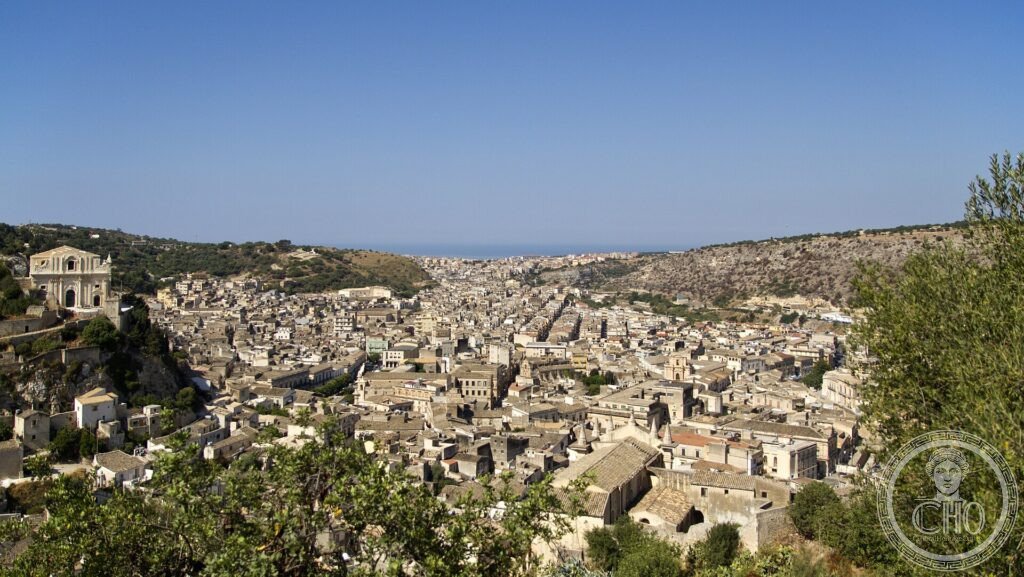
Scicli — a town in the convergence of three river valleys east of Modica, built on the plain below three rocky spurs that carry the ruins of its Arab-period predecessor (cave churches, troglodyte dwellings, and defensive towers carved directly into the limestone cliffs) — offers the most unusual topographic setting in the Val di Noto: a Baroque city visually dominated by abandoned medieval rock-cut settlements above it, creating a skyline that layers two completely different phases of Sicilian civilization in a single view.
At a glance
Scicli (province of Ragusa, Sicilia; UNESCO 2002, ref. 1024) was inscribed as part of the “Late Baroque Towns of the Val di Noto.” Unlike the other Val di Noto cities (which were simply destroyed by the earthquake and rebuilt), Scicli had an additional complication: the pre-earthquake town was built on the three rocky spurs above the current valley floor (the Arab-period settlement, which had expanded into the caves and cliff faces of the Colle di San Matteo, the Colle Santa Croce, and the Colle San Guglielmo); after the 1693 earthquake, the inhabitants rebuilt the new city on the flat valley floor below, abandoning the rocky cliffs and their cave churches entirely. The result is a city with two distinct phases of history: the visible Baroque city of 1693-1750 on the valley floor, and the ghostly remains of the Arab-medieval city on the cliffs above — the most vivid stratification of the 1693 before/after contrast anywhere in the Val di Noto.
Key facts
- Palazzo Beneventano (1772): The most famous building in Scicli (and arguably the most photographed facade in the Val di Noto after the Noto Cathedral): a late-Baroque noble palace on the Corso Mazzini, built for the Beneventano family in 1772; the facade is decorated with a continuous frieze of grotesque masks (mascheroni) at the balcony corbel level — exaggeratedly distorted human and zoomorphic faces — that are the most extravagant example of the Sicilian Baroque tradition of grotesque ornament. The Beneventano maskwork is the richest surviving example of 18th-century grotesque architectural ornament in Sicily
- The Commissariato di Montalbano: The Commissariato di Vigàta (the police station of Inspector Montalbano, the fictional detective of Andrea Camilleri's novels) has been filmed at the Palazzo del Municipio of Scicli (the town hall, a handsome 18th-century Baroque building with a clock tower on the Corso Mazzini) since the first RAI television season (1999-); the Scicli connection to the Montalbano series (plus the Ragusa Ibla, Modica, and Noto locations used for the fictional town of Vigàta) has made the Val di Noto a significant destination for Italian television tourism
- Chiese rupestri (rock-cut cave churches): The three rocky spurs above Scicli (San Matteo, Santa Croce, San Guglielmo) contain the remains of the Arab-period rock-cut churches and dwellings: roughly 20 cave chapels carved into the limestone, with fragments of Byzantine-period frescoes (11th-12th century) in the best-preserved examples (particularly in the cave church of San Matteo on the Colle San Matteo, which still has a carved apse and traces of painted figures). The ruins of the Gothic-period church of San Matteo (14th century, built over an Arab-period cave settlement, abandoned after 1693) are at the top of the San Matteo hill — a 20-minute walk from the valley floor
- UNESCO: 2002, ref. 1024
- GPS: 36.7904, 14.7039 — Google Maps (Palazzo Beneventano, Scicli)
History
The Scicli settlement is ancient (Bronze Age and Sicanian finds on the plateau above the current town), but the distinctive character of the site derives from the Arab period (9th-11th centuries): the Arab conquerors of Sicily (who arrived on the island from 827 and took Palermo in 831) favoured the defensive advantages of rocky hilltop sites, and the three spurs of Scicli were developed as a troglodyte-plus-surface-construction settlement with cave chapels, cisterns, and terrace-agriculture carved into the cliff faces. The Norman conquest (1072-1091) left the basic settlement pattern intact, adding Gothic churches over or beside the Arab structures. The 1693 earthquake destroyed the buildings but also triggered the decision to move the entire town from the cliffs to the flat valley floor — the rebuilding produced the current Baroque city in roughly 60 years, while the cliff settlements above were gradually abandoned and became ruins.
What you see
The Scicli circuit begins on the Corso Mazzini (the principal street of the Baroque city, running east-west through the valley floor): the Palazzo Beneventano facade (right/south side, approximately in the middle of the Corso, identifiable by the mascheroni frieze) is the primary architectural experience. The Palazzo del Municipio (the Commissariato di Montalbano, left/north side, near the east end of the Corso) is the most visited building for Italian television tourists. The church of San Bartolomeo (at the east end of the Corso, a handsome Baroque facade with a campanile) and the church of Santa Maria la Nova (mid-Corso, south side, with a curved Baroque facade) complete the principal streetscape.
The cliff walk: the ascent to the Colle di San Matteo (20-30 min on foot from the Corso, via the Via San Matteo; paved path to the Gothic San Matteo ruins at the top) gives the most dramatic panoramic view of the valley below and the best perspective on the relationship between the cliff city (Arab-medieval) and the valley city (Baroque). The cave church of San Matteo (just below the Gothic ruins) has the most legible interior of the rupestrian ensemble.
Gallery
Practical information
- Palazzo Beneventano: Corso Mazzini, Scicli; exterior always visible; the interior is occasionally accessible during cultural events.
- Palazzo del Municipio (Commissariato Montalbano): Corso Mazzini, Scicli; exterior always accessible; the town hall interior can sometimes be visited during opening hours (Mon-Fri 9:00-13:00).
- Colle San Matteo (cliff walk): Accessible on foot year-round; the path is well-marked but steep (not suitable for strollers or mobility-impaired visitors). Wear closed shoes. Best in morning or late afternoon light (the cliff faces catch raking light that reveals the cave details).
- From Ragusa: Scicli is 20 km south-east of Ragusa by car (SS115, 25 min); bus connection AST Ragusa-Scicli approximately 4 times daily (1h, slow). Combine Scicli with Ragusa Ibla in a single day — the two cities are the UNESCO Val di Noto sites best seen together.
Getting there
Palazzo Beneventano, Scicli (RG), Sicilia. GPS 36.7904, 14.7039. By car from Ragusa: SS115 south-east, 20 km, 25 min. By car from Modica: SP64 south, 12 km, 20 min. By bus: AST buses Ragusa-Scicli (approx 4/day from Ragusa); AST Modica-Scicli (more frequent); no train station in Scicli. By car from Catania: A18 south to Siracusa then SS115 west, approximately 130 km, 2h. Parking: Piazza Italia (free, at the east end of the Corso) and along the Via Roma on the north side of the town.
Nearby
- Ragusa Ibla — 20 km north; (CHO card: Ragusa Ibla barocca UNESCO 2002); the Duomo di San Giorgio di Gagliardi and the granita di mandorla capital of Sicily
- Modica — 12 km north-west; (CHO card: Modica barocca UNESCO 2002, batch298); the cioccolato modicano and the Duomo di San Giorgio
- Sampieri (Marina di Scicli) — 10 km south; unspoiled Sicilian beach with the famous “Fornace Penna” (a ruined early 20th-century brick factory on the beach, used as a location in the Montalbano series); the best beach in the Ragusa province
Sources
- UNESCO: whc.unesco.org/en/list/1024
- Wikipedia EN: Scicli
- Camilleri, Andrea: La forma dell'acqua, Palermo: Sellerio, 1994 (first Montalbano novel; Vigàta includes Scicli locations)
Find it on the map
See this place and what’s around it →📷 Become a Cultural Heritage Online photographer
Share your photos of places: they stay published under your name as the author. The more they're seen, the more you get noticed — and soon a contest will reward the most appreciated photos.
Log in or sign up free to add a photo