
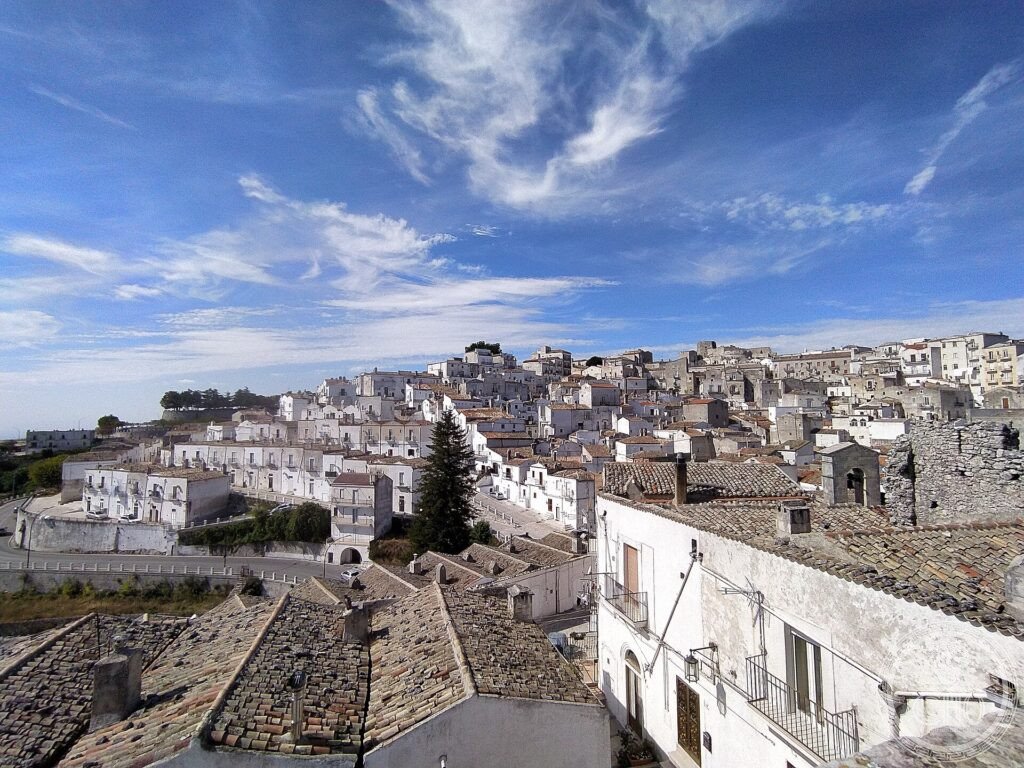
The Sanctuary of the Archangel Michael at Monte Sant’Angelo on the Gargano — the site of the first apparition of the Archangel Michael in the Western Christian tradition (490 CE, in a limestone cave on the side of a Apulian promontory) and the oldest continuously visited Christian pilgrimage site in the West (older than Canterbury, Lourdes, or Fatima) — is the only Christian sacred site that was never formally consecrated by a human bishop, because the Archangel himself was said to have consecrated the cave at his third apparition in 493 CE.
At a glance
Monte Sant’Angelo (province of Foggia, Puglia; UNESCO 2011, ref. 1318) was inscribed as part of the serial property “Longobards in Italy: Places of Power (568-774 AD).” The seven sites of the inscription represent different aspects of Lombard (Longobard) political and religious power in Italy from the Lombard invasion (568 CE) to the Lombard kingdom's incorporation into the Carolingian Empire (774 CE). Monte Sant’Angelo was included because the Sanctuary of the Archangel was the principal spiritual and political focus of the Duchy of Benevento (the southern Lombard territory, which survived the Carolingian conquest and remained independent until the Norman period, 11th century): the Lombard dukes of Benevento used the sanctuary as their dynastic sacred site, enriching it with liturgical furnishings and reinforcing the cult of the Archangel throughout their territory. The Lombard connection made Monte Sant’Angelo the most important pilgrimage centre of medieval southern Italy.
Key facts
- The apparitions of the Archangel Michael (490-493 CE): According to the Liber de apparitione Sancti Michaelis in Monte Gargano (an 8th-century text that documents the early cult), the Archangel Michael appeared three times at the cave on Monte Gargano: in 490 CE (to the Bishop Laurentius of Siponto, appearing in a cave on the hillside and forbidding a bull — the lost animal of a local rancher, Elvio Emanuele — to be sacrificed); in 492 CE (to the bishop again, ordering him to enter the cave); and in 493 CE (consecrating the cave as a sacred Christian space “in nomine meo” — in the Archangel's own name, by spreading his garment over the floor — an event that meant the cave needed no human bishop's consecration, a theological uniqueness that distinguished Monte Sant'Angelo from every other Christian church). The first apparition (490 CE) is the oldest recorded apparition of the Archangel Michael in Western Christendom — earlier than the Mont-Saint-Michel apparition in Normandy (708 CE, which explicitly named the Gargano as its model)
- Pilgrimage statistics (medieval period): From approximately 600 CE to 1300 CE, Monte Sant’Angelo was the fourth most important pilgrimage destination in the Western Christian world (after Jerusalem, Rome/Saint Peter's, and Santiago de Compostela); pilgrims to the Gargano included: Pope John I (523 CE, the first papal visit to the site), Emperor Frederick II (1221 CE, as a preliminary to the Fifth Crusade), the Knight Templar founder Bernard de Clairvaux (1147 CE), and numerous kings and nobles of Norman, Angevin, and Aragonese Sicily and southern Italy. The Via Sacra Langobardorum (the Lombard pilgrimage road) connected the Lombard kingdoms of northern Italy to the Gargano via the Via Francigena variant, passing through Benevento
- The campanile (1274, 59 m): The Angevin Gothic campanile (bell tower) was built under Charles I of Anjou (King of Sicily and Naples, r.1266-1285) in 1274; at 59 m it is one of the tallest Gothic bell towers in southern Italy; the four octagonal upper stages (with Gothic twin-lancet windows and decorative pilasters) are the finest example of Angevin Gothic military-ecclesiastical architecture in Puglia
- UNESCO: 2011, ref. 1318 (serial property: 7 sites — Cividale del Friuli, Castelseprio-Torba, Brescia Santa Giulia, Campello sul Clitunno, Spoleto San Salvatore, Benevento Santa Sofia, Monte Sant’Angelo)
- GPS: 41.7076, 15.9573 — Google Maps
History
The Gargano promontory (the “spur” of the Italian boot) was a liminal, sacred site in both pre-Christian and early Christian belief: the cave system at Monte Sant’Angelo was associated with chthonic deities (the Italic tradition of sacred caves) before the Christian apparitions. The 6th-7th century Lombard dukes of Benevento adopted the Archangel Michael as their patron and the Monte Gargano sanctuary as their dynastic sacred site, organizing the pilgrimage infrastructure and establishing the first monumental church over the cave. The Norman conquest of southern Italy (1071-1091, under Robert Guiscard) reinforced the sanctuary's importance: the Normans, already devoted to the Archangel from the Mont-Saint-Michel sanctuary in Normandy, considered the Gargano apparition the original model and made Monte Sant’Angelo a key stop on the Norman pilgrimage network. The Angevin dynasty (1266-1442) built the campanile and added the carved bronze doors (1076, made in Constantinople, now at the cave entrance — among the oldest Byzantine bronze doors in Italy).
What you see
The Sanctuary is entirely underground (or rather, inside the hillside): the entrance is from the Piazzetta del Santuario in the centre of Monte Sant’Angelo town, reached via a stepped covered road (the Via Sacra, with 19th-century devotional niches on the walls) leading to the church facade; the entrance through the Gothic portal gives access to the cave proper (the original limestone cave, with a 17th-century alabaster altar over the spot where the Archangel's footprint is said to be impressed in the rock, and the 11th-century marble episcopal throne of the Bishops of Siponto; the cave walls are covered with medieval pilgrimage inscriptions scratched by medieval visitors — the densest surviving collection of medieval votive graffiti in Italy, with inscriptions in Latin, Greek, Arabic, Hebrew, and Lombard runic script). The Byzantine bronze doors (1076, made in Constantinople, with 24 panels in bas-relief depicting scenes from the Old and New Testaments and images of the Archangel Michael) are at the cave entrance — among the finest examples of Byzantine metalwork in Italy outside the Pala d’Oro in Venice.
Gallery
Practical information
- Santuario di San Michele Arcangelo: Via Reale Basilica, Monte Sant’Angelo; open daily 7:30-12:30 and 14:30-19:00 (summer); shorter hours in winter; free (donations welcome). The cave interior: modest dress code (shoulders and knees covered); no photography inside the innermost cave area (the Byzantine bronze doors and the altar zone).
- Museo del Santuario: Adjacent to the Sanctuary entrance; open Tuesday-Sunday; admission ~€2; contains the medieval votive gifts, liturgical objects, and documents related to the pilgrimage tradition.
- Town of Monte Sant’Angelo: The town itself (above the Sanctuary) has a Lombard-period castle (Castello degli Angioini, 11th-12th century, with a Norman tower) and a compact historic centre with good fish restaurants and the local taralli al finocchietto (fennel seed biscuits).
Getting there
Piazzetta del Santuario, Monte Sant’Angelo (FG), Puglia. GPS 41.7076, 15.9573. By car: from Foggia, SS89 north-east to Manfredonia then SP53/SS272 north-east to Monte Sant’Angelo (45 km, 1h). The road from Manfredonia to Monte Sant’Angelo involves a series of tight hairpin bends (360 m altitude gain in 12 km); perfectly driveable but the last section is narrow. By bus: SITA Sud buses from Foggia to Monte Sant’Angelo (1h10, approximately 5/day). By train: the nearest train station is Foggia (on the main Rome-Bari line); then bus connection.
Nearby
- Vieste e il Gargano — 60 km north-east; the Gargano National Park (Parco Nazionale del Gargano, UNESCO Biosphere Reserve) with the limestone karst forests of the Foresta Umbra (the “shadow forest”, the largest old-growth broadleaf forest in southern Italy), the sea caves of the Gargano coast (accessible by boat from Vieste), and the white cliffs of the Baia di Vieste
- Manfredonia — 20 km south; the Siponto Cathedral ruins (12th century, abandoned after earthquakes, now an archaeological site with the Byzantine mosaic floor preserved under a shelter) and the Museo Nazionale del Gargano (the finds from the Daunian civilisation of the Foggia plain, 9th-5th century BCE)
- Alberobello — 100 km south; (CHO card: Alberobello trulli UNESCO 1996, batch9 done); the trulli beehive-domed limestone dwellings
Sources
- UNESCO: whc.unesco.org/en/list/1318
- Wikipedia EN: Monte Sant’Angelo
- Liber de apparitione Sancti Michaelis in Monte Gargano, 8th century (critical edition in Monumenta Germaniae Historica, Scriptores rerum Langobardicarum et Italicarum, ed. Waitz, 1878)
- Von Falkenhausen, Vera: I Longobardi meridionali, in Il Mezzogiorno dai Longobardi ai Normanni, UTET, 1983
Find it on the map
See this place and what’s around it →📷 Become a Cultural Heritage Online photographer
Share your photos of places: they stay published under your name as the author. The more they're seen, the more you get noticed — and soon a contest will reward the most appreciated photos.
Log in or sign up free to add a photoIs this page about you?
This page is read by travellers and heritage enthusiasts who find it on Google. Tell us how you are connected to this place and we will take it from there.