
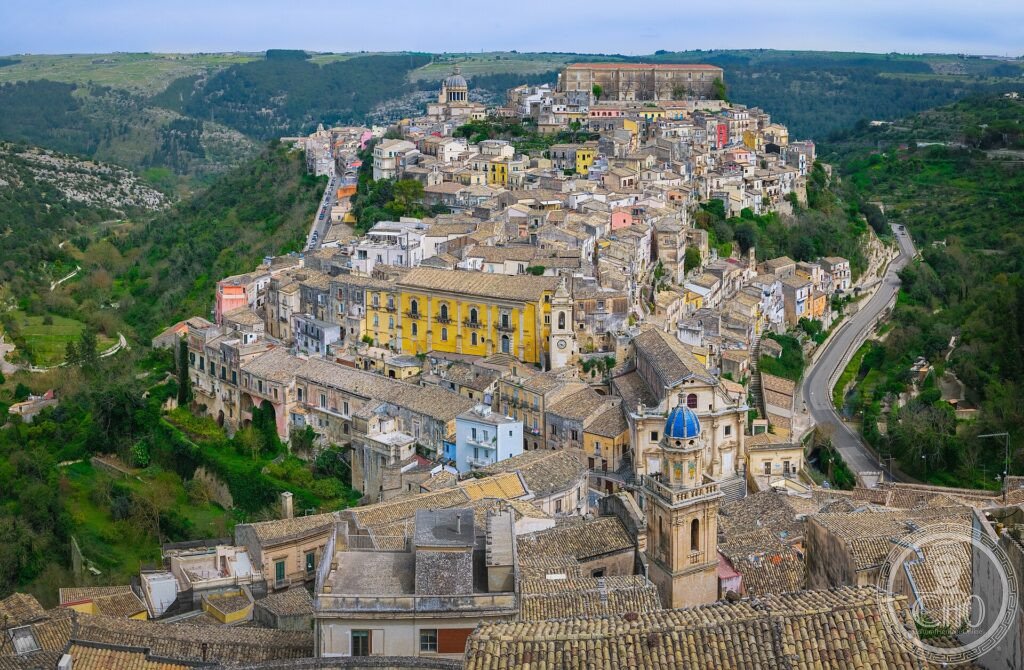
Ragusa Ibla — the lower of the two parts of Ragusa (the upper town, built on the adjacent plateau after the 1693 earthquake, became the administrative capital; the lower rocky spur, Ibla, was rebuilt in place by the noble families who refused to leave their ancestral land) — offers the most complete Baroque streetscape built on a single rocky outcrop in Europe: a city designed as if for a stage set, on terrain that makes every piazza and every curved facade a deliberately choreographed view.
At a glance
Ragusa (province of Ragusa, Sicilia; UNESCO 2002, ref. 1024) was inscribed as part of the “Late Baroque Towns of the Val di Noto” — the eight cities (Caltagirone, Militello in Val di Catania, Catania, Modica, Noto, Palazzolo Acreide, Ragusa, and Scicli) destroyed by the earthquake of 1693 and rebuilt in the Baroque style. The Ragusa component covers both Ragusa Ibla (the older rocky-spur settlement, rebuilt on the original site) and the upper town (Ragusa Superiore, built on the adjacent plateau as the new administrative centre), but Ibla is the architecturally exceptional element: a city of about 15,000 inhabitants compressed onto a V-shaped rocky ridge, accessible from three directions by steep staircases and ramps, with the Duomo di San Giorgio at the centre and the Giardino Ibleo public garden at the far eastern tip of the ridge.
Key facts
- Terremoto del Val di Noto (11 gennaio 1693): The earthquake of 11 January 1693 (estimated magnitude M~7.4 on the Mercalli-Cancani-Sieberg scale, one of the strongest earthquakes to affect Sicily in recorded history) destroyed or severely damaged over 45 towns in south-eastern Sicily and killed approximately 54,000 people (roughly one-quarter of the population of the affected area); all eight cities of the Val di Noto inscription were destroyed and rebuilt in the following decades. The rebuilding programme (roughly 1693-1760) was the most ambitious urban reconstruction project in Baroque Europe and produced the most coherent ensemble of Baroque architecture in Italy
- Duomo di San Giorgio (Gagliardi, 1738-1775): The principal church of Ragusa Ibla, dedicated to Saint George, begun in 1738 and consecrated in 1775; designed by Rosario Gagliardi (the most prolific architect of the Val di Noto Baroque, who also designed the Duomo di San Giorgio in Modica and the Duomo di San Nicolò in Noto — though the Noto attribution is debated); the three-tiered facade (concave-convex plan, with three campanile-pilasters rising above the three portals) and the octagonal drum dome behind it are the most photographed architectural element in the Val di Noto; the interior (three naves, barrel-vaulted, with 18th-century stucco decoration) contains the 17th-century panel painting of Saint George by Pietro Novelli (the principal Sicilian painter of the 17th century)
- The “split city” (Ragusa Ibla vs. Ragusa Superiore): After the 1693 earthquake, the inhabitants of the destroyed town divided: the common people rebuilt on the original rocky spur (Ibla), while the noble families initially chose to build a new town on the adjacent plateau (Ragusa Superiore); over time the upper town became the administrative and commercial centre (it is now the Ragusa comune centre with the prefecture, the cathedral of the upper town, and the main shopping streets); Ibla remained the older, quieter, more architecturally coherent settlement. The two halves were formally merged into a single municipality only in 1926 (under Fascist-era administrative rationalization)
- Giardino Ibleo: The public garden at the eastern tip of the Ragusa Ibla ridge (19th century, but on the site of the medieval city boundary): a viewpoint garden with terraces over the Irminio valley on three sides, with three medieval-era churches incorporated into the garden structure (San Giacomo, Sant'Agata, the Cappuccini portal) and the best panoramic view of the Ragusa Ibla ridge
- UNESCO: 2002, ref. 1024
- GPS: 36.9258, 14.7370 — Google Maps (Duomo di San Giorgio, Ibla)
History
The ancient town on the Ibla ridge (the “Hybla Heraea” of the Greeks, a minor trading settlement in antiquity) was occupied continuously from prehistoric times through the Arab period (9th-11th centuries), the Norman conquest (1061-1072), and the medieval Aragonese-Sicilian period. The 1693 earthquake essentially erased the pre-existing settlement: the reconstruction created the current urban fabric almost entirely in the 60 years between 1693 and 1750. The choice to rebuild on the original rocky-spur site (rather than relocating to the flat land above, which was the rational choice from an engineering standpoint) was made by the aristocratic families who had ancestral claims to the land and who could extract income from the feudal agricultural estates visible below the ridge. The result was a planned Baroque city built on an impossible site — a decision that now defines the aesthetic character of Ibla.
What you see
The Ibla circuit: Piazza del Duomo (the main urban piazza, with the Duomo di San Giorgio facade, the 18th-century palazzo facades, and the characteristic convex curve of the piazza street plan visible from the north end) → Via del Mercato (the main shopping street of Ibla, with food shops, pastry makers, and the local granita bars that make the best granita di mandorla in Sicily) → Giardino Ibleo (20 min on foot east from the Duomo; the garden is small but the terrace views of the Irminio valley below and the staircase churches incorporated into the garden boundary are distinctive) → the descent via the Santa Maria delle Scale staircase (the main connection between Ibla and the upper town, a flight of about 300 steps with Baroque balustrade details and the church of Santa Maria delle Scale at the top — the church that survived the earthquake and retains a 15th-century Gothic portal incongruously embedded in a Baroque facade).
Gallery
Practical information
- Duomo di San Giorgio: Piazza del Duomo, Ragusa Ibla; open daily 9:00-12:30 and 16:00-18:30 (approximately); free. The facade is best photographed in the late afternoon light (west-facing) or from the stepped Corso XXV Aprile approaching from below.
- Giardino Ibleo: open daily from 8:00 to sunset; free. Best viewpoints are the north terrace (over the rocky ridge towards the upper town) and the east terrace (over the Irminio valley).
- Getting from Ibla to the upper town: The easiest route is the CTM bus that connects the two halves of Ragusa (Ibla → Piazza del Popolo in the upper town) every 20-30 min; or the Santa Maria delle Scale staircase (300 steps, 15-20 min on foot).
- Season: Spring (April-June) and early autumn (September-October) are best. July-August Ragusa Ibla is extremely hot (often 36-40°C) and the piazza gets crowded. The granita season is May-October.
Getting there
Piazza del Duomo, Ragusa Ibla (RG), Sicilia. GPS 36.9258, 14.7370. By car: from Catania (via A18/SS114 to Siracusa then SP25, 120 km, 2h); from Palermo (via A19, 250 km, 3h). Ragusa is not well served by train (1 regional train/day from Catania, 3h+, slow); car or bus is the practical option. By bus: AST buses from Catania (Autostazione) to Ragusa (2h, multiple daily). Within Ragusa: Ibla is the lower town; the train station and main CTM bus depot are in the upper town (Ragusa Superiore); the CTM bus connects the two halves every 20-30 min. Parking: available on the upper town side (Piazza del Popolo, free) and on the SP59 at the entrance to Ibla.
Nearby
- Scicli — 20 km south; (CHO card: Scicli barocca UNESCO 2002); the Inspector Montalbano film location and another Val di Noto Baroque city, with the spectacular Palazzo Beneventano facade and the Chiese rupestri (rock-cut churches) carved into the cliff above the town
- Modica — 15 km west; (CHO card: Modica barocca UNESCO 2002, batch298); the famous cioccolato modicano (a cold-processed chocolate made without cocoa butter, a recipe from the Spanish colonial period) and the Duomo di San Giorgio by Gagliardi
- Marina di Ragusa — 24 km south; a contemporary Sicilian beach resort (sandy beaches, sea, the Lungomare); easily accessible from Ibla as a half-day beach excursion
Sources
- UNESCO: whc.unesco.org/en/list/1024
- Wikipedia EN: Ragusa, Sicily
- Tobriner, Stephen: The Genesis of Noto, University of California Press, 1982 (the definitive study of the 1693 earthquake and the Val di Noto reconstruction)
Find it on the map
See this place and what’s around it →📷 Become a Cultural Heritage Online photographer
Share your photos of places: they stay published under your name as the author. The more they're seen, the more you get noticed — and soon a contest will reward the most appreciated photos.
Log in or sign up free to add a photo