
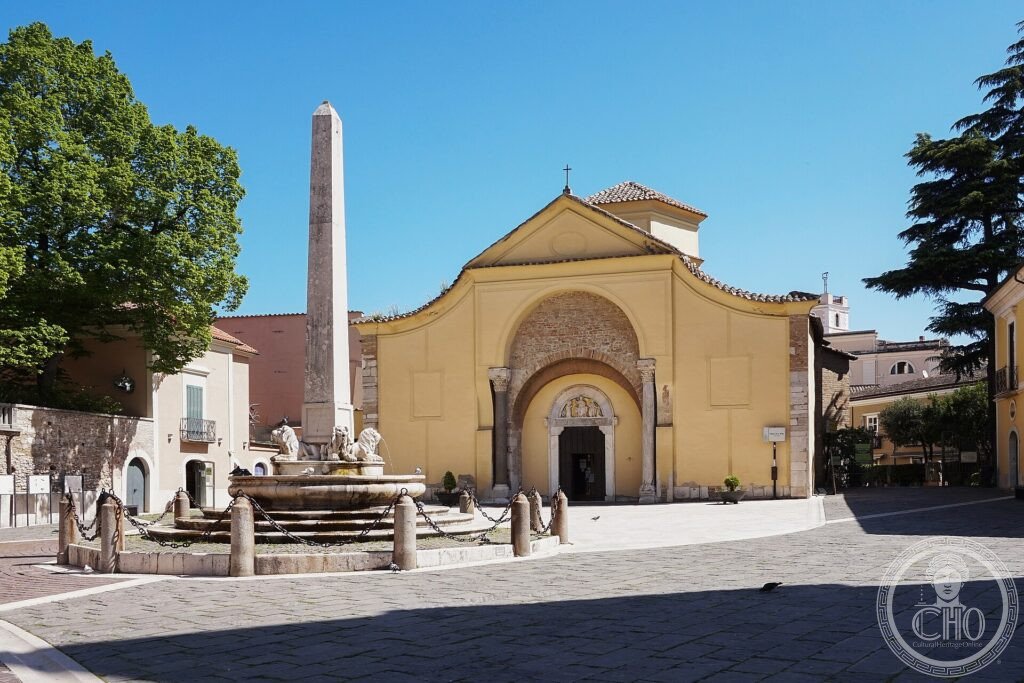
Santa Sofia in Benevento — founded in 762 CE by Arechis II, the Duke of Benevento (the last independent Lombard duchy, which outlasted the fall of the Lombard kingdom in 774 CE by surviving as a principality until 1077) — is the most geometrically original church building in early medieval Italy: its plan, derived from an intersection of a hexagon and a pentagram inscribed in a circle, is an experiment in sacred geometry that appears nowhere else in early Christian or early medieval architecture.
At a glance
Benevento (province of Benevento, Campania; UNESCO 2011, ref. 1318) was inscribed for the church of Santa Sofia as part of the serial property “Longobards in Italy: Places of Power (568-774 AD).” Benevento was the capital of the Duchy of Benevento (established 571 CE as the southernmost Lombard duchy, subsequently elevated to a Principality by Arechis II in 774 CE after the fall of the northern Lombard kingdom), which remained the most significant Lombard political entity in Italy until its gradual absorption into the Norman Kingdom of Sicily (completed 1077). The Santa Sofia church was built by Arechis II (r.758-787, as Duke then Prince of Benevento) as a dynastic oratory and model of Lombard piety after the Carolingian conquest of the northern Lombard kingdom had made the survival of Lombard political culture dependent on the southern principality.
Key facts
- The plan of Santa Sofia (762 CE): The church of Santa Sofia has the most geometrically unusual plan of any early medieval church in Italy: the interior is organized as a central hexagon (six columns supporting a central dome, now lost, replaced by a later vault) surrounded by an ambulatory (annular corridor) with an irregular polygon plan that was derived by intersecting a circle with a pentagonal star (5-pointed star inscribed in the circle, creating 10 alternating vertices that define the ambulatory wall angles); the apse is at the east end, with the altar in the hexagonal central space. The geometric plan was described by the 18th-century architect and antiquarian Francesco Milizia as “a work of admirable ingenuity and knowledge of geometry” — it remains unexplained in terms of its mathematical derivation and has no known predecessor or successor in European sacred architecture
- Reuse of Roman columns: The six columns of the central hexagon are Roman spolia (reused from demolished Roman buildings in Benevento — the city had a significant Roman-period monument stock, including the Arch of Trajan, 114 CE, which still stands in the city centre): the columns are of different heights, which gives the central hexagonal space an irregular, dynamically asymmetrical quality unusual in a deliberately designed sacred interior
- The 8th-century frescoes: The apse and the walls of Santa Sofia retain fragments of the original 8th-century fresco cycle (painted during or shortly after the church's construction under Arechis II): the most legible section shows scenes from the life of the Virgin Mary and the life of Christ, in a style that combines late antique (Byzantine-influenced) iconography with Lombard decorative elements — the only surviving 8th-century fresco cycle in Campania
- The Romanesque cloister (12th century): The cloister adjacent to Santa Sofia (now containing the Museo del Sannio) was built in the 12th century and is one of the most complete Romanesque cloisters in southern Italy: the ambulatory has small paired columns with elaborately carved capitals (over 100 different capital designs, including Lombard interlace patterns, classical acanthus, and figurative scenes from the Bestiary) of exceptional quality; the overall condition (largely intact, with the garden and the 12th-century well visible) makes it one of the finest surviving Romanesque cloister ensembles in Italy
- UNESCO: 2011, ref. 1318
- GPS: 41.1307, 14.7812 — Google Maps
History
Benevento (the Roman Beneventum, a Latin colony of 268 BCE on the Apennine road junction) became a Lombard city in 571 CE when the Lombard Duke Zotto established the Duchy of Benevento, extending Lombard control over most of Campania and the southern Apennines. Unlike the northern Lombard kingdoms (which fell to Charlemagne in 774 CE), the Duchy of Benevento (elevated to a Principality by Arechis II in 774, explicitly to claim equal dignity with the Carolingian kingdom) survived the Carolingian conquest and remained the principal Lombard political entity in Italy until the Norman period. Arechis II (r.758-787) built Santa Sofia in 762 CE as an act of political and spiritual self-assertion: the dedication to the Holy Wisdom (Sophia) was a deliberate evocation of the great Hagia Sophia in Constantinople, claiming for the Benevento principality the prestige of Byzantine imperial sacred architecture in the same year that the political relationship with the northern Lombard kingdom collapsed. After the Norman conquest (1077), Benevento became a Papal territory (it remained part of the Papal State until 1860) and the Church of Santa Sofia became a Benedictine monastery, which accounts for the construction of the Romanesque cloister in the 12th century.
What you see
The Santa Sofia complex: the church facade (a modest exterior that does not reveal the geometric complexity inside) gives access to the interior through the principal portal on the Piazza Santa Sofia. The interior experience is primarily spatial — the central hexagonal space with the ring of Roman columns, the ambulatory wrapping around it, and the apse at the east end create a sequence of spaces that works differently from any other early medieval Italian church interior. The 8th-century fresco fragments are in the apse and on the south side of the ambulatory wall; a guided visit is the best way to see them (the frescoes are partially obscured by later plasterwork and difficult to read without context).
The cloister (entrance from the church or from the museum entrance on the Piazza Santa Sofia) is the more immediately accessible and visually rewarding element: the double colonnade with its carved capitals (each different; look for the Lombard interlace, the Green Man mask, and the Daniel in the Lions' Den capital on the east arcade) and the central garden give the most complete experience of a Romanesque cloister interior in southern Italy. The Museo del Sannio (housed in the cloister wings) has an important collection of Samnite and Roman antiquities from the Benevento area.
Gallery
Practical information
- Santa Sofia: Piazza Santa Sofia, Benevento; open Monday-Saturday 9:00-13:00 and 16:00-19:00; Sunday 10:00-13:00; free.
- Museo del Sannio (in the cloister): Piazza Santa Sofia 1, Benevento; open Tuesday-Sunday 9:00-13:30; admission ~€4. The museum includes the Samnite finds (the Samnites were the Italic people who fought Rome in three wars and whose territory corresponds to the current Samnio region), the Roman period objects (including Egyptian monuments brought to Benevento by the Roman emperor Domitian for his Isis sanctuary — Benevento has the largest collection of Egyptian obelisks and sculptures outside Egypt after Rome), and the medieval art from the Santa Sofia treasury.
- Arco di Traiano (114 CE): 10 min on foot from Santa Sofia, in the historic centre; one of the best-preserved Roman triumphal arches (height 15.6 m, marble reliefs of exceptional quality showing Trajan's public works programme in Italy); always accessible and free.
Getting there
Piazza Santa Sofia, Benevento (BN), Campania. GPS 41.1307, 14.7812. By train: Trenitalia from Naples (1h15 regional; Napoli Centrale to Benevento, approximately 8/day); from Rome (2h with change at Caserta). The train station is 1 km south of the historic centre (15 min on foot via the Corso Garibaldi). By car: from Naples, A1 north-east to Caserta then A1 continuation or SS265/SS7 east (60 km, 1h); from Rome, A1 south to Caserta then east (250 km, 3h).
Nearby
- Arco di Traiano (114 CE) — 10 min on foot from Santa Sofia; the best-preserved Roman triumphal arch in Italy after the Arch of Titus in Rome
- Monte Sant’Angelo — 130 km north-east (Foggia province); (CHO card: Monte Sant’Angelo Santuario UNESCO 2011); the other Longobards-in-Italy site in southern Italy, the Sanctuary of the Archangel Michael
- Napoli — 60 km south-west; (CHO card TBD); the historic centre UNESCO 1995 (ref.726); Museo Nazionale with the Pompeii finds, the Certosa di San Martino, Castel Nuovo
Sources
- UNESCO: whc.unesco.org/en/list/1318
- Wikipedia EN: Santa Sofia, Benevento
- Rotili, Mario: La necropoli longobarda di Benevento, Napoli: L'Arte Tipografica, 1977
- Krautheimer, Richard: Early Christian and Byzantine Architecture, Yale University Press, 4th ed. 1986 (for the geometric plan analysis)
Find it on the map
See this place and what’s around it →📷 Become a Cultural Heritage Online photographer
Share your photos of places: they stay published under your name as the author. The more they're seen, the more you get noticed — and soon a contest will reward the most appreciated photos.
Log in or sign up free to add a photoIs this page about you?
This page is read by travellers and heritage enthusiasts who find it on Google. Tell us how you are connected to this place and we will take it from there.