

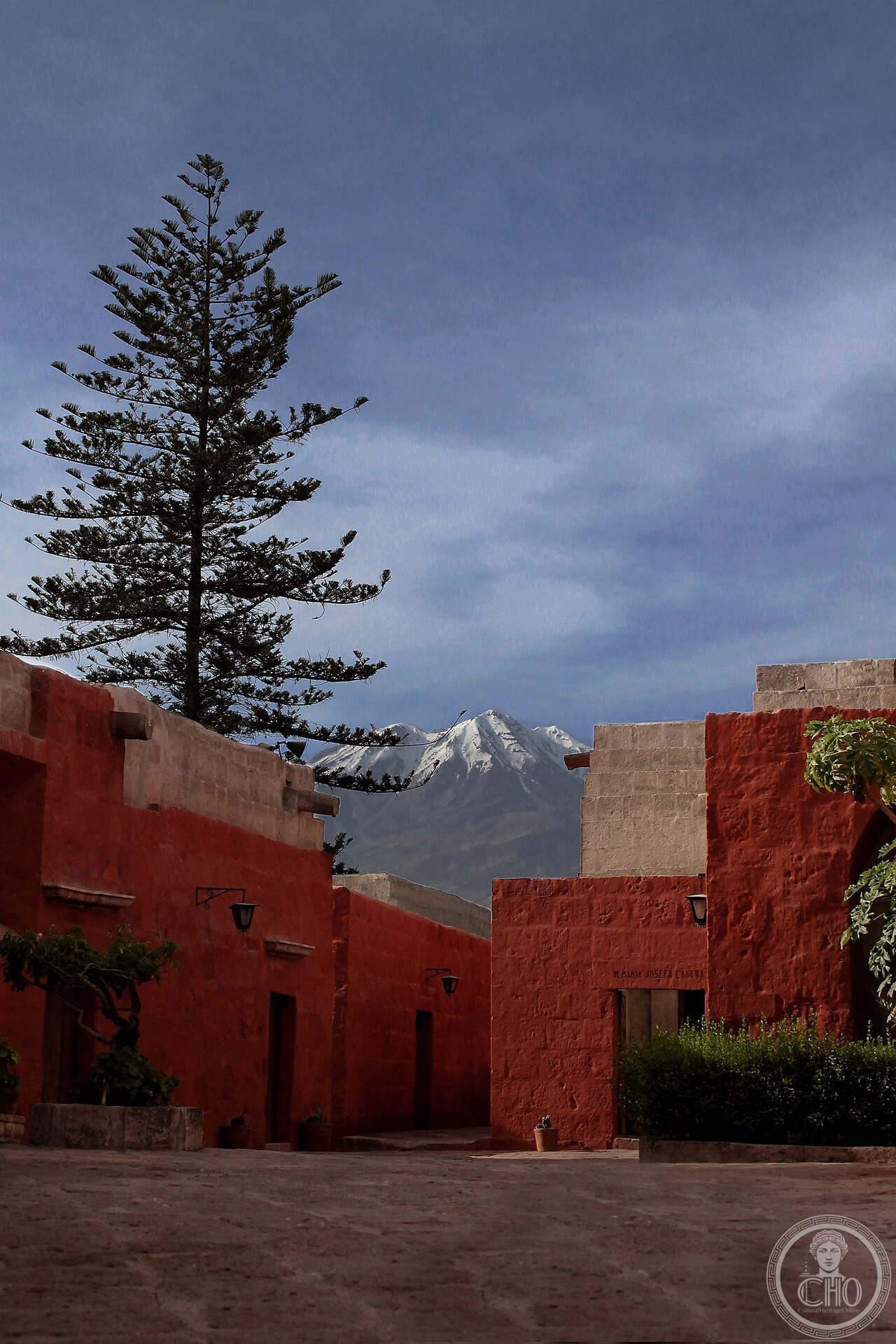
In Arequipa, in Peru, the Monastery of Santa Catalina de Siena was founded by Doña María de Guzmán, a wealthy young widow who gave up her possessions to enter religious life. The founding document was signed on 10 September 1579, with the authorization of Viceroy Francisco de Toledo, and named her “first inhabitant and prioress”. A solemn mass on 2 October 1580 marked the beginning of habit-taking for the first sisters. The Dominican complex covers roughly 20,000 square metres. It is built of white sillar, the volcanic stone of the Chachani volcano, and of pink stone from El Misti. It works as a self-contained citadel, with narrow streets, small plazas, cloisters, a cemetery, a communal laundry with large clay basins, kitchens and a bakery, alongside some eighty individual dwellings for the nuns at its peak. The walls are painted in the characteristic colours of “Seville blue”, ochre and white, and the streets carry the names of Spanish cities: Córdoba, Málaga, Toledo, Granada, Sevilla and Burgos. Until 1871 the nuns, often daughters of wealthy criollo families, brought dowries and up to four personal servants with them, and lived in private cells that could be quite luxurious, with rooms for servants, a kitchen and a terrace. That year Sister María Josefa Cadena y Pastor, sent by Pope Pius IX to restore discipline, abolished the system of private cells and the categories of nun, and moved everyone into a shared dormitory divided by curtains. Closed to the outside world for centuries, the monastery largely opened to the public in 1970, following an arrangement for its tourist management that also allowed it to be modernised with electricity. A small community of cloistered Dominican nuns still lives today in a restricted area, not open to visitors, while the rest works as a museum. The monastery forms part, together with the rest of the historic centre, of the UNESCO World Heritage Site “Historic Centre of the City of Arequipa”, inscribed in December 2000.
About Santa Catalina Monastery
In Arequipa, Peru, the Monastery of Santa Catalina de Siena was founded by Doña María de Guzmán, a wealthy young widow who gave up her possessions to enter religious life. The founding document was signed on 10 September 1579, with the authorization of Viceroy Francisco de Toledo, and named her “first inhabitant and prioress”. A solemn mass on 2 October 1580 marked the beginning of habit-taking for the first sisters. The Dominican complex covers roughly 20,000 square metres. It is built of white sillar, the volcanic stone of the Chachani volcano, and of pink stone from El Misti. It works as a self-contained citadel, with narrow streets, small plazas, cloisters, a cemetery, a communal laundry with large clay basins, kitchens and a bakery, alongside some eighty individual dwellings for the nuns at its peak. The walls are painted in the characteristic colours of “Seville blue”, ochre and white, and the streets carry the names of Spanish cities: Córdoba, Málaga, Toledo, Granada, Sevilla and Burgos. Until 1871 the nuns, often daughters of wealthy criollo families, brought dowries and up to four personal servants with them, and lived in private cells that could be quite luxurious, with rooms for servants, a kitchen and a terrace. That year Sister María Josefa Cadena y Pastor, sent by Pope Pius IX to restore discipline, abolished the system of private cells and the categories of nun, and moved everyone into a shared dormitory divided by curtains. Closed to the outside world for centuries, the monastery largely opened to the public in 1970, following an arrangement for its tourist management that also allowed it to be modernised with electricity. A small community of cloistered Dominican nuns still lives today in a restricted area, not open to visitors, while the rest works as a museum. The monastery forms part, together with the rest of the historic centre, of the UNESCO World Heritage Site “Historic Centre of the City of Arequipa”, inscribed in December 2000.
Key facts
- 1579: founding document signed by Doña María de Guzmán, first prioress.
- 20,000 m²: the walled complex, built in white sillar and pink volcanic stone.
- Streets named after Spanish cities — Córdoba, Málaga, Toledo, Granada, Sevilla, Burgos.
- 1871: Sister María Josefa Cadena y Pastor abolishes private cells, enforcing communal life.
- 1970: the monastery largely opens to the public after centuries of enclosure.
- 2000: becomes part of the UNESCO World Heritage Site “Historic Centre of the City of Arequipa”
History
For nearly three centuries, Santa Catalina functioned as a genuinely self-sufficient walled town. Its wealthier nuns lived with private servants and personal quarters, in open contradiction of vows of poverty, until the 1871 reform imposed by Rome finally levelled that internal hierarchy into shared communal life. Its 1970 opening to outsiders, after roughly 400 years of near-total enclosure, turned one of colonial Peru’s most secluded religious communities into one of Arequipa’s most visited landmarks, without displacing the small community that remains cloistered there today.
What you see
Narrow streets and small plazas wind between walls painted in vivid Seville blue, ochre and white, opening onto cloisters, a communal laundry lined with large clay basins, kitchens, a bakery and a cemetery. The layout and colour scheme deliberately echo southern Spain, down to street names like Sevilla, Toledo, Granada and Málaga, while the individual former cells — some with their own kitchens and terraces — reveal the stratified, often surprisingly comfortable domestic life the 1871 reform later dismantled.
Practical information
- Opening hours: generally open daily with seasonal variation; admission fee applies; check current hours before visiting.
- Address: Santa Catalina 301, Arequipa, Peru.
Getting there
Santa Catalina Monastery lies a few blocks north of Arequipa’s Plaza de Armas, easily reached on foot within the historic centre. GPS: 16°23′42″S, 71°32′12″W.
Nearby
- Arequipa Cathedral — the city’s main cathedral, a short walk south on the Plaza de Armas.
- La Compañía de Arequipa — the Jesuit church with its mestizo Baroque facade, on the same square.
- Plaza de Armas de Arequipa — the historic city’s main square.
Sources
- Wikipedia — “Monastery of Santa Catalina de Siena, Arequipa” (en.wikipedia.org).
- Official site — Monasterio de Santa Catalina (santacatalina.org.pe).
- UNESCO World Heritage Centre — “Historic Centre of the City of Arequipa” (whc.unesco.org).
Find it on the map
See this place and what’s around it →📷 Become a Cultural Heritage Online photographer
Share your photos of places: they stay published under your name as the author. The more they're seen, the more you get noticed — and soon a contest will reward the most appreciated photos.
Log in or sign up free to add a photo