

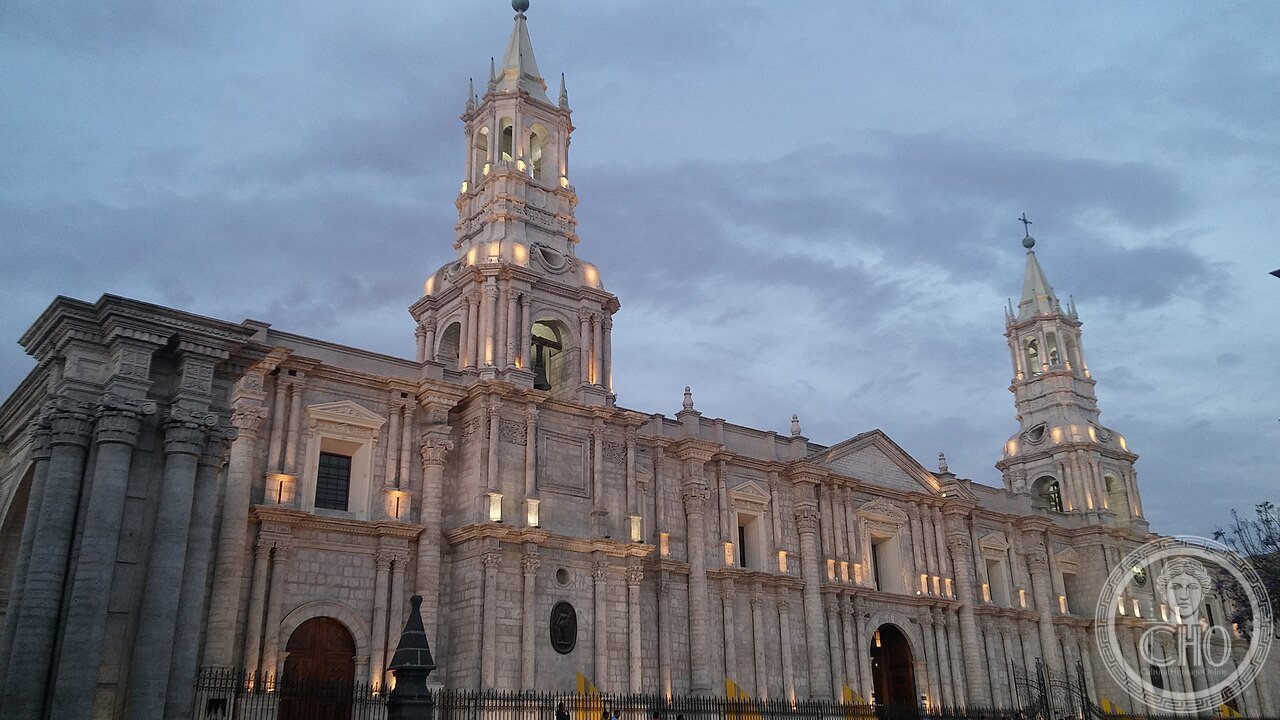
On the Plaza de Armas in Arequipa, Peru, building of the cathedral began in the same year the city was founded, 1540, with a formal contract signed in February 1544 with the architect Pedro Godínez and the work on the portal entrusted to Toribio de Alcaraz from September of the same year. The present building, however, bears the marks of centuries of rebuilding: a fire in 1844 destroyed much of the interior — paintings, sculpture, furnishings, vaults and piers — and the rebuilding was directed by Bishop José Sebastián de Goyeneche y Barreda with the architect Lucas Poblete in technical charge; a violent earthquake in 1868 brought down the towers, part of the main portal, some arches of the facade and several altars, rebuilt in the following years taller and more slender by the same team; and finally the magnitude 8.3 earthquake of 23 July 2001 damaged both towers, with the partial collapse of the left one. The cathedral is built entirely of sillar, the white volcanic stone that gives Arequipa its nickname of “the White City”, in a style described as Neo-Renaissance with Gothic influences, or sometimes Neoclassical. It faces the whole northern side of the Plaza de Armas — among the few examples in the world of a cathedral occupying an entire side of a square on its own, as is commonly reported — and is divided into three aisles forming a Latin cross. Inside are a Belgian-made pipe organ, the work of François Bernard Loret and considered among the largest in South America, a pulpit of carved oak from the Buisine-Rigot workshop of Lille, in France, installed in 1879, and the high altar in Carrara marble, the work of the sculptor Felipe Maratillo. The cathedral forms part, with the rest of the historic centre, of the UNESCO World Heritage “Historical Centre of the City of Arequipa”, inscribed in December 2000, and is today the seat of the archbishop and the metropolitan council of the Archdiocese of Arequipa.
About Arequipa Cathedral
On Arequipa’s Plaza de Armas in Peru, construction of the cathedral began in the same year the city was founded, 1540, with a formal contract signed in February 1544 with the architect Pedro Godínez and portal work assigned to Toribio de Alcaraz from September of that year. The building standing today, however, carries the marks of centuries of rebuilding: a fire in 1844 destroyed much of the interior — paintings, sculptures, furnishings, vaults and pillars — and reconstruction was directed by Bishop José Sebastián de Goyeneche y Barreda with technical direction from the architect Lucas Poblete; a violent earthquake in 1868 brought down the towers, part of the main portal, some of the facade arches and several altars, rebuilt in the following years taller and more slender by the same team; and finally the magnitude-8.3 earthquake of 23 July 2001 damaged both towers, with the left tower partially collapsing. The cathedral is built entirely of sillar, the white volcanic stone that gives Arequipa its nickname “the White City,” in a style described as Neo-Renaissance with Gothic influences, or sometimes Neoclassical. It fronts the entire north side of the Plaza de Armas — one of the few cathedrals anywhere commonly said to occupy a full side of a main square on its own — and is divided into three naves forming a Latin cross. Inside stand a Belgian-made pipe organ, the work of François Bernard Loret and considered among the largest in South America, an oak pulpit carved by the Buisine-Rigot workshop of Lille, France, installed in 1879, and a main altar of Carrara marble by the sculptor Felipe Maratillo. The cathedral forms part, together with the rest of the historic centre, of the UNESCO World Heritage Site “Historic Centre of the City of Arequipa,” inscribed in December 2000, and today serves as the seat of the Archbishop and metropolitan council of the Archdiocese of Arequipa.
Key facts
- 1540: construction begins the same year Arequipa is founded; formal contract signed 1544
- 1844: a major fire destroys much of the interior; rebuilt under Bishop Goyeneche and architect Lucas Poblete
- 1868: an earthquake destroys the towers and part of the facade, later rebuilt taller and more slender
- 2001: a magnitude-8.3 earthquake damages both towers, partially collapsing the left one
- Built of sillar, the white volcanic stone giving Arequipa its “White City” nickname
- 2000: becomes part of the UNESCO World Heritage Site “Historic Centre of the City of Arequipa”
History
Few cathedrals anywhere have been rebuilt as many times, by as many different causes, as Arequipa’s: fire in 1844, earthquake in 1868, and earthquake again in 2001, each time repaired or reconstructed rather than replaced, so that the structure standing today is best understood as a layered record of the city’s repeated recoveries rather than a single unbroken 16th-century building. The cathedral’s siege by nature has become part of local identity in a city nicknamed for its white volcanic stone and framed by three active volcanoes, chief among them El Misti.
What you see
The cathedral’s white sillar facade runs the full length of the Plaza de Armas’ north side, its twin towers rebuilt taller and more slender after the 1868 earthquake and repaired again after 2001. Inside, three naves forming a Latin cross lead to a Carrara marble main altar, flanked by the Belgian-made Loret organ and the French oak pulpit carved in Lille — a gathering of European craftsmanship inside a building shaped, again and again, by Andean geology.
Practical information
- Opening hours: generally open daily with seasonal variation; some areas require a separate ticket; check current hours before visiting
- Address: Plaza de Armas, Arequipa, Peru
Getting there
Arequipa Cathedral occupies the north side of the Plaza de Armas, easily reached on foot within the historic centre. GPS: 16°23′53″S, 71°32′12″W.
Nearby
- La Compañía de Arequipa — the Jesuit church on the same square, famed for its mestizo Baroque facade
- Santa Catalina Monastery — the famous walled convent complex, a short walk away
- Plaza de Armas de Arequipa — the historic city’s main square
Sources
- Wikipedia — “Basilica Cathedral of Arequipa” (en.wikipedia.org)
- UNESCO World Heritage Centre — “Historic Centre of the City of Arequipa” (whc.unesco.org)
- Wikipedia — “Historic Centre of Arequipa” (en.wikipedia.org)
Find it on the map
See this place and what’s around it →📷 Become a Cultural Heritage Online photographer
Share your photos of places: they stay published under your name as the author. The more they're seen, the more you get noticed — and soon a contest will reward the most appreciated photos.
Log in or sign up free to add a photo