
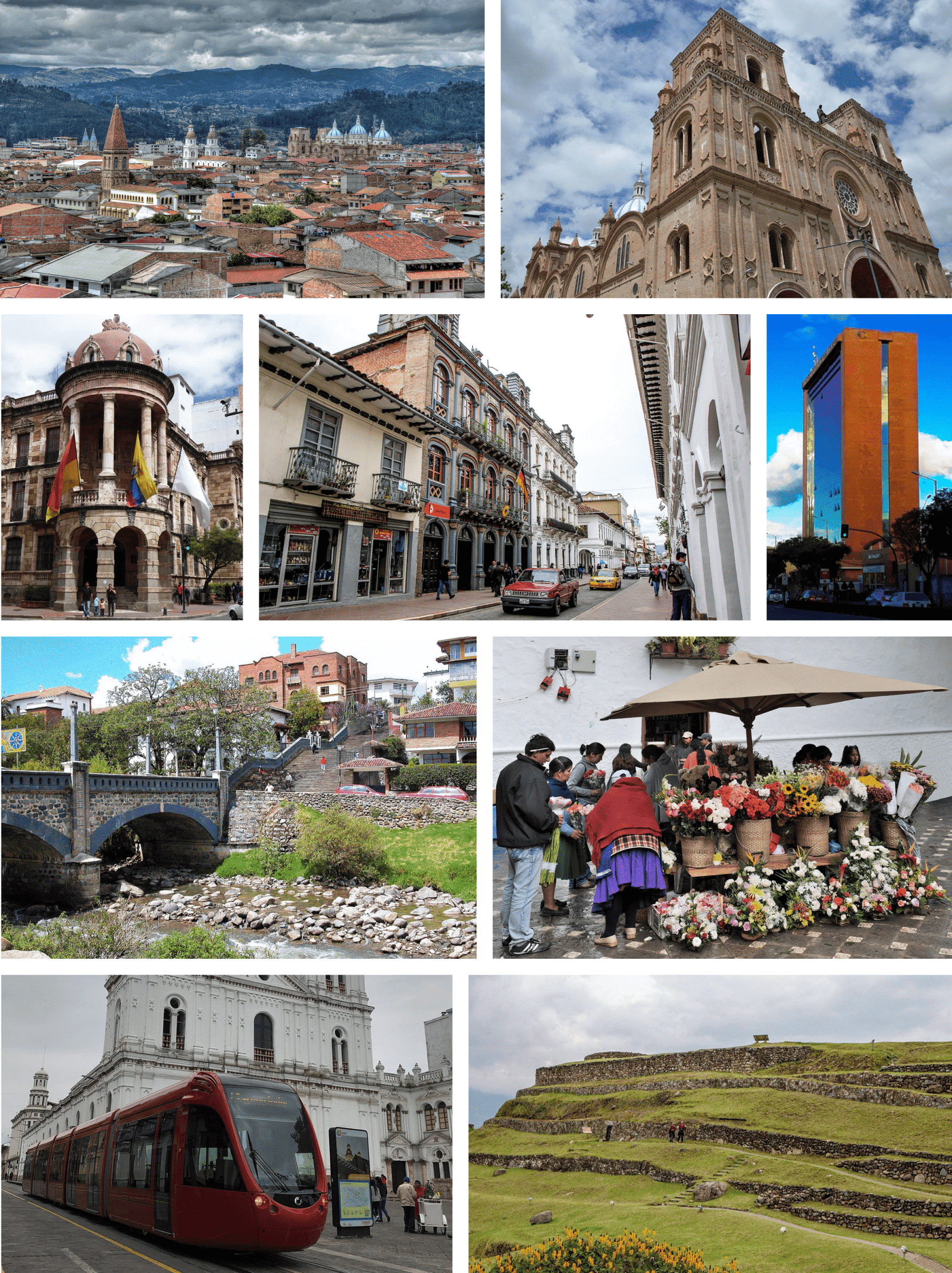
Cuenca is the best-preserved colonial Spanish city in Ecuador — a Renaissance grid laid down in 1557 at 2,550 metres altitude where four rivers meet, its white-plastered facades, blue-and-red tile roofs, and turquoise cathedral domes surviving almost intact. Beneath the cobblestones lie the ruins of Tomebamba, one of the four capitals of the Inca Empire. UNESCO World Heritage Site since 1999.
At a glance
Founded in 1557 CE by Spanish captain Gil Ramírez Dávalos on orders from the Viceroy of Peru, Cuenca exemplifies the Renaissance urban planning model applied to a New World colonial city — an orthogonal grid centred on a plaza mayor, from which streets extend in a regular pattern matching the Laws of the Indies prescriptions. The extraordinary quality of Cuenca is its completeness: the 17th to 19th century colonial core survives with remarkable integrity, and the city continues to function as a living Ecuadorian cultural centre. UNESCO inscribed it in 1999 under criteria (ii), (iv), and (v).
Key facts
- Full name: Santa Ana de los Ríos de Cuenca
- Founded: 1557 CE by Gil Ramírez Dávalos
- UNESCO inscription: 1999, criteria (ii)(iv)(v)
- Elevation: 2,550 metres above sea level
- Rivers: Four rivers converge at the site — Tomebamba, Yanuncay, Machángara, and Tarqui
- Pre-Hispanic site: Tomebamba — one of the four capitals of the Inca Empire
- Population: approximately 650,000 — third largest city in Ecuador
- Province: Azuay, southern highlands of Ecuador
History
Long before the Spanish arrived, the site was Tomebamba — a major Inca administrative and ceremonial capital founded around 1470 CE by Inca Tupac Yupanqui and expanded under Huayna Capac, who may have been born there. Tomebamba was considered by some sources to rival Cusco in grandeur, with temples, storehouses, and royal palaces built in classic Inca polygonal stone masonry. When the civil war between Huáscar and Atahualpa tore the Inca Empire apart in the 1520s, Tomebamba was largely destroyed.
The Spanish conquistadors arrived in the region in the 1530s. In 1557, the colonial city of Cuenca was formally established by order of the Viceroy of Peru, Andrés Hurtado de Mendoza, and founded by Captain Gil Ramírez Dávalos. The city was laid out on the Renaissance grid model, with a central Plaza Mayor (today Parque Calderón), a cathedral, town hall, and administrative buildings. Stone from the destroyed Inca temples was reused in colonial construction, and some Inca walls are still visible beneath and beside colonial buildings.
Cuenca flourished through the colonial and Republican eras as an artisanal and commercial centre. By the 19th century the city was producing fine textiles, ceramics, and the hat that would become known worldwide as the Panama hat — actually a Cuencan invention. These hats were called Panama hats because they were shipped to global markets via Panama during the Canal construction. The New Cathedral, with its distinctive turquoise domes, was begun in 1885 and completed only in 1975, and remains the city’s most recognisable landmark.
What you see
Parque Calderón and the two cathedrals: The central plaza is flanked by the Old Cathedral (Catedral del Sagrario, 1557 — begun on the day of the city’s foundation, now a museum of religious art) and the New Cathedral (Catedral de la Inmaculada Concepción, 1885–1975 — its three turquoise-blue Byzantine domes dominate the skyline and are visible from the surrounding hills). The New Cathedral was designed to be one of the largest in South America, though its towers were never completed to the planned height.
The colonial streetscape: The historic core preserves block after block of 17th to 19th century architecture — white-plastered facades, carved wooden balconies overhanging the narrow cobblestone streets, interior flower-filled courtyards, and the characteristic blue and red barrel-tile roofs. The four rivers running through the city provide green balconies of vegetation along their banks.
Inca remains: The Pumapungo Museum (Banco Central del Ecuador) stands on the excavated ruins of the Inca royal compound of Tomebamba. The site preserves Inca polygonal stonework, channels, and ritual spaces alongside the museum collections of pre-Columbian and colonial art.
Panama hats: Cuenca is the world capital of the toquilla straw hat, woven from the fibres of the Carludovica palmata plant. Workshops throughout the historic centre and surrounding villages produce hats at every price point, from everyday to museum-quality pieces requiring months of weaving.
Practical information
- Getting in: Mariscal Lamar International Airport in Cuenca with flights from Quito and Guayaquil; bus from Quito takes approximately 9 to 10 hours
- Walking the historic core: The UNESCO-listed centre is compact and walkable in a day; the main monuments are within a few blocks of Parque Calderón
- Entry fees: Parque Calderón and street access free; cathedrals and Pumapungo museum charge modest entry
- Best time: Dry season June to September is most reliable for clear skies; the city sits at 2,550 m so temperatures are mild year-round, around 7 to 22 degrees C
- Hat shopping: Authentic toquilla straw hats widely available; quality varies — finer weaves take longer to produce and command higher prices
- Expat community: Cuenca has a significant international expat community and English is widely understood in tourist areas
Getting there
Cuenca lies in the southern highlands of Ecuador, approximately 460 km south of Quito and 240 km east of Guayaquil. Domestic flights from Quito (under one hour) and Guayaquil (30 minutes) connect to Mariscal Lamar Airport, which is within the urban area. Long-distance bus services connect Cuenca to Quito, Guayaquil, Loja, and the Peruvian border. For visitors to Ecuador, Cuenca is typically combined with Quito and the Galápagos Islands.
Nearby
- Ingapirca — 80 km north; the best-preserved Inca ruin in Ecuador, a Temple of the Sun built by Huayna Capac over an earlier Cañari platform
- Cajas National Park — 30 km west; a high-altitude Andean lake plateau with over 230 lakes, excellent for trekking and birdwatching
- Chordeleg — 35 km east; a village renowned for gold and silver filigree jewellery workshops
- Loja — 200 km south; gateway to Podocarpus National Park and the Ecuadorian Amazon
Sources
Find it on the map
See this place and what’s around it →📷 Become a Cultural Heritage Online photographer
Share your photos of places: they stay published under your name as the author. The more they're seen, the more you get noticed — and soon a contest will reward the most appreciated photos.
Log in or sign up free to add a photo