
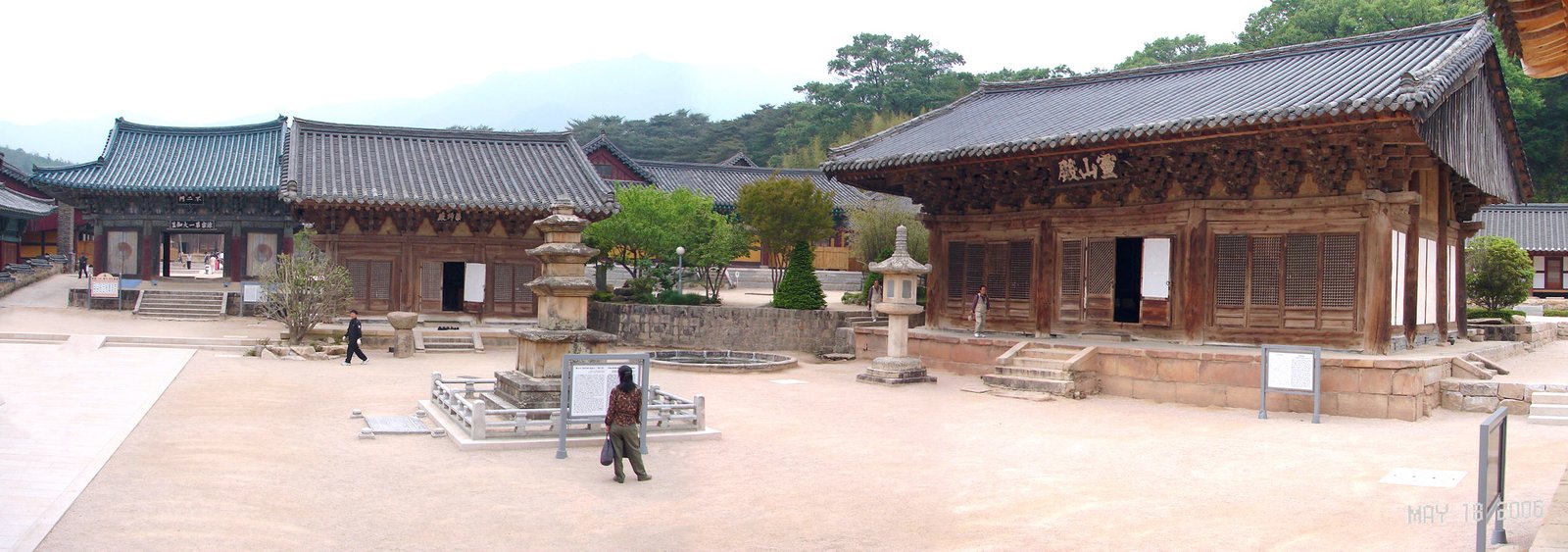
Seven living Buddhist monasteries hidden in the southern Korean mountains, continuously active for over 1,300 years — the only intact Buddhist monastic tradition in Asia never interrupted by secularisation or war.
At a glance
The seven sansa (산사, mountain monasteries) inscribed by UNESCO in 2018 are: Tongdosa (founded 646 CE, South Gyeongsang), Beopjusa (553 CE, North Chungcheong), Magoksa (640 CE, South Chungcheong), Seonamsa (875 CE, South Jeolla), Daeheungsa (traditional date 426 CE, South Jeolla), Beopjusa, and Seonamsa. Together they represent an unbroken living tradition: hundreds of monks and nuns still reside in each, following the original monastic rule established over a millennium ago.
UNESCO recognised the sansa as the sole example of an intact Asian Buddhist tradition never disrupted by secularisation or political upheaval — surviving the Mongol invasions of the 13th century, the devastating Japanese invasions of 1592–1598 (Imjin War), and the Korean War of 1950–1953.
Key facts
- UNESCO inscription: 2018 (serial property, seven monasteries)
- Oldest foundation: Daeheungsa — traditional date 426 CE (Baekje period)
- Largest monastery: Tongdosa (South Gyeongsang Province)
- Active community: monks and nuns resident in all seven, following the Jogye Order
- Korean name: 산사 (sansa) — literally mountain monastery
- Architectural sequence: ilju-mun gate → guardian gate → bell pavilion → main hall (preserved intact at all sites)
- Art collections: 1,000+ years of Korean Buddhist paintings, sculpture, ceramics, and manuscripts at each site
History
Buddhism arrived in the Korean peninsula during the Three Kingdoms period (4th–7th century CE), introduced separately to Goguryeo (372 CE), Baekje (384 CE), and Silla (527 CE). From the outset, Korean Buddhism developed a strong tradition of mountain retreat — monks sought remote peaks for meditation and cultivation, following the Buddhist concept of the sacred mountain as a site of enlightenment.
The foundation dates of the seven sansa span three centuries (426–875 CE), all during the period of the Three Kingdoms and Unified Silla. By the Goryeo dynasty (918–1392 CE), Buddhism had become the state religion, and the sansa were major centres of scholarship, art production, and royal patronage. The Tripitaka Koreana — the world’s most complete collection of Buddhist scriptures, carved on 81,258 wooden printing blocks — was produced in this period, partly in response to the Mongol invasions that destroyed earlier woodblocks.
The Joseon dynasty (1392–1897 CE) officially adopted Neo-Confucianism and suppressed Buddhism, forcing the monasteries from the cities into the mountains. Paradoxically, this persecution is partly responsible for the exceptional preservation of the sansa: driven from urban centres, the monasteries became self-sufficient mountain communities whose physical isolation protected them from repeated waves of destruction.
The Japanese invasions of 1592–1598 (Imjin War) destroyed much of Korea’s built heritage. The sansa suffered damage but were rebuilt in the 17th century, producing much of the architecture visible today. The buildings of this reconstruction period — characterised by the dancheong polychrome painted decoration on wooden brackets — are among the finest examples of Korean traditional architecture.
What you see
Each of the seven sansa preserves the complete traditional Korean monastic spatial sequence: visitors enter through the ilju-mun (一柱門, one-pillar gate), symbolising the transition from secular to sacred space; proceed through the cheonwangmun (guardian gate, housing the four heavenly kings); past the beomjong-gak (wooden bell pavilion, with the ritual instruments: bell, drum, fish-shaped gong, and cloud-shaped gong); and arrive at the daeungjeon (main hall), housing the primary Buddha image.
Tongdosa, the largest sansa, is known as the monastery without a Buddha statue — its main hall, the Daeungjeon, contains no image, only an outdoor stone stupa visible through a window behind the altar, symbolising the omnipresence of the historical Buddha. Beopjusa houses a monumental bronze Maitreya (future Buddha) statue completed in 1990 on the site of an earlier wooden statue. Daeheungsa in Jiri Mountain is associated with the Buddhist monk Seo San Daesa, who organised the monk-soldiers (義僧軍) who fought the Japanese during the Imjin War.
The dancheong painted decoration — geometric and floral patterns in red, blue, green, yellow, and black applied to wooden beams and brackets — is one of the defining visual characteristics of Korean Buddhist architecture. The pigments used at the sansa are among the best-preserved examples of traditional Korean mineral pigments surviving from the 17th century.
Each monastery also maintains extensive woodland, vegetable gardens, and tea plantations — several sansa are renowned for their temple food (사찰음식, sachal eumsik), a sophisticated vegetarian cuisine developed over centuries that is now recognised as a distinct Korean culinary tradition.
Practical information
- Access: All seven monasteries are open to visitors year-round; small entrance fees apply (typically 1,500–3,000 KRW)
- Temple stay programme: All seven offer the official Korea Temple Stay programme — overnight stays with meditation, monastic meals, and dawn ceremonies (book via templestay.com)
- Temple food: Tongdosa, Beopjusa, and Daeheungsa are particularly noted for their traditional monastic vegetarian restaurants open to the public
- Photography: Permitted in grounds; ask permission before photographing monks, nuns, or interior shrines
- Dress code: Shoulders and knees covered; remove shoes before entering main halls
- Best season: Spring (cherry blossom, late March–April) and autumn (foliage, October–November); summer monsoon season makes mountain paths slippery
Getting there
Tongdosa (largest, most accessible): from Busan (South Korea’s second city), take the KTX or express bus to Gyeongju or Ulsan, then local bus to Tongdosa. By car from Busan: approximately 45 minutes via the Gyeongbu Expressway. Beopjusa: from Seoul, take the KTX to Cheongju or Daejeon, then bus to Sokni-san National Park (Beopjusa is inside the park). Daeheungsa: from Seoul or Gwangju, bus to Haenam town, then local bus into Duryun Mountain. The seven monasteries are spread across five provinces; a dedicated sansa circuit requires 4–7 days.
Nearby
Tongdosa sits at the gateway to Yeongchuk Mountain (영취산). The nearby city of Busan offers the Haedong Yonggungsa clifftop temple, Gamcheon Culture Village, and the APEC House. Beopjusa is inside Songnisan National Park, one of Korea’s most scenic mountain parks with ancient stone lanterns and the dramatic nine-storey Palsangjeon wooden pagoda. Daeheungsa borders Duryun Mountain and is one of the starting points for treks on the Namdo trail (South Sea coastal long-distance path).
Sources
- UNESCO World Heritage: Sansa, Buddhist Mountain Monasteries in Korea — whc.unesco.org/en/list/1562
- Korea Tourism Organization — english.visitkorea.or.kr
- Temple Stay Korea — templestay.com
- Cultural Heritage Administration of Korea — english.cha.go.kr
Find it on the map
See this place and what’s around it →📷 Become a Cultural Heritage Online photographer
Share your photos of places: they stay published under your name as the author. The more they're seen, the more you get noticed — and soon a contest will reward the most appreciated photos.
Log in or sign up free to add a photo