
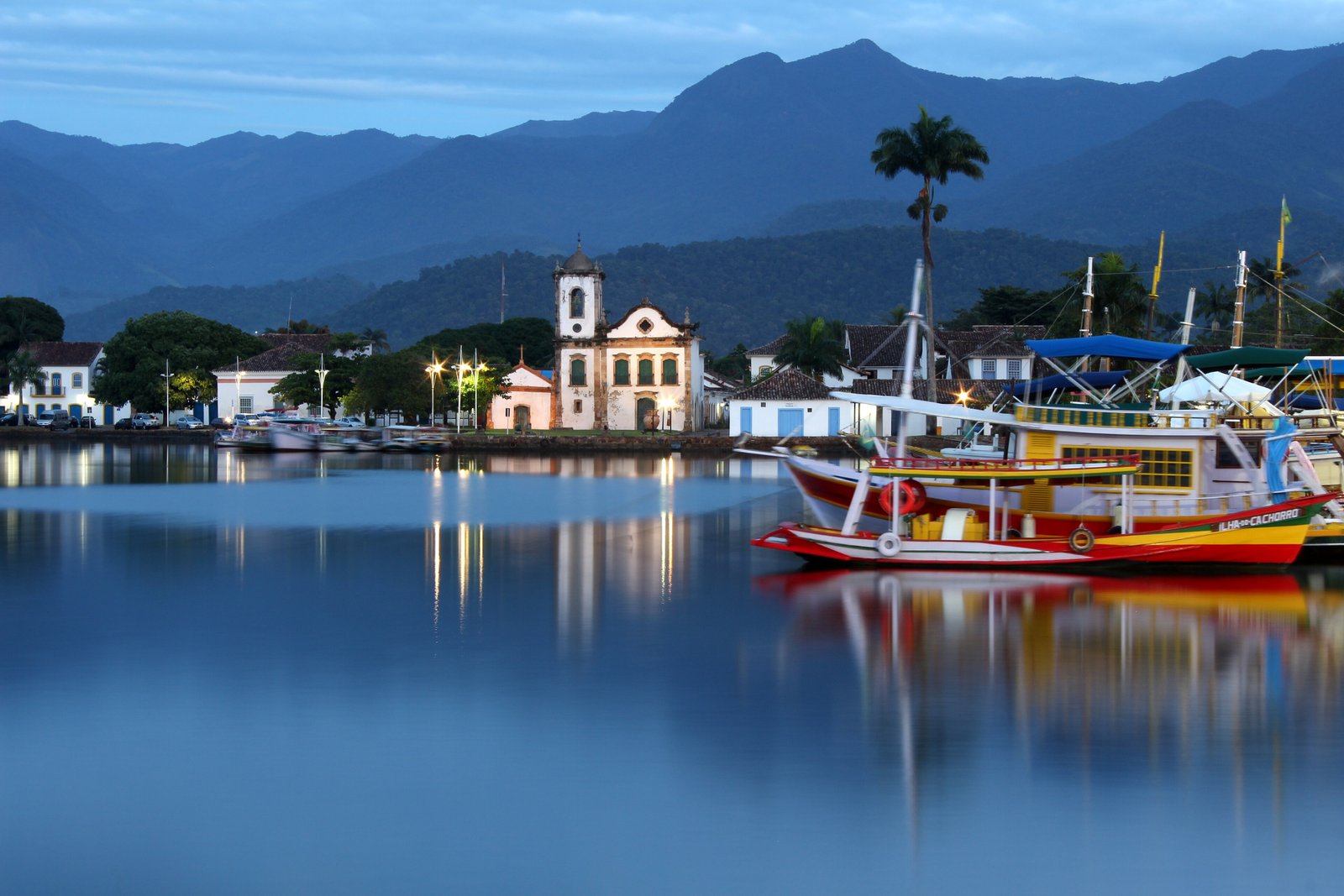
Brazil’s first mixed UNESCO World Heritage Site: a colonial town at the end of the gold road from Minas Gerais, paired with an island of near-pristine Atlantic Forest — two adjacent places united by exceptional cultural heritage and extraordinary biodiversity.
At a glance
Inscribed on the UNESCO World Heritage List in 2019 under both cultural and natural criteria, Paraty and Ilha Grande (Big Island) represent an exceptional case where colonial history and ecological significance converge in a single property. Paraty is one of the best-preserved colonial towns in Brazil, founded in 1667 at the foot of the Serra do Mar escarpment at the terminus of the gold and diamond trade route from the interior. Ilha Grande, 20 km to the south, is a 193 km² island with no motor vehicles and some of the most intact Atlantic Forest on Earth. Together they form Brazil’s first “mixed” World Heritage property — a category recognising outstanding value in both cultural and natural dimensions simultaneously.
Key facts
- UNESCO designation: World Heritage Site, 2019 — Brazil’s first “mixed” (cultural + natural) WHS
- Cultural area: Paraty historic town — founded 1667, at the terminus of the Caminho do Ouro (Gold Road)
- Natural area: Ilha Grande and surrounding Atlantic Forest — 193 km² island; one of the most biodiverse coastal areas in the Americas
- Atlantic Forest: One of the world’s most threatened and biodiverse ecosystems; approximately 55 million years old; less than 12% of original cover survives globally
- Distinctive feature (Paraty): Stone streets designed to flood twice daily at high tide, historically self-cleaning
- Ilha Grande history: Quarantine station → leper colony → maximum-security federal prison (closed 1994) → near-wilderness nature reserve
- UNESCO criteria: (v) outstanding example of traditional human settlement; (ix) outstanding examples of ongoing ecological processes; (x) most important natural habitats for in-situ conservation of biological diversity
History
Paraty was founded in 1667 by Portuguese settlers at a natural harbour at the foot of the Serra do Mar — the steep coastal escarpment that divides the coastal zone from the Brazilian interior. Its founding coincided with, and was propelled by, the discovery of gold and diamonds in the Minas Gerais region in the late 17th century. The Caminho do Ouro (Gold Road) — a mule track that climbed the Serra do Mar — connected the mines of the interior to the port of Paraty, through which vast quantities of gold flowed to Lisbon during the 18th century. The town grew rapidly, accumulating churches, merchants’ houses, and a distinctive urban grid.
Paraty’s streets were designed with a remarkable practical feature: the stone paving is set slightly below the level of the surrounding structures and is graded to flood twice daily as tides rise in the bay. High tides wash through the streets, flushing waste into the sea — a self-cleaning urban infrastructure built into the colonial city’s fabric. These tidal floods remain a characteristic feature of daily life in the historic centre.
When a new road was built through the mountains in the early 19th century, bypassing Paraty entirely, the town lost its commercial role and stagnated. As with São Cristóvão, this economic marginalisation preserved Paraty’s colonial heritage almost intact through the 19th and 20th centuries. By the time Paraty was “rediscovered” by artists and intellectuals in the 1950s and 60s, its 17th- and 18th-century urban fabric was essentially complete. Today Paraty is also celebrated for its production of cachaça (sugarcane spirits) — among the finest in Brazil.
Ilha Grande’s history follows a different arc. The island served successive functions as a quarantine station for disease-carrying ships, a leper colony, and ultimately (from the 1960s) the site of the Cândido Mendes maximum-security federal prison. Its prison history made the island inaccessible to most Brazilians for decades — inadvertently preserving its forest cover. After the prison was demolished in 1994, the island was returned to nature and has recovered to a near-wilderness state. It is now one of the finest examples of Atlantic Forest regeneration in the world.
What you see
In Paraty, the historic centre is entirely closed to motor vehicles. The town’s characteristic stone streets — irregular, rounded cobblestones set in the distinctive tidal-flooding pattern — are the defining experience of the place. The central churches include the Igreja de Nossa Senhora dos Remédios (the main town church, 18th century), the Igreja de Santa Rita (1722, the oldest church in the town, now a museum of sacred art), and the Igreja de Nossa Senhora das Dores (1800). The colonial mansions lining the main streets preserve much of their 17th- and 18th-century fabric: whitewashed walls, bright painted window frames, and heavy wooden doors.
Paraty’s position at the foot of the Serra do Mar means that the green wall of Atlantic Forest rises steeply behind the town — a constant reminder of the ecological context. The bay is studded with islands, and boat trips to surrounding beaches are a central part of the visitor experience.
On Ilha Grande, there are no paved roads and no motor vehicles. The island is explored on foot or by boat. The former prison site at Dois Rios is accessible via a forest trail (approximately 2 hours each way) and preserves ruins and the beach beyond. The island’s 102 beaches and extensive trail network make it one of the most biodiverse coastal walking destinations in Brazil. Wildlife includes golden lion tamarins, capuchins, diverse bird species, and sea turtles nesting on the beaches.
Practical information
- Paraty location: Approximately 250 km southwest of Rio de Janeiro along the Costa Verde (Green Coast); 160 km east of São Paulo
- Paraty access: Regular bus service from Rio de Janeiro (4–5 hours) and São Paulo (5–6 hours); private transfer or rental car via BR-101 coastal highway
- Historic centre: Vehicle-free; all sites walkable; best explored over 1–2 days
- Ilha Grande: Reached by ferry from Angra dos Reis (approximately 1.5 hours) or Mangaratiba (2 hours); no motor vehicles on the island; accommodation in the village of Abraão
- Best time: April–June and August–October for fewer crowds; July and summer holidays (December–February) are peak season
- Paraty cachaça: The town has dozens of artisanal producers; tasting tours available and highly recommended
Getting there
Paraty is served by regular coach services from Rio de Janeiro’s Novo Rio bus terminal (journey 4–5 hours; multiple daily departures) and from São Paulo’s Tietê terminal. By car from Rio, take the BR-101 coastal highway (Via Dutra to Angra dos Reis, then continue on BR-101 south) — approximately 3.5 hours in light traffic. For Ilha Grande, the nearest ferry terminal is at Angra dos Reis (approximately 70 km north of Paraty): ferries and speedboat services operate to Abraão village throughout the day. Paraty itself has a small boat terminal with services to Ilha Grande and the surrounding islands.
Nearby
- Angra dos Reis — a larger coastal city 70 km north of Paraty, the main departure point for Ilha Grande ferries; with its own bay and archipelago
- Trindade — a small beach village 20 km south of Paraty, known for its natural rock pools and dramatic Atlantic Forest backdrop; part of the same coastal ecosystem
- Cunha — a mountain town in São Paulo state across the Serra do Mar, at the top of the historic Caminho do Ouro; reached via the famous Estrada Paraty-Cunha mountain road
- Costa Verde (Green Coast) — the stretch of BR-101 between Rio de Janeiro and Paraty is one of the most scenic coastal drives in South America
Sources
- UNESCO World Heritage Centre — Paraty and Ilha Grande — Culture and Biodiversity (whc.unesco.org)
- Wikipedia — Paraty; Ilha Grande
- IPHAN — documentation of Paraty historic centre
- SOS Mata Atlântica Foundation — Atlantic Forest conservation data
Find it on the map
See this place and what’s around it →📷 Become a Cultural Heritage Online photographer
Share your photos of places: they stay published under your name as the author. The more they're seen, the more you get noticed — and soon a contest will reward the most appreciated photos.
Log in or sign up free to add a photo