
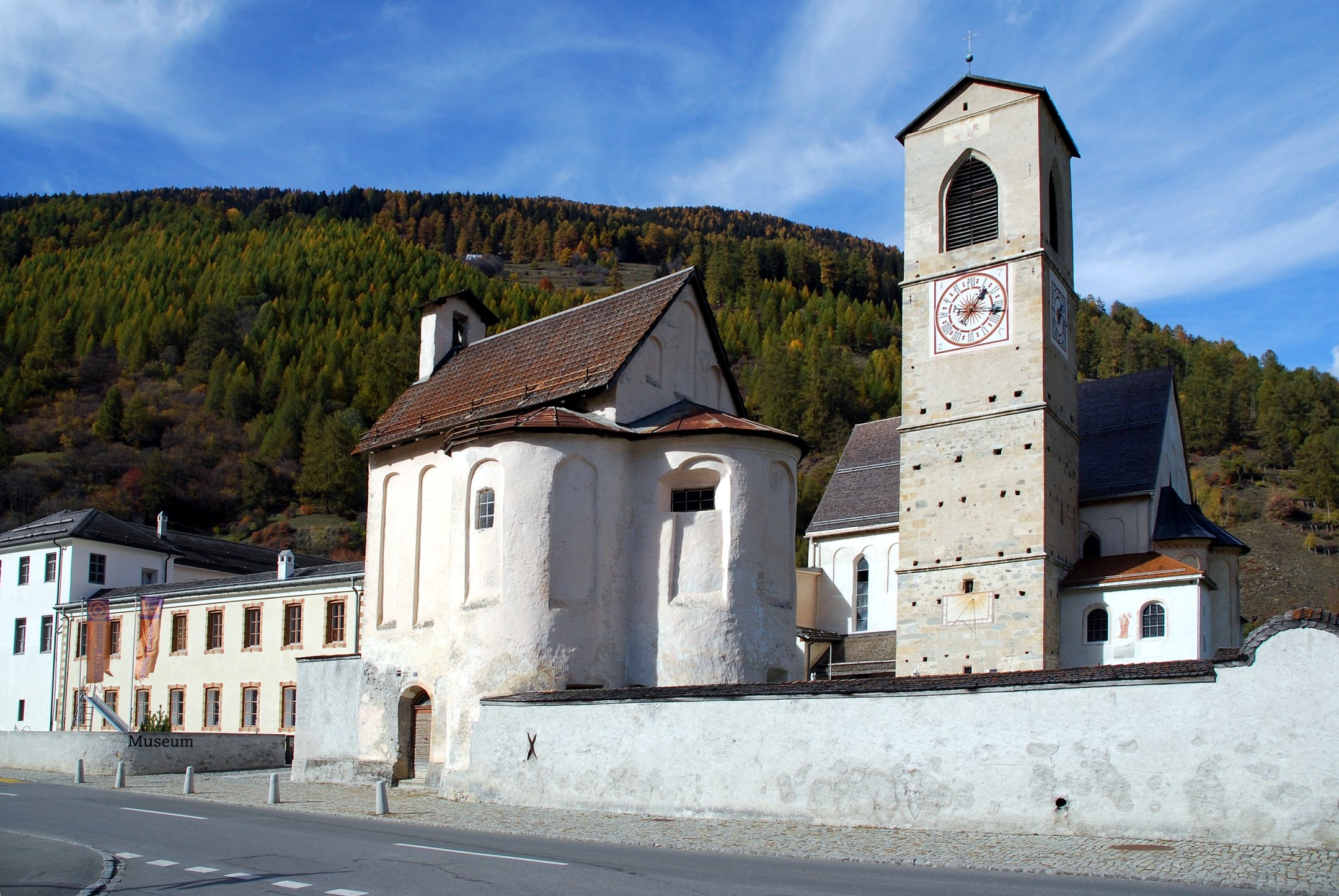
A Benedictine monastery whose remarkably intact Carolingian art collection earned it UNESCO recognition and secured its place among Europe’s most significant early medieval religious complexes.
At a glance
Saint John Abbey stands in Val Müstair, a remote Alpine valley in Graubünden. Founded in the early medieval period, the monastery survives as one of the finest repositories of Carolingian artistic heritage in the Alps. Its preservation is exceptional, offering rare insight into monastic life and artistic production during the reign of Charlemagne and his successors.
History
The abbey emerged during the early medieval era as a center of Benedictine observance. Its survival through the centuries, when many similar institutions disappeared or were radically transformed, reflects both its isolated mountain location and the stability of its religious community. The monastery has maintained continuous occupation and function since its foundation.
What you see
The complex preserves structures and decorative schemes characteristic of Carolingian design and craftsmanship. Architectural elements and interior ornamentation reflect the sophisticated aesthetic and technical knowledge of the early medieval church. The cloister and monastic buildings retain evidence of their original construction and decoration.
Cultural significance
Saint John Abbey represents a crucial link to Carolingian culture, a transformative era in medieval Europe. Its art and architecture illustrate the intellectual and spiritual ambitions of Charlemagne’s empire and the role monasteries played in preserving and advancing civilization. The site demonstrates how religious communities functioned as centers of artistic innovation and cultural continuity.
Key facts
- Location: Val Müstair, Canton of Graubünden, Switzerland
- Coordinates: 46.63°N, 10.45°E
- UNESCO World Heritage Site: inscribed 1983
- Religious order: Benedictine
- Primary heritage: Carolingian art and architecture
Practical information & getting there
The abbey is accessible by road through the Val Müstair valley. Detailed opening hours, admission fees, and current visiting arrangements should be confirmed in advance, as religious sites maintain specific access protocols. The remote Alpine location requires planning for transportation.
Sources & resources
Find it on the map
See this place and what’s around it →📷 Become a Cultural Heritage Online photographer
Share your photos of places: they stay published under your name as the author. The more they're seen, the more you get noticed — and soon a contest will reward the most appreciated photos.
Log in or sign up free to add a photoIs this page about you?
This page is read by travellers and heritage enthusiasts who find it on Google. Tell us how you are connected to this place and we will take it from there.